New Hardware Mimics Complex Brain Signals for Efficient Computing
In a new study published in Nature Nanotechnology, researchers created flexible, low-cost printed devices capable of generating electrical signals that closely resemble those produced by biological neurons. When tested on mouse brain tissue, the artificial neurons successfully triggered responses in real neurons, demonstrating a new level of compatibility between electronics and living neural systems.
The breakthrough could pave the way for advanced brain–machine interfaces and next-generation neuroprosthetics, including potential applications in restoring hearing, vision, and movement. It also opens new possibilities for energy-efficient, brain-inspired computing systems.
The world we live in today is dominated by artificial intelligence,” said Mark C. Hersam, PhD, who led the study. “The way you make AI smarter is by training it on more and more data. This data-intensive training leads to a massive power-consumption problem. Therefore, we have to come up with more efficient hardware to handle big data and AI. Because the brain is five orders of magnitude more energy efficient than a digital computer, it makes sense to look to the brain for inspiration for next-generation computing.”
Hersam, a professor at Northwestern University, co-led the study with Vinod K. Sangwan, PhD.
Mimicking the Brain’s Structure
Traditional computers rely on billions of identical silicon-based transistors arranged on rigid chips. In contrast, the human brain operates through diverse, adaptive, and three-dimensional networks of neurons that continuously evolve and rewire.
The brain is heterogeneous, dynamic and three-dimensional. To move in that direction, we need new materials and new ways to build electronics,” Hersam explained.
To replicate these properties, the team used aerosol jet printing to fabricate artificial neurons on flexible polymer surfaces. The devices were built using electronic inks made from nanoscale materials, including molybdenum disulfide and graphene.
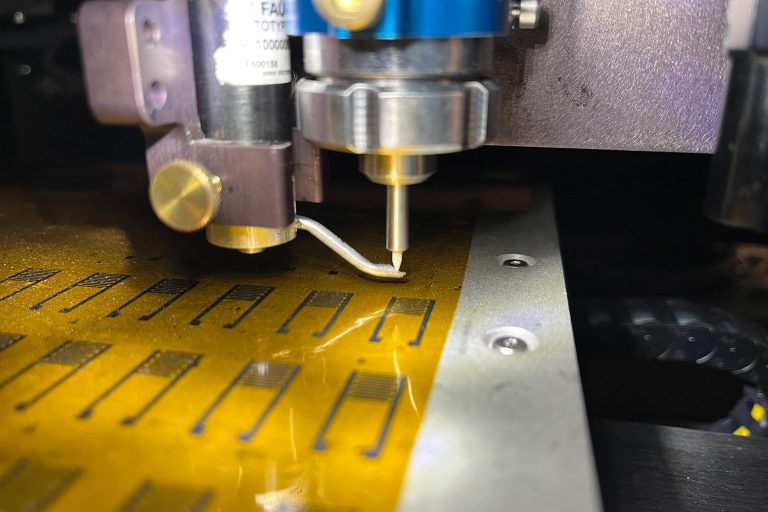
An aerosol jet printer in Hersam’s laboratory deposits electronic inks onto a flexible polymer substrate. (Northwestern University)
A New Approach to Artificial Neurons
Instead of removing stabilizing polymers in the ink—a common step in traditional fabrication—the researchers partially decomposed them to create conductive pathways. This process generates neuron-like electrical behavior, producing complex firing patterns similar to those in biological neurons.
Each device is capable of generating multiple signal types, including single spikes, bursts, and continuous firing patterns, allowing for more information-rich communication while reducing system complexity and energy use.
Successful Biological Testing
To evaluate real-world compatibility, the team collaborated with neuroscientists to test the artificial neurons on mouse brain tissue. The devices successfully activated neural circuits, closely matching the timing and behavior of natural neuron signals.
“You can see the living neurons respond to our artificial neuron,” Hersam said. “We’ve demonstrated signals that are not only the right timescale but also the right spike shape to interact directly with living neurons.”
Toward Energy-Efficient Computing
Beyond medical applications, the technology could help address one of the biggest challenges in artificial intelligence: energy consumption. Modern AI systems require massive computing power, driving the construction of energy-intensive data centers.
“To meet the energy demands of AI, companies are building gigawatt-scale data centers powered by nuclear energy,” Hersam said. “This level of consumption will limit future scaling. We need more energy-efficient hardware for AI.”
Because the printing process is additive, it also reduces material waste, making it a more sustainable manufacturing approach.
Research Support
The study was supported by the National Science Foundation.