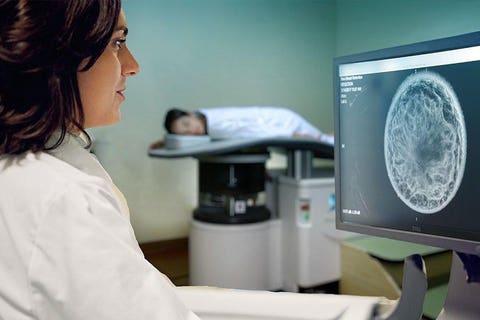
Although mammograms remain the recommended standard for screening, many eligible women still do not get screened consistently. A recent survey by MedStar Health found that 59% of eligible women do not book their yearly mammogram, while data from the Centers for Disease Control and Prevention suggests about 23% do not follow screening guidelines. The impact is substantial: roughly 380,000 women in the United States are expected to receive a breast cancer diagnosis this year, continuing a rise seen over the past decade. Even among those who undergo timely screening, limitations remain, as mammograms can miss approximately one in eight breast cancers.
These gaps in screening and diagnosis make the latest American College of Physicians’ recommendation – that average-risk women should wait until 50 for routine mammograms and screen only every other year – a concerning shift away from the early, broad screening that has long been considered protective. The American College of Radiology warned the change “may contribute to thousands of additional breast cancer deaths each year.”
As screening recommendations continue to evolve, the medical community is increasingly developing complementary tools that strengthen existing screening methods without introducing additional health risks. One example is Clarity Health, a breast cancer screening tool that uses AI to evaluate completed mammograms and estimate a patient’s future cancer risk. Its clinical recognition is expanding, with the National Comprehensive Cancer Network incorporating this AI-driven risk assessment approach into its 2026 guidelines.
These adjunct tools are critical because, for many women, breast cancer screening doesn’t end with a ‘normal’ mammogram. This past year, I had my own mammogram, which was read as normal. But it also mentioned that I have dense breast tissue. Beyond that, there was no further recommendation or plan. Since then, I have been searching for the best next steps for myself and women with similar reports.
Seeking clearer insights, I engaged experts developing next-generation screening technologies. I spoke with Raluca Dinu, PhD, CEO, and Satrajit Misra, CCO of QT Imaging, a medical device company pioneering 3D ultrasound for breast cancer screening. Our discussion focused on their mission to expand access to early screening while improving the accuracy and reliability of breast cancer diagnosis.
I
Why the Gold Standard Mammogram May Not Be Enough for Modern Breast Cancer Screening
Raluca Dinu PhD Scott Chernis Photography
Scott Chernis PhotoMammography remains the only imaging modality with FDA approval for routine breast cancer screening. Yet, according to Dinu, “mammography still misses cancers today.” A false negative occurs when a mammogram appears normal despite the presence of cancer.One of the primary challenges behind these missed detections is breast density. Approximately 40% of women have dense breast tissue, a known limitation that emerging technologies such as 3D ultrasound aim to address. On a mammogram, both dense tissue and potential tumors appear white, making it difficult to distinguish between normal and abnormal findings. This overlap significantly reduces detection sensitivity and helps explain why cancers are more difficult to identify in dense breasts—an issue compounded by the fact that breast density is also an independent risk factor for cancer.For women with dense breast tissue, follow-up screening often involves MRI. However, MRI is costly, requires contrast agents, and depends on highly specialized radiological expertise. Alternatively, handheld ultrasound performed by a credentialed sonographer can be used, but access is limited by workforce availability and infrastructure constraints.“60 to 70% of women today are in this middle, intermediate-risk group,” Dinu explains—a population for whom, according to the U.S. Preventive Services Task Force, there is currently no formal recommendation either for or against additional screening with MRI or ultrasound.
What 3D Ultrasound Offers to Patients
Unlike mammography, which compresses breast tissue and uses radiation, MRI, which requires contrast injection and specialized radiologists, or handheld ultrasound, which is performed by a sonographer, a 3D ultrasound scanner uses sound waves to create a three-dimensional image. There is no compression, no radiation, no contrast.
The scanning process differs significantly from both mammography and traditional ultrasound. The patient lies face down on a padded table, placing one breast at a time into a tank of warm, chlorinated water. A rotating ring of transducers then moves around the breast, capturing coronal slices every two millimeters—from the chest wall to the nipple—producing approximately 60 slices for an average-sized breast.
These images are reconstructed into a complete three-dimensional representation of the breast tissue.
“The technologist doesn’t have to be a highly trained sonographer or mammographer,” says Misra. In some clinical settings, medical assistants can perform the scan—an intentional design choice aimed at reducing one of the key limitations of conventional ultrasound: operator dependency.
The full examination takes about 20 to 30 minutes and has been validated for patients across a wide range of breast sizes, from A cup to triple D
Does 3D Ultrasound Work? The Clinical Data Is Encouraging
Of course, feasibility alone is not enough—accuracy ultimately determines clinical value. Clinical validation is therefore central to QT Imaging’s current strategy, and while early results are attracting attention, the full picture is still evolving.
In a preliminary head-to-head study conducted with Mayo Clinic, QT Imaging’s scanner reportedly detected all findings identified by MRI, according to Dinu. In one notable case, the two modalities produced differing assessments: MRI classified a lesion as BI-RADS 4 (suspicious), while the QT scan categorized it as BI-RADS 3 (probably benign). A subsequent biopsy confirmed the QT Imaging assessment.
“We are going to get fewer women to unnecessary biopsies,” says Dinu, while noting that larger studies are still required to draw more definitive conclusions about false-positive rates and overall diagnostic performance.
Early findings also suggest the technology may offer capabilities that differ from MRI. QT’s speed-of-sound imaging can detect calcifications, something MRI does not reliably detect, and distinguishes cysts from solid masses with high precision. The scanner additionally calculates breast density automatically, without the third-party processing currently required in mammography.
Perhaps most intriguing is its potential as a surveillance tool. Because QT involves no radiation or contrast agents, it can theoretically be repeated frequently and safely. Ongoing research at Toronto’s Sunnybrook Health Sciences Centre is exploring its use for monitoring tumor response in patients undergoing chemotherapy — a context where repeated MRIs or mammograms would raise concerns about cumulative contrast load or radiation exposure. That research, like the Mayo Clinic work, remains ongoing.
Ongoing studies with Mayo Clinic and Sunnybrook Health Sciences Centre continue to evaluate the technology, with Stanford slated as the next research partner. While early findings have been consistent, sample sizes remain limited, and peer-reviewed publication will be critical before broader clinical validation can be established.
“We keep comparing ourselves head-to-head with MRI and showing again and again that the sensitivity and specificity are there,” says Dinu. “There is no shortcut. We have to keep showing.
Getting a QT Scan: What Patients Need to Know
As with many emerging technologies, availability and cost remain key considerations. Right now, QT imaging is considered by Dinu and Misra a supplement to the gold standard mammogram. They emphasize that patients should not use QT imaging to replace their screening mammogram, but rather as a tool, especially those with dense breast tissue, to get additional screening.
For women interested in pursuing a QT scan, the process is more straightforward than many imaging procedures. No physician referral is required — patients can book directly at independent imaging centers. For women navigating an increasingly complicated screening landscape, the ability to self-refer is a meaningful option.
The main barrier at present is cost. Scans typically range from $600 to $700 out of pocket, and insurance coverage is not yet widely available, although providers may use existing unlisted billing codes in some cases.
This out-of-pocket expense, if it persists, could widen disparities in breast cancer screening access—particularly for lower-income and under-resourced communities who may already face barriers to early detection.
However, Misra notes that QT Imaging has recently secured a Category III reimbursement code, marking an important early step toward broader insurance adoption. The code, which takes effect on January 1, 2027, represents the first formal mechanism for insurers to track utilization of the technology before considering full reimbursement.
“It’s a process,” says Misra, adding that the company plans to begin working with payers immediately to advocate for fair reimbursement pathways.
Category III codes serve primarily as data-collection tools, allowing insurers to evaluate real-world usage and clinical value. Once sufficient evidence is gathered, technologies may be elevated to Category I status—the standard classification for established procedures that are routinely reimbursed by insurance providers.