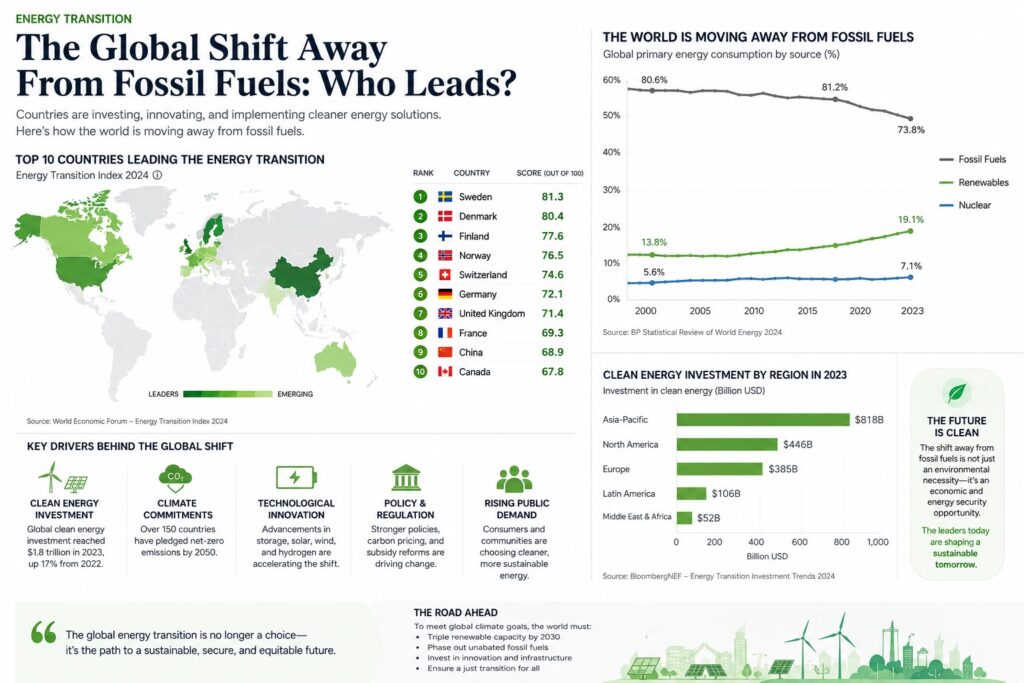
The global energy landscape is undergoing one of the most significant transformations in modern history. As concerns about climate change, energy security, and long-term sustainability continue to grow, countries around the world are investing heavily in renewable energy and clean technologies.
For decades, fossil fuels such as coal, oil, and natural gas powered economic growth and industrial development. Today, however, governments, businesses, and investors are increasingly looking toward solar power, wind energy, electric vehicles, battery storage, and green hydrogen as the foundation of the future energy system.
While the transition is unfolding at different speeds across regions, several countries have emerged as leaders in the global clean energy revolution.
Why the Energy Transition Matters
The shift toward clean energy is being driven by multiple factors.
Climate scientists have repeatedly warned that reducing greenhouse gas emissions will be essential to limiting the long-term effects of global warming. At the same time, advances in technology have significantly lowered the cost of renewable energy, making it increasingly competitive with traditional fossil fuels.
Energy security has also become a major consideration. Many countries are seeking to reduce dependence on imported fuels by developing domestic renewable energy sources that can provide more stable and predictable supplies.
As a result, clean energy is no longer viewed solely as an environmental issue—it is increasingly seen as an economic and strategic priority.
China: The Renewable Energy Giant
China has become the world’s largest investor in renewable energy and clean technology.
The country leads globally in solar panel manufacturing, battery production, and electric vehicle development. Massive investments in solar and wind power have transformed China’s energy sector, while government policies continue to support the expansion of clean energy infrastructure.
Although China remains a major consumer of fossil fuels, its scale and investment levels make it one of the most influential players in the global energy transition.
Germany’s Long-Term Energy Strategy
Germany has spent years positioning itself as a leader in renewable energy through its ambitious energy transition strategy.
The country has invested heavily in wind and solar power while pursuing policies designed to reduce dependence on fossil fuels. Renewable sources now contribute a significant share of Germany’s electricity generation.
Germany’s experience has also highlighted the challenges of balancing energy affordability, reliability, and environmental goals during a large-scale transition.
Denmark’s Wind Energy Success
Denmark is widely recognized as one of the world’s pioneers in wind energy.
Through decades of investment and innovation, the country has developed a strong wind power industry that supplies a substantial portion of its electricity needs. Danish companies have become global leaders in wind turbine technology, exporting expertise and equipment worldwide.
The country’s success demonstrates how long-term planning and policy consistency can accelerate renewable energy adoption.
The United States and Clean Energy Innovation
The United States remains one of the most important players in the global clean energy market.
Major investments in solar power, wind energy, electric vehicles, and battery technologies have expanded rapidly in recent years. American companies continue to play leading roles in energy innovation, particularly in battery storage and electric transportation.
The size of the U.S. economy means that policy decisions and investment trends within the country can significantly influence global energy markets.
India’s Renewable Energy Expansion
India has emerged as one of the fastest-growing renewable energy markets in the world.
Faced with rising energy demand and environmental concerns, the country has accelerated investments in solar power and other clean energy technologies. Large-scale solar projects are helping increase electricity access while reducing dependence on imported fuels.
India’s experience illustrates how developing economies can pursue economic growth while expanding renewable energy capacity.
The Electric Vehicle Revolution
One of the most visible aspects of the clean energy transition is the rapid growth of electric vehicles.
Countries such as China, Norway, the United States, and several European nations have adopted policies encouraging EV adoption through incentives, charging infrastructure investments, and emissions targets.
As battery costs continue to fall, industry experts expect electric vehicles to capture an increasingly larger share of the global automotive market.
Green Hydrogen and the Next Frontier
Beyond solar and wind power, attention is increasingly turning to green hydrogen.
Produced using renewable electricity, green hydrogen is viewed by many experts as a potential solution for industries that are difficult to decarbonize, including steel production, shipping, and heavy manufacturing.
Several countries are investing heavily in hydrogen research and infrastructure, hoping to secure leadership positions in what could become a major future energy market.
Challenges Still Ahead
Despite impressive progress, the clean energy transition faces significant challenges.
Many countries must modernize electricity grids, improve energy storage capabilities, and secure the raw materials required for renewable technologies. Financing remains a major obstacle for some developing nations, while political and economic considerations continue to influence energy policy decisions.
There are also ongoing debates about how quickly fossil fuels can be phased out without affecting energy affordability and reliability.
The Future of Global Energy
The shift away from fossil fuels is unlikely to happen overnight, but momentum continues to build.
Renewable energy is becoming a larger part of the global energy mix each year, supported by technological innovation, falling costs, and growing public awareness of climate risks.
Countries that successfully invest in clean energy infrastructure, innovation, and workforce development may gain significant economic advantages in the decades ahead.
As the world works toward a lower-carbon future, the nations leading today’s clean energy revolution are helping shape the energy system of tomorrow.
More News: https://www.theprojectherald.com/halfway-through-2026-who-is-winning-and-losing-in-nigerias-economy/