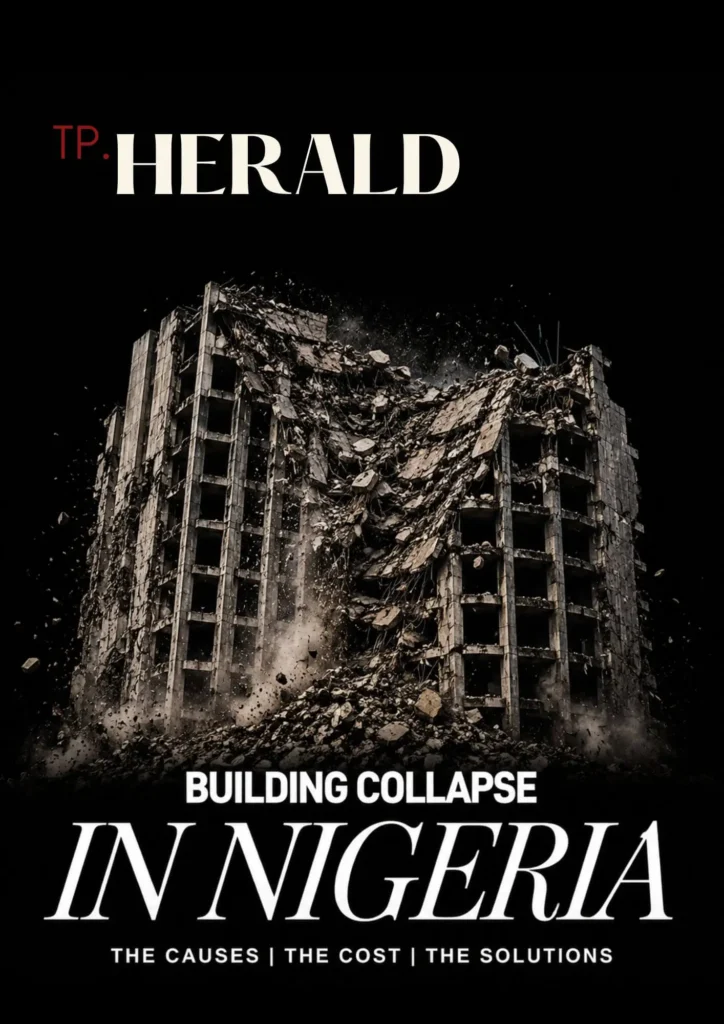
A Project Herald Special Report
LAGOS, NIGERIA — As rescue workers searched through piles of concrete, twisted steel and shattered walls following the latest building collapse in Satellite Town, Lagos, many Nigerians watched with a familiar sense of frustration.
The questions have become painfully predictable.
How many people were trapped?
How many survived?
What caused the collapse?
Yet perhaps the most important question receives far less attention:
Why does this keep happening?
For years, building collapses have repeatedly made headlines across Nigeria, leaving behind grief, economic losses and renewed calls for reform. Despite regulations, professional standards and lessons from previous disasters, structures continue to fail.
The latest Lagos incident is not simply another isolated accident. It is a reminder of a deeper problem within Nigeria’s construction ecosystem—one that extends beyond a single building, a single developer or a single city.
The collapse in Satellite Town should not only trigger rescue operations and investigations. It should force a national conversation about safety, accountability and the future of urban development in Nigeria.
A Tragedy That Keeps Repeating
From Lagos to Abuja, Port Harcourt, Ibadan and other growing urban centres, building collapse has become an unfortunate feature of Nigeria’s development story.
Every collapse follows a familiar cycle.
A structure fails.
Emergency agencies respond.
Investigations begin.
Officials promise action.
Public attention fades.
Then another building collapses.
The result is a growing list of avoidable tragedies that continue to undermine confidence in the construction sector.
For a country experiencing rapid urbanisation and rising demand for housing, this pattern raises serious concerns.
Nigeria Is Building Faster—But Is It Building Safely?
Nigeria’s population continues to grow, and cities are expanding at unprecedented rates.
The demand for residential apartments, office complexes, shopping centres and mixed-use developments has increased significantly over the past decade.
While this construction boom reflects economic activity and urban growth, experts warn that speed often becomes the enemy of safety.
In a highly competitive environment, some developers face pressure to complete projects quickly and at lower costs.
When cost-cutting replaces compliance, safety can become the first casualty.
The Dangerous Economics of Cutting Corners
One of the recurring issues identified by construction professionals is the temptation to reduce costs through shortcuts.
These shortcuts can take many forms.
Using inferior materials.
Reducing structural specifications.
Ignoring professional advice.
Skipping critical inspections.
Employing unqualified personnel.
On paper, such decisions may reduce project costs.
In reality, they can weaken a building long before the first tenant moves in.
What appears to be a profitable shortcut during construction can eventually become a life-threatening risk.
The Enforcement Gap
Nigeria does not suffer from a complete absence of building regulations.
In fact, many of the rules needed to ensure safe construction already exist.
The bigger challenge lies in enforcement.
Industry stakeholders have repeatedly pointed to weak monitoring, inadequate inspections and inconsistent compliance across parts of the sector.
In some cases, approved designs are altered during construction without proper review.
In others, projects move forward despite clear warning signs.
Experts argue that stronger enforcement may save more lives than new regulations.
After all, rules only work when they are implemented.
When Professionals Are Removed from the Process
Construction is a multidisciplinary profession.
Architects design.
Engineers calculate structural loads.
Builders supervise implementation.
Quantity surveyors manage project costs.
Each professional plays a specific role in ensuring safety.
Problems often arise when these roles are ignored, bypassed or handed to individuals lacking the required expertise.
The result can be structural weaknesses that remain hidden until disaster strikes.
Industry bodies have long advocated tougher penalties against quack practitioners whose activities continue to endanger lives and property.
The Problem Nobody Talks About: Existing Buildings
While attention often focuses on new developments, experts say another risk is hiding in plain sight.
Thousands of older buildings across Nigeria have never undergone proper structural integrity assessments.
Many were constructed decades ago.
Others have experienced years of neglect.
Some have been modified without professional approval.
As buildings age, they become increasingly vulnerable to structural deterioration if maintenance is ignored.
Cracks, water damage, weakened foundations and corrosion rarely generate headlines.
But they often provide early warnings of future disasters.
Why Building Collapse Is Also an Economic Problem
The consequences of building collapse extend far beyond physical damage.
Families lose homes.
Businesses lose investments.
Financial institutions face losses.
Governments spend resources on emergency response.
Communities suffer economic disruption.
Investor confidence can also be affected when safety concerns become widespread.
In this sense, building collapse is not merely a construction issue.
It is a public safety issue, a governance issue and an economic issue.
What Needs to Change?
The latest Lagos collapse offers another opportunity to move beyond sympathy and toward solutions.
Experts say meaningful reform should focus on several key areas:
- Stronger enforcement of existing building regulations.
- Mandatory structural audits for ageing buildings.
- Improved certification and monitoring of construction professionals.
- Harsher penalties for safety violations.
- Better public awareness of structural warning signs.
- Increased investment in inspection capacity.
- Digital monitoring systems for building approvals and compliance.
These reforms may not eliminate every risk.
However, they could significantly reduce the likelihood of future tragedies.
The Project Herald Perspective: Building a Culture of Safety
Nigeria’s construction challenge is not simply about concrete, steel and engineering calculations.
It is about culture.
A culture that values compliance over shortcuts.
A culture that rewards professionalism over improvisation.
A culture that treats safety as a necessity rather than an afterthought.
The Satellite Town collapse should not become just another headline added to a growing archive of preventable disasters.
The true measure of progress will not be how efficiently rescue operations are conducted after buildings collapse.
It will be whether fewer buildings collapse in the first place.
For a country investing heavily in housing, infrastructure and urban expansion, that may be one of the most important development goals of all.
Because when a building collapses, the damage extends beyond bricks and mortar.
It erodes public confidence, destroys livelihoods and reminds Nigerians that development without safety comes at a very high cost.
The rubble in Lagos will eventually be cleared.
The bigger question is whether the lessons buried beneath it will be ignored once again.
See news: https://www.theprojectherald.com/lagos-building-collapse-16-rescued-alive-satellite-town/