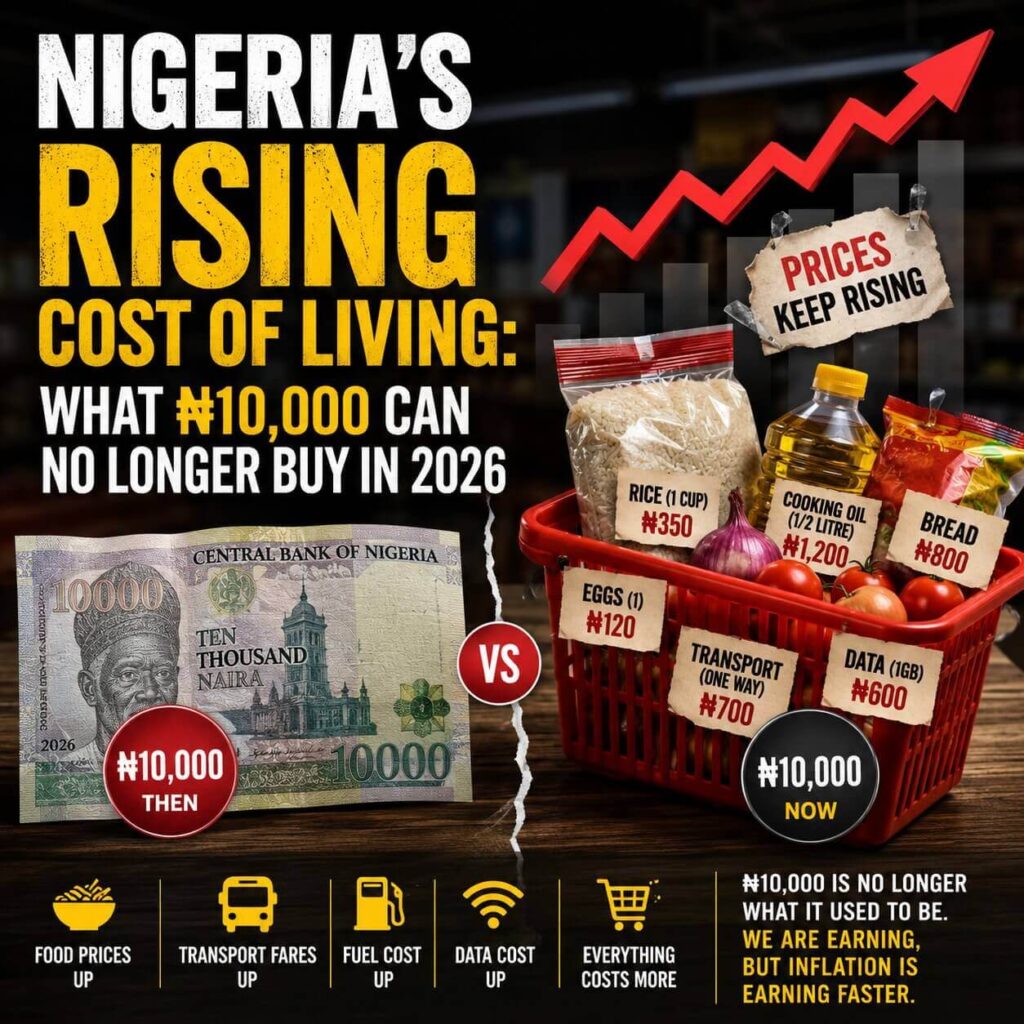
In 2026, the value of ₦10,000 in Nigeria has significantly declined in terms of purchasing power. Across food markets, transport routes, and basic household needs, the amount now covers far fewer essentials than it did in previous years.
Inflation, fuel price increases, exchange rate pressure, and rising logistics costs continue to influence the prices of goods and services across the country. These combined factors have reshaped daily living expenses for households.
Food Prices and Market Reality
Food remains the most affected sector in daily spending. In many markets, ₦10,000 can no longer complete a meaningful household food purchase.
Staples such as rice, garri, yam, and beans have all increased in price due to higher production and transportation costs. Cooking essentials like oil, seasoning, onions, and pepper also fluctuate frequently, making budgeting difficult.
Protein sources such as eggs, fish, and meat have become more expensive, reducing how often many households can include them in meals. As a result, food purchases are now more frequent but smaller in quantity.
Transport Fare Adjustments
Transportation costs have increased in most cities and towns. Fare adjustments are commonly linked to fuel price changes and vehicle maintenance expenses.
Short-distance routes that were previously affordable now require significantly higher fares. Daily commuting for workers, traders, and students now takes a larger share of small budgets.
Transport operators also adjust prices frequently depending on fuel availability and road conditions, making costs less stable for passengers.
Fuel Price Impact
Fuel remains a major driver of overall inflation in Nigeria.
Its cost affects not only transportation but also electricity generation, small business operations, and goods distribution. Many households relying on generators now spend more on fueling them, while businesses include higher energy costs in their pricing.
This ripple effect contributes directly to rising prices in both urban and rural markets.
Data and Communication Costs
Mobile data and communication services have also become more expensive relative to income levels.
Data plans now last shorter periods under regular usage. Individuals who rely on internet access for work, education, or business operations allocate a higher portion of their income to staying connected.
This has increased the overall cost of participating in digital activities, especially for young people and small business owners.
General Market Conditions
Markets across Nigeria reflect continuous price adjustments. Retail prices change frequently due to fluctuations in wholesale supply, transportation costs, and currency value.
Imported goods are particularly affected by exchange rate movements, while locally produced goods are impacted by fuel and production expenses.
This has created a situation where prices are no longer stable for extended periods.
Household Spending Patterns
Households have adjusted their spending behavior in response to rising costs.
Purchasing has become more selective, with focus placed primarily on essential items. Many families now buy in smaller quantities and more frequently rather than in bulk.
Non-essential spending has reduced significantly, and household budgets are now structured around immediate daily needs rather than long-term planning.
Economic Condition at Daily Level
At the daily level, ₦10,000 no longer functions as a sufficient budget for basic living expenses in many parts of the country. It is now often consumed quickly by a combination of food purchases, transport fares, and minor household costs.
The gap between income levels and the cost of living continues to widen, especially for low and middle-income earners whose earnings have not increased at the same pace as inflation.
Return to home page: https://www.theprojectherald.com/