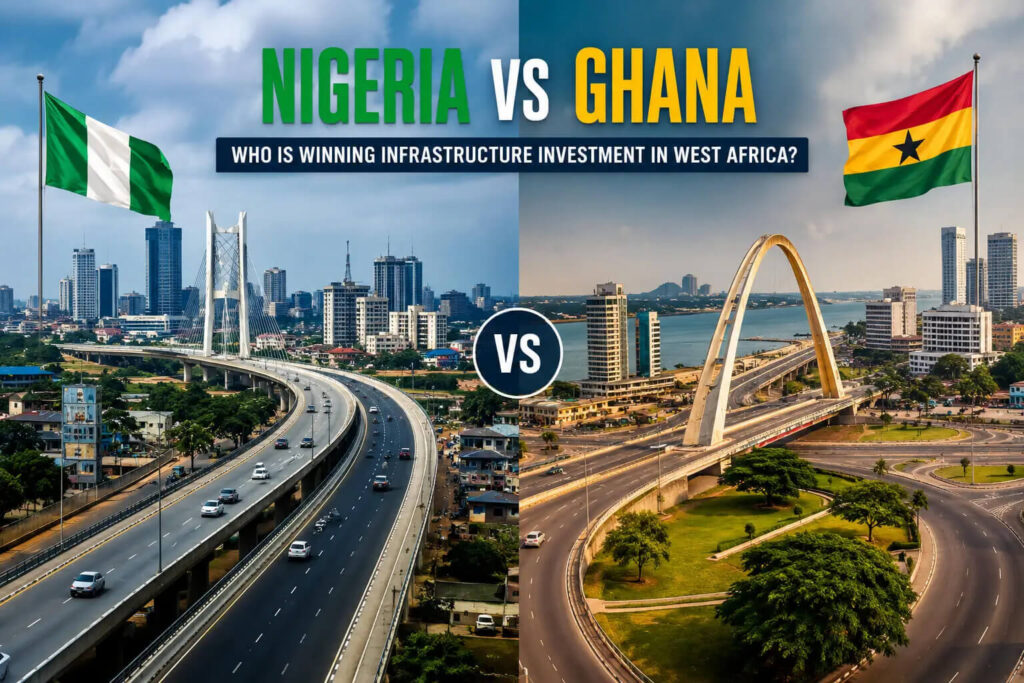
For years, the comparison between Nigeria and Ghana has gone beyond football and culture. It has now shifted strongly into something more serious, infrastructure investment. Roads, ports, energy, digital infrastructure and industrial development have become the real battleground for economic positioning in West Africa.
Both countries are actively competing for foreign capital, regional influence and long-term investor confidence. But when you look closely at where the money is going, what is being built and how fast projects are moving, the picture becomes more detailed than simple assumptions.
Nigeria Still Leads in Scale, Ghana Leads in Coordination
Nigeria remains the largest economy in Africa and that alone gives it a structural advantage in attracting infrastructure investment. The size of its population, market demand and resource base continues to pull in large-scale projects across energy, transport and manufacturing.
Ghana, on the other hand, is often seen as more coordinated in execution. Investors frequently point to more predictable regulatory systems and relatively smoother project implementation processes, especially in sectors like ports, digital finance and public-private partnerships.
So the real comparison is not just about who is building more, but who is building with more consistency.
Ports and Logistics: Nigeria’s Volume vs Ghana’s Efficiency
On the maritime side, Nigeria dominates in volume. Lagos ports, including Apapa and Tin Can Island, handle a significant share of West Africa’s cargo traffic. The addition of the Lekki Deep Sea Port has further strengthened Nigeria’s position as a major logistics hub in the region.
However, congestion, road access challenges and clearance delays have long affected efficiency in Nigeria’s port system.
Ghana’s Tema Port, on the other hand, is often highlighted for improved efficiency and modernization efforts that have reduced turnaround time for vessels. While it does not match Nigeria in scale, it competes strongly on operational smoothness.
In simple terms, Nigeria moves more cargo, Ghana often moves it faster.
Energy and Power Infrastructure: Nigeria’s Gap, Ghana’s Stability
Nigeria continues to struggle with electricity supply reliability despite major investments in generation and transmission projects. The national grid remains under pressure, and many businesses still rely heavily on self-generated power.
Ghana’s power sector has faced its own challenges in the past, but relative grid stability has been a key advantage in attracting certain types of industrial investment, particularly in manufacturing and services.
However, Nigeria’s ongoing transmission upgrades, solar investments and state electricity reforms suggest that the gap is not static. The scale of current projects in Nigeria is significantly larger, even if outcomes are still in progress.
Digital Infrastructure: Nigeria’s Market Size Advantage
When it comes to data centers, fintech infrastructure and digital economy growth, Nigeria has a clear advantage in market size and user base.
The country is one of Africa’s largest technology markets, driving demand for cloud services, data storage, telecom infrastructure and AI-related systems. This has attracted major investments in data centers and digital infrastructure across Lagos and other commercial hubs.
Ghana has also built a strong reputation as a digital and fintech-friendly environment, especially in regulatory innovation and ease of doing business in the tech sector. Accra continues to attract startups and regional tech operations, but Nigeria’s scale remains significantly larger.
Industrial and Manufacturing Investment: Nigeria’s Heavyweight Position
Nigeria leads in industrial scale projects, particularly in cement, food processing, petrochemicals and large industrial complexes.
Major private sector-led investments have continued to shape Nigeria’s industrial landscape, supported by free trade zones and expanding infrastructure networks. The Lekki Free Zone and other industrial corridors have become key destinations for manufacturing and export-oriented investments.
Ghana is steadily growing its industrial base, especially in agro-processing and light manufacturing, but Nigeria’s industrial footprint remains much larger in both size and capital intensity.
Foreign Investment Flow: Size vs Stability Debate
Nigeria consistently attracts higher total foreign investment due to its market size and resource base. Large-scale infrastructure projects, energy investments and manufacturing facilities continue to flow into the country.
Ghana, however, often attracts smaller but more diversified and stable investment portfolios. Investors sometimes view Ghana as a lower-risk entry point into West Africa, particularly for services, fintech and mid-scale industrial projects.
This creates a balance where Nigeria dominates in volume and scale, while Ghana competes in perceived stability and execution environment.
The Real Picture: Two Different Investment Models
When you break it down properly, Nigeria and Ghana are not simply competing in the same way. They represent two different investment models in West Africa.
Nigeria is a high-volume, high-potential, high-complexity market. It attracts big infrastructure, big money and big risks.
Ghana is a smaller but more structured and predictable market that appeals to investors who prioritise stability and ease of execution.
Final Outlook
The question of who is “winning” infrastructure investment is not a simple one.
Nigeria clearly leads in scale, population-driven demand and the size of ongoing infrastructure projects across ports, energy and industrial development. Ghana, however, maintains an advantage in consistency, regulatory stability and operational efficiency in certain sectors.
In reality, both countries are playing different roles in shaping West Africa’s investment landscape. Nigeria is building big and fast, while Ghana is building steadily and predictably.
For investors watching the region, the real opportunity is not choosing one over the other, but understanding how both markets complement each other in a rapidly evolving West African economy.
More News: https://www.theprojectherald.com/nigeria-airport-projects-drive-aviation-infrastructure-growth/