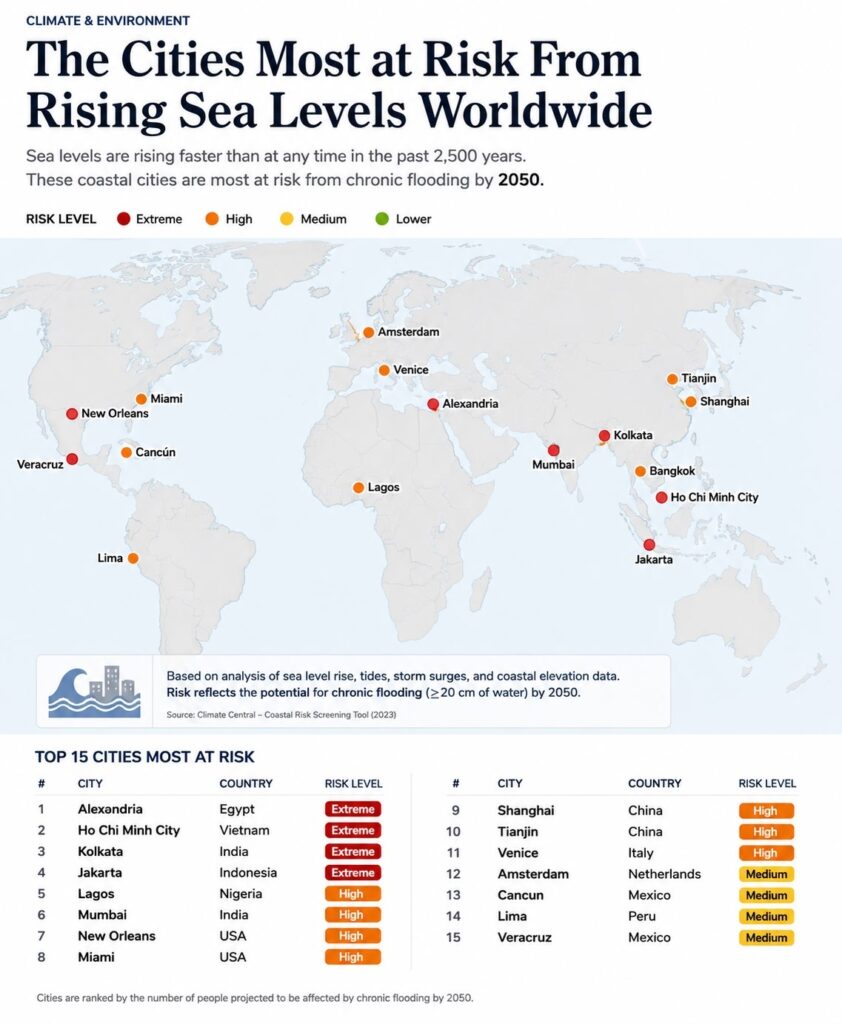
For centuries, the world’s great coastal cities have been engines of trade, innovation, and population growth. Today, many of those same cities face one of the greatest challenges of the 21st century: rising sea levels driven by climate change.
Scientists have repeatedly warned that warming global temperatures are causing glaciers and ice sheets to melt while also expanding ocean water through a process known as thermal expansion. Together, these forces are gradually raising sea levels around the world.
While the changes may appear slow on a year-to-year basis, their long-term impact could reshape coastlines, damage infrastructure, disrupt economies, and force millions of people to relocate.
For many cities, the question is no longer whether sea levels will rise, but how quickly communities can adapt.
Why Sea Levels Are Rising
Global sea levels have been increasing for more than a century, but the pace has accelerated in recent decades.
The primary drivers are the melting of land-based ice in regions such as Greenland and Antarctica and the warming of ocean waters. As temperatures rise, seawater expands, occupying more space and contributing to higher sea levels.
Scientists warn that even modest increases can have significant consequences. Higher sea levels make coastal flooding more frequent, increase the impact of storm surges, and accelerate shoreline erosion.
In many regions, communities are already experiencing these effects.
Jakarta: The Sinking Megacity
Indonesia’s capital has become one of the most frequently cited examples of a city threatened by rising seas.
Parts of Jakarta are sinking due to excessive groundwater extraction, while sea levels continue to rise along its coastline. Some neighborhoods experience regular flooding, and concerns about long-term habitability have contributed to Indonesia’s decision to construct a new capital city elsewhere in the country.
The situation demonstrates how climate change can combine with local environmental pressures to create serious urban challenges.
Miami: Living With Water
Miami is often considered one of the most vulnerable cities in the United States.
Built on porous limestone, the city faces challenges that cannot be solved through traditional seawalls alone. Even minor increases in sea level can worsen flooding during storms and exceptionally high tides.
Local authorities have invested heavily in pumps, drainage systems, and resilience projects, but climate experts continue to view the city as a major test case for adaptation strategies.
Bangkok and the Threat to Southeast Asia
Bangkok faces a combination of rising sea levels, land subsidence, and rapid urbanization.
The city sits on low-lying terrain and experiences seasonal flooding that experts believe could become more severe in the future. Similar concerns extend across parts of Southeast Asia, where millions of people live in densely populated coastal regions.
The economic implications are particularly significant because many of these cities serve as major manufacturing and trade hubs.
The Challenge Facing European Coastal Cities
Europe is not immune to rising sea levels.
Cities such as Amsterdam, Venice, and Hamburg have invested heavily in flood defenses and water-management systems. The Netherlands, in particular, is recognized globally for its expertise in protecting low-lying communities from the sea.
However, climate experts caution that maintaining and expanding these defenses will become increasingly expensive as sea levels continue to rise.
African Coastal Cities Under Pressure
Several African cities are also facing growing risks.
Rapid urbanization, population growth, and coastal erosion are creating challenges in cities such as Lagos, Alexandria, and Dar es Salaam. Many coastal communities depend heavily on fishing, tourism, and port activities, making them especially vulnerable to environmental changes.
Limited infrastructure and rapid population growth could make adaptation more difficult in some regions compared to wealthier countries.
Small Island Nations Face Existential Questions
While large cities often attract headlines, some of the greatest risks are faced by small island nations.
Countries located only a few meters above sea level could experience significant land loss if ocean levels continue to rise over the coming decades. For some communities, climate change is raising fundamental questions about long-term survival and national identity.
The issue has become a major topic in international climate negotiations, with vulnerable nations calling for stronger global action.
The Economic Cost of Inaction
The impact of rising sea levels extends far beyond environmental concerns.
Ports, airports, roads, housing developments, power infrastructure, and industrial facilities are frequently located near coastlines. Damage to these assets could result in enormous economic losses and disrupt global supply chains.
Insurance costs are also rising in some high-risk areas, creating additional financial pressures for homeowners and businesses.
As climate risks become more apparent, governments and investors are increasingly incorporating sea-level projections into long-term planning.
Can Cities Adapt?
Many experts believe adaptation is possible, but it will require significant investment and long-term planning.
Potential solutions include stronger flood defenses, improved drainage systems, wetland restoration, resilient building standards, and smarter urban planning. Some cities are also exploring managed retreat strategies, which involve relocating infrastructure and communities away from high-risk areas.
The effectiveness of these measures will vary depending on geography, resources, and political commitment.
A Global Challenge for the 21st Century
Rising sea levels are no longer viewed as a distant environmental concern. They represent a growing challenge for cities, economies, and governments around the world.
From Jakarta and Miami to Lagos and Bangkok, coastal communities are already experiencing the effects of a changing climate. The decisions made today regarding infrastructure, urban planning, and emissions reduction could determine how successfully these cities adapt in the decades ahead.
As the world’s population continues to concentrate in coastal regions, the future of many major cities may depend on how effectively humanity responds to one of the defining environmental challenges of our time.
Morw News: https://www.theprojectherald.com/a-look-at-one-of-nigerias-oldest-companies-uac/