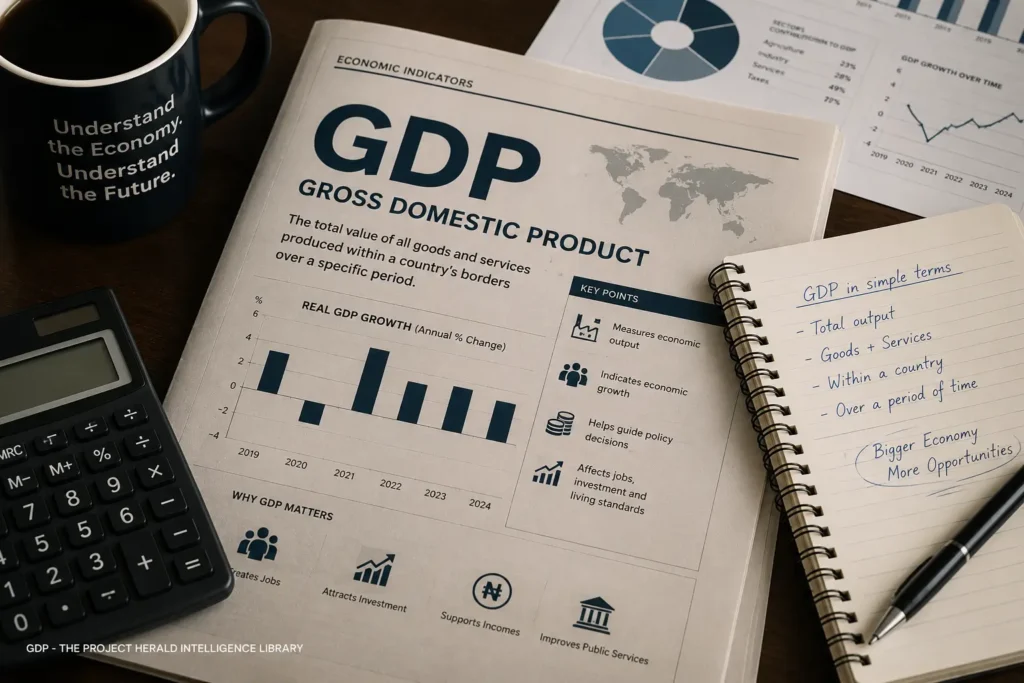
What GDP Really Means (In Plain English)
Every few months, you hear statements like these:
“The economy grew by 3.8%.”
“GDP increased this quarter.”
“The country’s Gross Domestic Product has expanded.”
The news usually moves on without explaining what any of this actually means.
Many people assume GDP is simply another complicated economic term.
It isn’t.
In fact, once you understand GDP, you’ll begin to understand why governments celebrate economic growth, why investors pay attention to it and why it doesn’t always mean ordinary people are becoming wealthier.
Let’s break it down.
What Is GDP?
GDP stands for Gross Domestic Product.
Don’t let the name intimidate you.
Think of GDP as a giant scoreboard.
Imagine your country’s economy is one huge company.
Every day, millions of people go to work.
Factories produce goods.
Farmers harvest crops.
Construction companies build roads.
Banks provide financial services.
Restaurants serve meals.
Technology companies create software.
Doctors treat patients.
Teachers educate students.
All these activities create value.
GDP measures the total value of everything produced within a country’s borders over a given period, usually one year or one quarter.
Simply put:
GDP is the total value of a country’s economic production.
Imagine a Small Island
Suppose an island has only five businesses.
A farmer grows crops worth ₦20 million.
A bakery sells bread worth ₦10 million.
A tailor makes clothes worth ₦15 million.
A builder constructs houses worth ₦40 million.
A transport company earns ₦15 million.
Together they produced ₦100 million worth of goods and services.
The island’s GDP would be ₦100 million.
The calculation is far more complex in real life, but the idea is exactly the same.
GDP measures how much value an economy creates.
Why Does GDP Matter?
Imagine two companies.
One keeps expanding every year.
The other keeps shrinking.
Which one would investors prefer?
Probably the growing company.
Countries are similar.
A growing GDP usually suggests businesses are producing more, people are working, consumers are spending and investment is taking place.
That often signals a healthy economy.
Does a Higher GDP Mean Everyone Is Rich?
No.
This is one of the biggest misconceptions.
A country’s GDP can grow while many citizens still struggle financially.
Imagine a company earns record profits.
That does not automatically mean every employee received a salary increase.
The same principle applies to countries.
Economic growth does not always mean prosperity is shared equally.
This is why economists also look at unemployment, inflation, wages, poverty and income distribution.
GDP tells an important part of the story.
It does not tell the whole story.
Can GDP Fall?
Yes.
Sometimes businesses produce less.
Consumers spend less.
Investments decline.
Factories reduce production.
Construction slows.
When this happens, GDP may shrink.
If GDP continues falling for a prolonged period, it may signal serious economic weakness.
Why Do Governments Want GDP to Grow?
Because growing economies usually create more opportunities.
Businesses expand.
New companies emerge.
Jobs are created.
Tax revenue increases.
Governments have more resources to invest in roads, schools, hospitals and other public services.
Growth alone does not solve every problem, but without growth, creating opportunities becomes much harder.
What Makes GDP Grow?
Many factors contribute.
Businesses investing in new factories.
Farmers producing more food.
Technology companies creating new products.
Governments building infrastructure.
Foreign companies investing.
People spending money.
Exports increasing.
Innovation improving productivity.
Every productive activity adds to economic output.
What Doesn’t GDP Measure?
GDP does not measure happiness.
It does not measure quality of education.
It does not measure environmental sustainability.
It does not measure safety.
It does not measure whether people feel financially secure.
A country may have a large GDP while still facing serious social and economic challenges.
That is why GDP should never be viewed in isolation.
A Simple Way to Remember GDP
Imagine the economy is one enormous bakery.
Every loaf of bread, every cake and every pastry baked during the year represents production.
At the end of the year, someone calculates the total value of everything produced.
That total is like GDP.
It tells you how much the bakery produced.
It does not automatically tell you whether every baker was well paid or whether every customer could afford the bread.
Project Herald Insight
GDP is one of the world’s most closely watched economic indicators because it helps measure the size and performance of an economy.
But GDP is not a measure of national happiness or personal prosperity.
It tells us how much value an economy produces, not necessarily how that value is distributed.
Understanding GDP helps explain why governments celebrate growth figures, why investors monitor economic performance and why strong GDP numbers should always be considered alongside employment, inflation, wages and living standards.
Understanding GDP is not about memorising another economic abbreviation.
It is about understanding how economists measure the engine that drives a country’s economy.
Catch up: https://www.theprojectherald.com/understanding-exchange-rates-explained/