What a Recession Really Means (In Plain English)
You’ve probably heard headlines like these:
“The country has entered a recession.”
“Economists fear another global recession.”
“Businesses are preparing for a possible recession.”
Whenever the word appears, it usually creates concern.
People worry about losing jobs.
Businesses become cautious.
Investors pay closer attention to the economy.
But what exactly is a recession?
Does it mean the economy has collapsed?
Not necessarily.
Let’s understand what it really means.
What Is a Recession?
Imagine your body.
Some days you have plenty of energy.
You work, exercise and think clearly.
Other days you feel weak.
You become less productive.
You need time to recover.
The economy behaves in a similar way.
Sometimes it grows.
Sometimes it slows down.
Sometimes it shrinks.
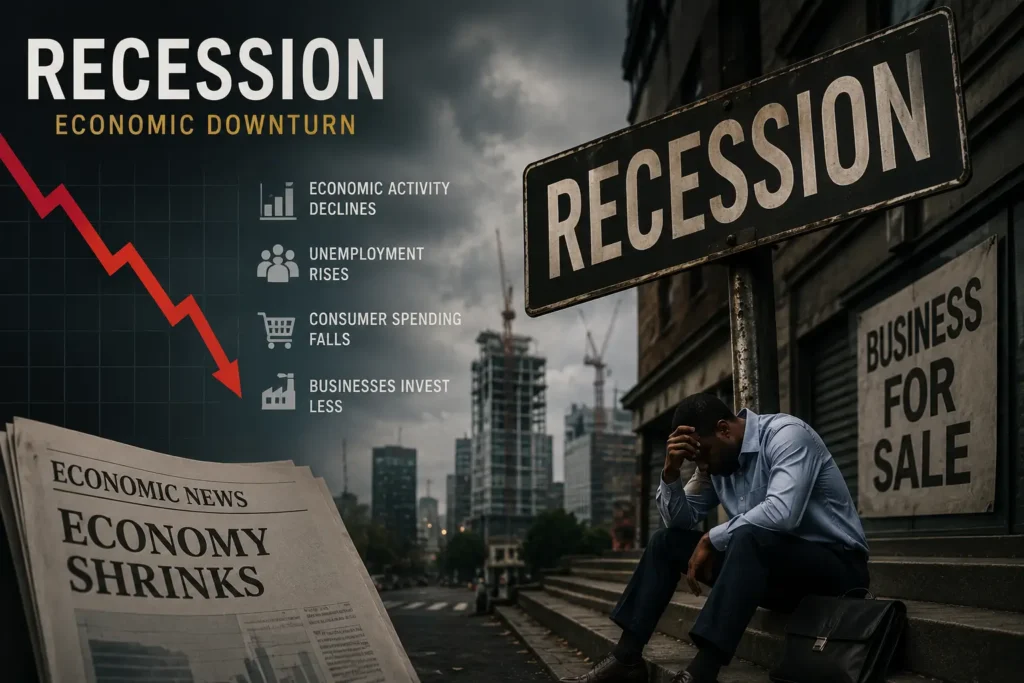
A recession is a period when economic activity declines significantly across a country.
Businesses produce less.
Consumers spend less.
Companies invest less.
People lose jobs.
Overall economic activity slows.
A recession is not the economy stopping.
It is the economy losing momentum.
How Do Economists Know a Country Is in a Recession?
There isn’t one single sign.
Economists look at several indicators.
They ask questions like:
Is the economy producing less?
Are businesses investing less?
Are people spending less?
Is unemployment rising?
Are factories reducing production?
In many countries, a common rule is that if the economy shrinks for two consecutive quarters, it is considered a recession.
However, economists also look beyond that simple measure to understand the broader picture.
Why Do Recessions Happen?
There is no single cause.
Sometimes people and businesses stop spending because they are uncertain about the future.
Sometimes inflation becomes so high that consumers cut back on purchases.
Sometimes central banks raise interest rates to control inflation, making borrowing more expensive.
Sometimes wars, pandemics, financial crises or natural disasters disrupt economic activity.
Sometimes major industries experience sharp declines.
Often, several factors happen at the same time.
What Happens During a Recession?
Imagine you own a clothing store.
Sales begin to fall.
Customers buy fewer clothes.
Your income drops.
To reduce costs, you delay opening another branch.
You postpone buying new equipment.
You reduce overtime.
You may even lay off workers.
Now imagine thousands of businesses making similar decisions.
Less hiring.
Less investment.
Less spending.
The slowdown spreads through the economy.
That is how recessions affect millions of people.
How Does a Recession Affect Ordinary People?
Even people who never read financial news may feel its effects.
Businesses may recruit fewer workers.
Salary increases may slow.
Finding a new job may become more difficult.
Some families reduce unnecessary spending.
Businesses delay expansion.
Property sales may slow.
Investments may lose value.
In short, confidence becomes weaker.
People become more careful with money.
Does Every Business Suffer?
Not always.
Some businesses actually perform well during recessions.
Companies that provide essential goods and services often continue to attract customers.
People still need food.
They still need healthcare.
They still need electricity.
Repair services may even become busier because consumers choose to repair existing items instead of buying new ones.
Some businesses adapt and emerge even stronger.
How Do Governments Respond?
Governments often introduce measures to support the economy.
They may increase spending on infrastructure projects.
They may reduce certain taxes.
They may introduce programmes that support businesses or households.
Central banks may lower interest rates to encourage borrowing and investment.
The goal is to restore confidence and encourage economic activity.
Does a Recession Last Forever?
No.
Every recession eventually ends.
Some last only a few months.
Others continue for several years.
Recovery depends on many factors, including government policies, business confidence, global economic conditions and consumer spending.
Economic history shows that recessions are part of the normal economic cycle.
They are periods of weakness, not permanent conditions.
Is a Recession the Same as a Depression?
No.
People often confuse the two.
A recession is a significant slowdown in economic activity.
A depression is much more severe.
It lasts much longer and causes far deeper economic damage.
Fortunately, depressions are very rare.
Most economic downturns are recessions.
A Simple Way to Remember a Recession
Imagine an athlete running a marathon.
The runner doesn’t stop.
But at some point, they slow down because they are tired.
They need time to recover before picking up speed again.
A recession is similar.
The economy is still moving.
It is simply moving more slowly than before.
Project Herald Insight
Recessions are often seen only as periods of hardship.
But they also reveal the strengths and weaknesses of an economy.
They expose businesses that are unprepared, while highlighting those that are resilient, adaptable and innovative.
For governments, recessions test economic policy.
For businesses, they test strategy.
For households, they reinforce the importance of financial planning.
Understanding recessions helps explain why governments introduce stimulus packages, why businesses change investment plans and why economic recovery often takes time.
Understanding a recession is not about predicting the next downturn.
It is about understanding one of the natural phases of every economy and why preparation matters long before difficult times arrive.
Catch up: https://www.theprojectherald.com/understanding-gdp-explained/