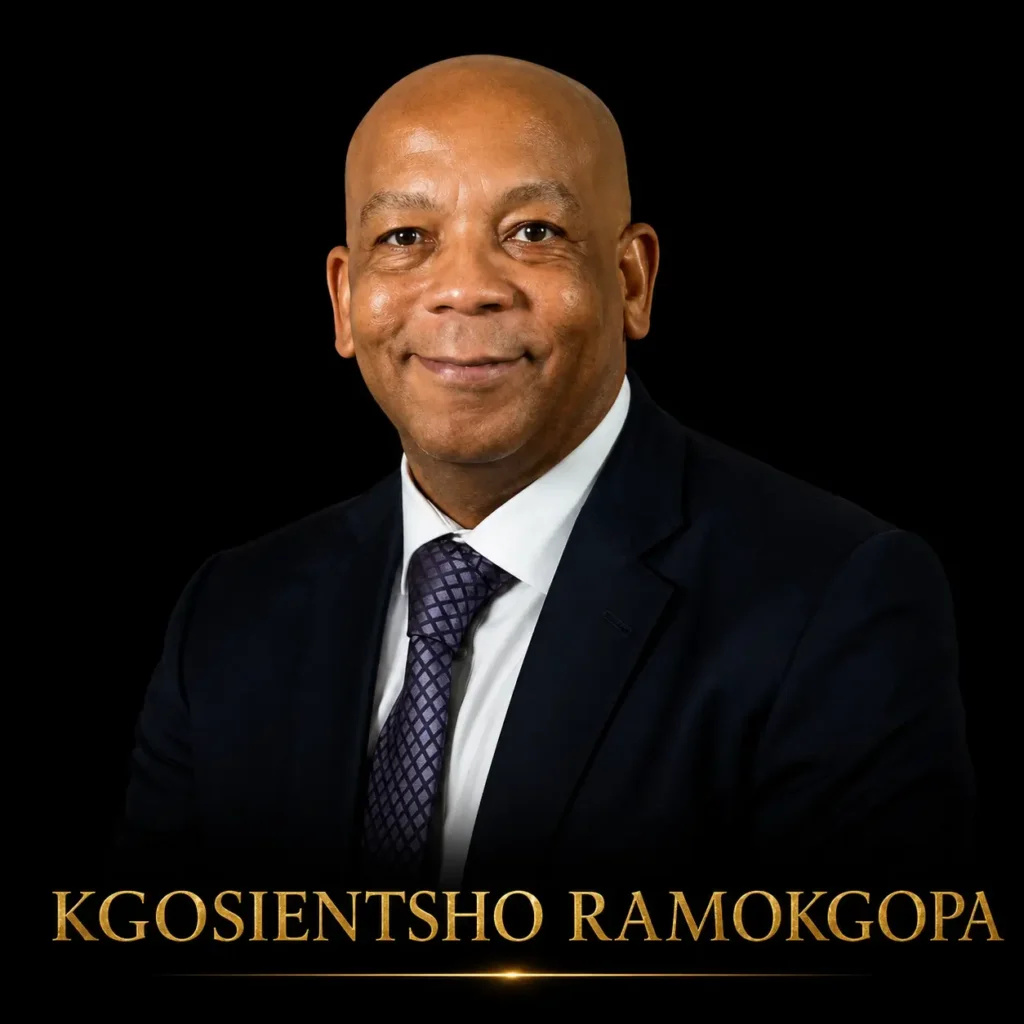
Country: South Africa
Current Position: Minister of Electricity and Energy
Sector: Energy, Infrastructure, Power, Nuclear, Renewable Energy
Leader Category: Government / Infrastructure & Energy Transformation
Why Project Herald Is Watching Him
South Africa’s electricity story is moving into a different phase.
After years in which the country’s energy debate was dominated by load shedding and the operational performance of Eskom, the focus is increasingly shifting toward generation expansion, transmission infrastructure, private investment, nuclear development and the restructuring of the country’s electricity system.
At the centre of that transition is Dr. Kgosientsho Ramokgopa, South Africa’s Minister of Electricity and Energy.
Ramokgopa’s significance goes beyond the management of the immediate electricity crisis. His portfolio is now connected to one of South Africa’s most consequential infrastructure and investment cycles.
From Crisis Management to Infrastructure Development
Ramokgopa first became nationally prominent as the Minister in the Presidency responsible for Electricity, where he was tasked with coordinating the government’s response to the electricity crisis and implementing the Energy Action Plan.
His responsibilities included improving generation capacity, supporting Eskom’s Generation Recovery Plan, addressing transmission constraints and developing mechanisms for new energy investment.
That experience now feeds directly into his expanded role as Minister of Electricity and Energy.
South Africa’s energy agenda has consequently evolved from simply asking how to reduce power cuts to a much larger question: how does the country build enough reliable electricity and transmission capacity to support its next phase of economic and industrial growth?
The Transmission Opportunity
One of the most important developments under Ramokgopa’s portfolio is the attempt to bring private capital into electricity transmission infrastructure.
South Africa is planning a major expansion of its transmission network, with more than 14,000 kilometres of new transmission lines envisaged over the coming years.
The government is developing mechanisms that would allow private investors to participate in transmission infrastructure while the state retains ownership and control of the network.
The first Independent Transmission Projects are already moving through the procurement process.
For Project Herald, this is particularly important because transmission infrastructure sits at the intersection of government policy, procurement, engineering, infrastructure finance and private investment.
Nuclear Is Returning to the Strategy
Ramokgopa is also becoming one of the most visible government advocates for a larger role for nuclear energy in South Africa’s future electricity mix.
His energy strategy includes maintaining Koeberg, developing a Multi-Purpose Reactor and exploring advanced nuclear and small modular reactor technologies.
Nuclear development is not simply an electricity-generation issue. It potentially creates a wider industrial ecosystem involving engineering, advanced manufacturing, specialised skills, scientific research, construction, financing, fuel technology and long-term infrastructure services.
The minister has also indicated that South Africa is exploring fleet approaches to nuclear procurement and advancing environmental authorisations and siting processes.
The Investment Dimension
The scale of South Africa’s energy transition makes Ramokgopa particularly relevant to investors.
The country requires significant investment not only in new generation but also in transmission, grid strengthening, storage, renewable-energy integration and other supporting infrastructure.
At the same time, government is developing mechanisms to make traditionally state-dominated infrastructure more accessible to private capital.
The proposed transmission investment structures are therefore worth watching alongside the physical infrastructure itself.
For Project Herald, this creates several different intelligence layers:
Policy — the country’s long-term electricity strategy.
Capital — mechanisms designed to mobilise private investment.
Procurement — transmission projects entering competitive stages.
Projects — generation, transmission, nuclear and supporting infrastructure.
This makes Ramokgopa particularly valuable to the Leaders to Watch list.
Why Businesses Should Pay Attention
The opportunity is broader than electricity generators.
A large-scale energy build-out can create demand for transmission engineering, grid equipment, power infrastructure, renewable-energy development, battery storage, nuclear engineering and services, construction, project finance, infrastructure investment, technical advisory and energy technology.
The implications also extend beyond the energy sector. Reliable electricity and expanded transmission capacity are prerequisites for industrial expansion, mining, mineral beneficiation, data centres, hydrogen projects and other energy-intensive activities.
What We Are Watching Next
Project Herald will be watching whether South Africa can successfully move from energy reform and project planning into bankable projects, procurement, financial close and physical construction.
The immediate signals include the progression of the Independent Transmission Projects, private-capital mechanisms for transmission infrastructure, implementation of the country’s electricity strategy, nuclear procurement preparations and continued performance improvements across the existing generation fleet.
The transition from policy to procurement is particularly important.
When a project moves from a government strategy into an actual procurement process, its commercial significance changes considerably.
Project Herald Assessment
Why he is on the Leaders to Watch list: Ramokgopa is positioned at the centre of one of Africa’s largest energy infrastructure and investment transformations.
Key Signal: South Africa is moving beyond emergency electricity interventions toward a broader programme involving transmission expansion, generation investment, private capital and nuclear development.
Opportunity Areas: Energy infrastructure, transmission, renewable energy, nuclear, engineering, construction, project finance and infrastructure investment.
Key Risk: The scale and complexity of South Africa’s energy transition mean that institutional capacity, regulatory processes, financing, procurement execution and grid constraints could affect the pace at which projects move from planning to implementation.
What Project Herald Is Watching: The conversion of South Africa’s energy strategy into procurement, capital mobilisation and physical infrastructure delivery.
Related Intelligence: Independent Transmission Projects (ITP) — Phase 1, South Africa: https://www.theprojectherald.com/intelligence/kgosientsho-ramokgopa-south-africa-energy-leader/
South Africa Integrated Resource Plan 2025 — R2.23tn Electricity Investment Framework: https://www.theprojectherald.com/intelligence/south-africa-integrated-resource-plan-2025/
South Africa Credit Guarantee Vehicle — $500m Infrastructure Capital Platform:https://www.theprojectherald.com/intelligence/south-africa-credit-guarantee-vehicle-500m-infrastructure/