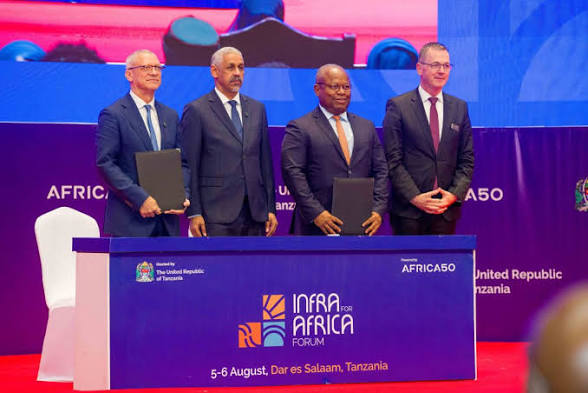
British International Investment, the UK’s development finance institution, has signed a Memorandum of Understanding with Africa50 and committed $20 million to Africa50’s Infrastructure Acceleration Fund (IAF), which is managed by Africa Infrastructure Investment Partners, a subsidiary of Africa50. The commitment was announced at the 2026 Infra for Africa Forum and Africa50 General Shareholders’ Meeting in Dar es Salaam, Tanzania, and brings the IAF’s total capital commitments to approximately $330 million.
The Broader Package
The BII commitment did not arrive alone. Alongside it, Africa50 announced a set of partnerships covering natural gas, electricity transmission and healthcare infrastructure in Tanzania — including a first-phase agreement with Tanzania Petroleum Development Corporation and TAQA Arabia to develop a small-scale LNG project distributing domestic natural gas to industrial and transport customers. BII’s CEO framed the partnership around closing Africa’s infrastructure financing gap, which African Development Bank President Dr Sidi Ould Tah told the same forum sits between $68 billion and $100 billion a year against total continental needs of $130–170 billion annually.
Why the IAF Structure Matters
The Infrastructure Acceleration Fund is designed around one specific bottleneck: project preparation. Early-stage infrastructure ideas across Africa routinely stall before they become “bankable” enough to attract private capital, and the IAF exists to fund that gap-stage work rather than construction itself. That makes BII’s $20 million a relatively small check with outsized intended leverage — it is meant to unlock projects that later draw in much larger private and institutional financing, not to fund infrastructure directly.
What This Means in Practice
First, the $330 million total gives the IAF real scale as an early-stage vehicle, and it’s now large enough that other DFIs are likely to view a commitment here as a credible entry point into African infrastructure pipeline-building, rather than a token gesture.
Second, the Tanzania-specific deals — LNG, transmission, healthcare — are a concrete near-term test of whether IAF-style project-preparation capital actually converts into signed, financeable projects, and are worth tracking individually as they progress toward financial close.
Third, this fits a broader pattern of European and UK development finance institutions positioning early in Africa’s infrastructure pipeline rather than waiting for construction-ready deals — a strategy shift worth watching alongside similar recent DFI activity on the continent.
Twenty million dollars will not build a power line or a gas plant on its own. What it buys is a seat in deciding which early-stage African infrastructure ideas get the preparation capital to become bankable in the first place — and that’s a more consequential kind of leverage than the headline figure suggests.