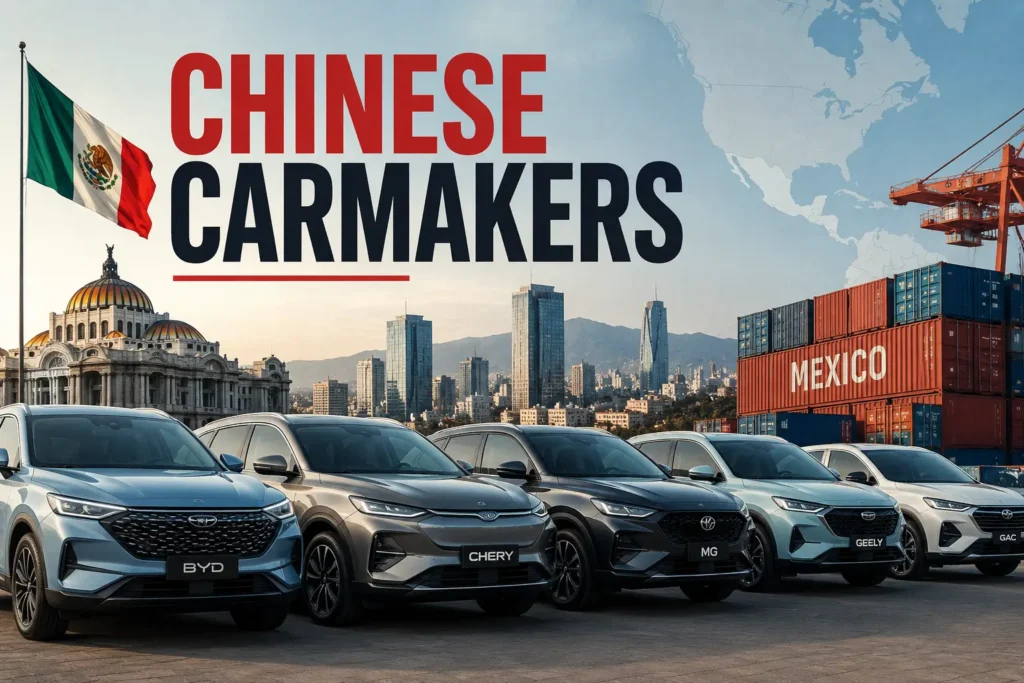
Mexico City, Mexico
At a time when tariffs, trade disputes and geopolitical tensions dominate global headlines, one development is quietly challenging conventional thinking.
Chinese carmakers are selling more vehicles in Mexico than ever before.
According to industry data, sales of Chinese branded vehicles in Mexico rose by nearly 30 percent during the first half of 2026, highlighting the country’s growing importance as both a consumer market and a strategic gateway into North America.
On the surface, this appears to be another automotive sales story.
It is not.
It is a story about how global trade is adapting rather than retreating.
It demonstrates that even as governments introduce new trade restrictions, businesses continue finding new ways to reach customers, diversify production and expand internationally.
China’s Global Automotive Ambitions
Over the past decade, Chinese vehicle manufacturers have transformed themselves from largely domestic producers into global competitors.
Companies such as BYD, Chery, MG, GAC, Geely and Great Wall Motors have expanded rapidly across Asia, Latin America, Africa and parts of Europe.
Improved vehicle quality, competitive pricing, advances in electric vehicle technology and significant manufacturing scale have enabled these companies to compete with long established international brands.
Mexico has become one of their most important growth markets.
Rather than viewing Mexico simply as another country to sell vehicles, many manufacturers see it as a strategic location within the broader North American economy.
Why Mexico Matters
Mexico occupies a unique position in global manufacturing.
Its extensive industrial base, skilled workforce and close integration with North American supply chains have made it one of the world’s largest vehicle manufacturing centres.
Major international automakers have operated production facilities in Mexico for decades.
The country’s proximity to the United States, combined with established logistics networks and trade agreements, has strengthened its position as a manufacturing hub.
For Chinese manufacturers, success in Mexico offers more than growing sales.
It provides experience operating in one of the world’s most competitive automotive markets while strengthening relationships throughout the region.
Trade Barriers Are Changing Global Strategy
Many governments have introduced tariffs or restrictions aimed at protecting domestic industries from rapidly expanding Chinese exports.
Some analysts expected these measures to significantly slow Chinese automotive expansion.
Instead, manufacturers appear to be adjusting their strategies.
Rather than relying on a single export model, companies are increasingly diversifying production locations, building partnerships and expanding into markets where demand continues growing.
This illustrates an important lesson about global commerce.
Trade barriers rarely eliminate competition.
They often reshape it.
Businesses respond by redesigning supply chains, relocating investment and identifying alternative growth opportunities.
Competition Benefits Consumers
Greater competition within Mexico’s automotive market has also benefited consumers.
More manufacturers entering the market generally increases product choice.
Competition encourages innovation.
Pricing becomes more competitive.
Technology adoption accelerates.
Consumers gain access to a wider range of vehicles across different price categories.
While established manufacturers face stronger competition, buyers often benefit from greater value and improved technology.
What This Means For The Global Auto Industry
The automotive industry is undergoing one of its largest transformations in decades.
Electrification.
Digital technology.
Autonomous driving.
Connected vehicles.
Artificial intelligence.
Global supply chain restructuring.
Chinese manufacturers have positioned themselves aggressively within many of these emerging technologies.
Their growing presence in markets like Mexico suggests that future competition may increasingly focus not only on vehicle design, but also on manufacturing efficiency, battery technology and software capability.
Traditional automotive leaders are therefore facing competition from companies that did not occupy the global spotlight only a decade ago.
Questions Worth Asking
Will more Chinese manufacturers establish production facilities closer to major export markets?
Can established global automakers maintain market leadership as competition intensifies?
Will trade restrictions encourage greater regional manufacturing rather than reducing international competition?
How will governments balance industrial protection with consumer choice?
These questions extend well beyond Mexico.
They will shape the future of global manufacturing.
Project Herald Outlook
The nearly 30 percent increase in Chinese vehicle sales in Mexico represents more than commercial success.
It reflects the changing structure of international trade.
Globalisation is not disappearing.
It is evolving.
Companies are becoming more flexible.
Supply chains are becoming more regional.
Manufacturing strategies are becoming increasingly influenced by geopolitics as well as economics.
For businesses, policymakers and investors, the lesson is clear.
Competitive advantage in the modern economy depends not only on producing quality products.
It depends on adapting quickly as the global trading environment continues to change.
The companies that succeed over the next decade are unlikely to be those waiting for markets to become easier.
They will be the ones learning how to compete effectively in a more complex world.
Read more news: https://www.theprojectherald.com/oil-crosses-90-global-economic-impact/