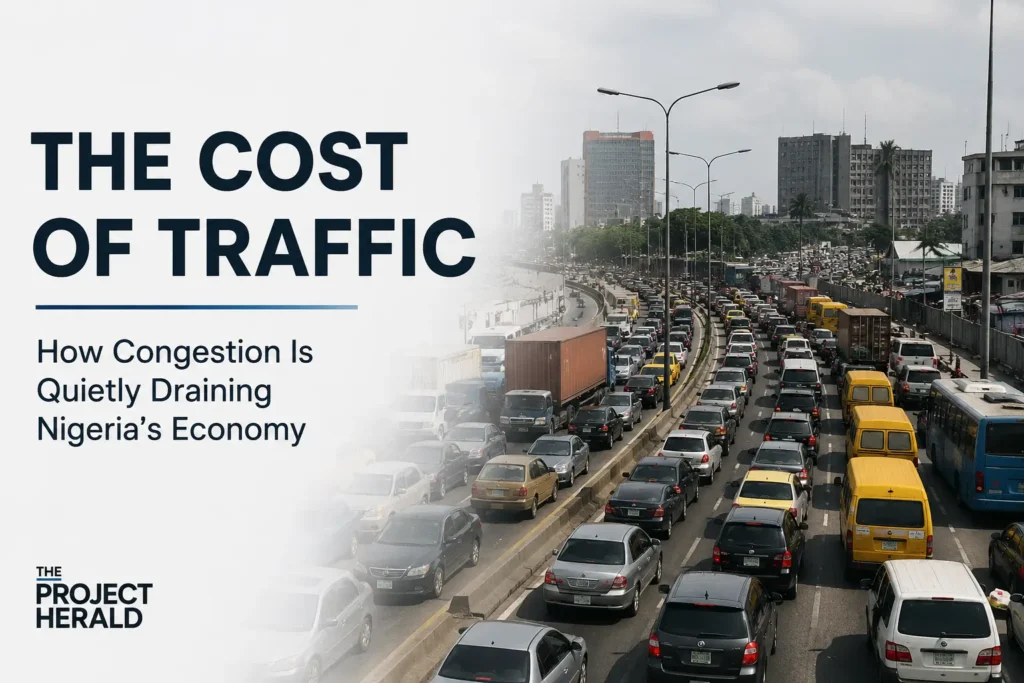
LAGOS, NIGERIA — For millions of Nigerians, traffic has become such a normal part of daily life that many no longer see it as an economic problem. It is simply something they expect before leaving home each morning and after closing from work in the evening.
But beyond the frustration of sitting in endless queues of vehicles lies a much bigger story.
Traffic congestion is quietly costing Nigeria billions of naira every year through lost productivity, higher transport costs, increased fuel consumption, delayed deliveries and reduced business efficiency. While many discussions focus on inflation, exchange rates and electricity, economists increasingly recognise urban congestion as another hidden tax on businesses and households.
The effects are visible across Lagos, Abuja, Port Harcourt, Kano and several fast-growing cities where expanding populations are placing enormous pressure on transport infrastructure that was never designed to handle today’s volume of vehicles.
For commuters, traffic means arriving home late.
For businesses, it means losing money.
For the economy, it means producing less than it otherwise could.
Every Hour in Traffic Comes at an Economic Cost
Time is one of the most valuable resources in any economy.
When workers spend hours in traffic instead of being productive, those lost hours can never be recovered.
A professional who spends three hours every day travelling to and from work loses more than 700 hours each year. That is the equivalent of almost one full month of working time spent inside vehicles rather than creating value.
Multiply that across millions of commuters and the scale of the economic loss becomes easier to understand.
Businesses also suffer when employees consistently arrive late because of congestion.
Meetings begin behind schedule.
Projects take longer to complete.
Customer appointments are missed.
Productivity declines even though salaries continue to be paid.
Economists often describe this as an invisible cost because it rarely appears on company balance sheets, yet it reduces overall economic output.
Businesses Pay More Than Many People Realise
Traffic congestion increases operating costs across almost every sector of the Nigerian economy.
Logistics companies consume more fuel while vehicles remain trapped on congested roads.
Delivery schedules become unreliable.
Commercial drivers complete fewer trips in a day.
Manufacturers experience delays receiving raw materials and distributing finished products.
Retailers wait longer for inventory to arrive.
Construction companies face slower movement of equipment and building materials.
These additional costs rarely remain with businesses.
Most companies eventually recover them by increasing the prices paid by consumers.
In practical terms, every unnecessary hour spent in traffic can quietly contribute to higher prices in shops and markets.
Fuel Consumption Rises Even When Vehicles Are Not Moving
Traffic congestion also affects fuel consumption.
Vehicles trapped in long queues continue to burn fuel while moving very little.
This means households spend more on petrol and diesel without travelling any greater distance.
Commercial transport operators face the same challenge.
Taxi drivers, ride-hailing operators, logistics firms and interstate transport companies often consume significantly more fuel because of prolonged congestion.
As operating expenses increase, transport fares usually follow.
That increase eventually affects workers travelling to offices, students commuting to school and businesses transporting goods across cities.
Lagos Illustrates the Scale of the Challenge
Nowhere is the economic impact of congestion more visible than Lagos.
As Nigeria’s commercial capital, Lagos handles a significant share of the country’s trade, financial services, manufacturing and logistics activities.
Every day, millions of people travel across the city using roads that carry both passenger traffic and heavy-duty trucks.
Key corridors such as the Apapa axis, the Lagos-Ibadan Expressway, Third Mainland Bridge, Ikorodu Road, Lekki-Epe Expressway and sections of the Lagos-Badagry corridor regularly experience heavy congestion.
Although substantial investments have been made in road rehabilitation, rail transport and water transportation, demand continues to grow alongside the city’s population.
The result is that infrastructure expansion often struggles to keep pace with urban growth.
Traffic Is Also an Infrastructure Challenge
Congestion is not simply caused by having too many vehicles.
It often reflects deeper infrastructure gaps.
Limited alternative transport systems mean more people rely on roads.
Poor road maintenance reduces carrying capacity.
Inadequate drainage causes flooding that slows movement during the rainy season.
Roadside trading, illegal parking and unplanned developments further reduce available road space.
Where public transportation remains insufficient, more households purchase private vehicles, placing even greater pressure on already congested roads.
Urban planners argue that solving congestion therefore requires more than building additional roads.
It demands integrated transport planning that combines highways, rail, water transport, bus networks, pedestrian infrastructure and intelligent traffic management.
The Cost Extends Beyond the Economy
Traffic congestion also affects public health.
Long commuting hours contribute to stress, fatigue and reduced quality of life.
Extended exposure to vehicle emissions increases air pollution, while emergency services sometimes struggle to reach patients quickly during periods of severe congestion.
Parents spend less time with their families.
Small business owners lose valuable trading hours.
Workers arrive home exhausted before beginning the cycle again the following morning.
The impact extends well beyond economics.
Technology Is Becoming Part of the Solution
Around the world, cities are increasingly using technology to improve traffic management.
Artificial intelligence is helping optimise traffic signal timing.
Digital traffic monitoring enables authorities to identify congestion before it becomes severe.
Smart transport systems provide commuters with real-time travel information, allowing drivers to choose more efficient routes.
Nigeria has begun adopting some of these technologies, but experts believe significantly greater investment will be required as cities continue to expand.
Technology alone will not eliminate congestion.
However, when combined with better infrastructure and stronger urban planning, it can substantially improve traffic flow.
Why This Matters for Nigeria’s Economic Future
Nigeria’s population is projected to continue growing rapidly over the coming decades.
Urbanisation will increase alongside that growth.
Without corresponding investments in transport infrastructure, congestion is likely to become even more expensive for businesses and households.
Efficient transportation supports trade, attracts investment, improves labour productivity and strengthens economic competitiveness.
Poor transportation does the opposite.
For an economy seeking faster growth, transport efficiency is no longer simply a convenience.
It has become an economic necessity.
The Project Herald Outlook: Solving Traffic Means Investing Beyond Roads
Whenever congestion worsens, public attention often turns immediately to calls for more roads.
Road expansion remains important, but it cannot be the only solution.
Nigeria’s fastest-growing cities require modern transport systems that move people and goods efficiently through multiple options.
That includes expanding urban rail networks, improving bus rapid transit systems, strengthening inland water transport where practical, enforcing traffic regulations consistently and investing in smart traffic management technologies.
Equally important is better urban planning that prevents future developments from creating new transport bottlenecks before they emerge.
Reducing congestion is not simply about helping motorists reach their destinations faster.
It is about lowering business costs, improving productivity, attracting investment, reducing inflationary pressures and enhancing the quality of life for millions of Nigerians.
Every hour saved on Nigeria’s roads is an hour returned to the economy.
As the country pursues sustainable economic growth, traffic congestion should no longer be viewed as an unavoidable inconvenience.
It should be recognised for what it truly is: one of the country’s most significant infrastructure and economic challenges, and one that deserves far greater policy attention than it often receives.
Read more news: https://www.theprojectherald.com/enugu-airport-concession-aero-alliance-nigeria-aviation-infrastructure/