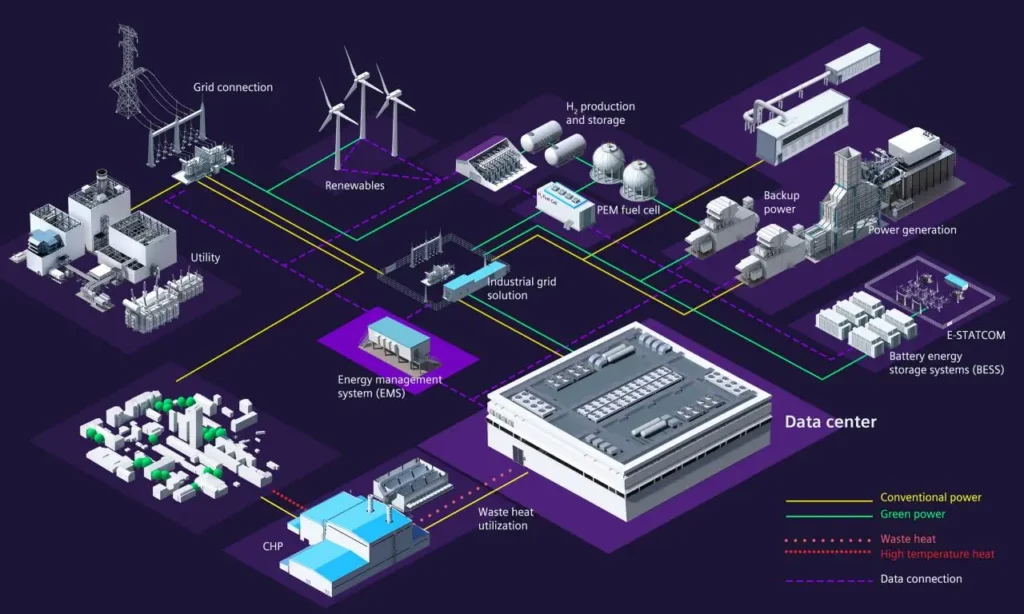
Six U.S. grid operators have until August 17 to explain whether their existing rules can handle the rapid growth of data centers and other massive electricity users — or propose changes. The fight is not only about getting power faster. It is also about who pays for the grid upgrades needed to supply it.
The biggest constraint on America’s AI expansion may not be chips, money or even land.
It is electricity.
Data center power demand is growing so quickly that getting a new facility connected to the grid can become a major project in itself. For developers building large AI facilities, the problem is increasingly straightforward: you can have the site, the financing and the computers ready to go — and still be waiting for enough electricity.
That is why the Federal Energy Regulatory Commission (FERC) has stepped into the issue.
On June 18, 2026, FERC opened six separate proceedings covering the country’s major regional electricity markets. The commission ordered PJM, MISO, SPP, CAISO, ISO New England and NYISO to examine their existing rules for connecting very large electricity users, including data centers and manufacturing facilities.
The next major deadline is August 17.
That is when the six grid operators must respond to FERC’s orders — either demonstrating that their existing tariffs can handle the rapid growth in large electricity demand or proposing changes where FERC’s concerns cannot be resolved under the current rules.
Why FERC data center interconnection has become a problem
Connecting a normal new electricity customer to the grid is relatively straightforward.
Connecting a giant data center is different.
A hyperscale AI facility can require hundreds of megawatts of electricity. Several such projects arriving in the same region can create a demand for new transmission lines, substations, generation capacity and other infrastructure.
The existing system was not designed for this kind of concentrated and rapidly growing demand.
FERC itself says today’s large loads can be dramatically larger than traditional load growth and can create new challenges for reliability, transmission planning and cost allocation.
Related Intelligence
→ Virginia GS-5 Large-Load Electricity Rate Class; https://www.theprojectherald.com/intelligence/virginia-gs5-large-load-electricity-rate-class/
The result is what developers increasingly describe as a data center grid connection queue.
A project may be ready to build, but before it can receive power, the grid operator may need to study the connection, determine what upgrades are required and establish who will pay for them.
FERC’s intervention is designed to make that process faster and more predictable.
This is not just about connecting data centers faster
The most important part of the FERC action may actually be the question sitting underneath the grid interconnection reform:
Who pays for the infrastructure?
Suppose a data center needs a new transmission upgrade costing hundreds of millions of dollars.
Someone has to pay for it.
If the cost is spread broadly across electricity customers, households and other businesses could end up paying for infrastructure primarily needed by a single large technology customer.
If the entire cost is pushed onto the data center, the project’s economics become more expensive.
FERC’s June orders explicitly address this problem.
The commission is seeking mechanisms that ensure large electricity users pay their fair share of the costs they create. One example is a Cost Recovery Agreement, designed to protect other customers if a large project fails to materialise after infrastructure has already been built for it.
That is a significant shift in the economics of the AI infrastructure buildout.
The question is no longer simply:
“Can we get power to the data center?”
It is increasingly:
“Who is going to finance the infrastructure required to get that power there?”
Virginia is already testing the model
Virginia provides an early example of where this debate could be heading.
The Virginia State Corporation Commission created a separate GS-5 rate class for very large electricity users, including data centers. The new class takes effect on January 1, 2027.
Under the approved framework, qualifying large-load customers will be required to pay at least 85% of the transmission and distribution costs incurred to serve them each month. Certain customers will also face minimum contract obligations and collateral requirements designed to reduce the risk that other electricity customers are left carrying the cost of infrastructure built for large loads.
That makes Virginia an important precedent.
FERC is dealing with interstate transmission rules, while state regulators control important parts of retail electricity pricing. But the direction is similar: large electricity users are increasingly being expected to demonstrate that they can carry more of the costs associated with their demand.
The August 17 response is only the beginning
FERC’s June 18 action did not create one national data-center electricity rule.
Instead, the commission deliberately issued six separate orders, recognising that the six regional markets operate differently.
For example, SPP already has a High Impact Large Load process designed to deal with very large new electricity demand. Other regions have different procedures and proposals at different stages.
That regional approach matters because the outcome may not be identical across the United States.
One region could introduce faster studies for projects that meet strict readiness requirements.
Another could impose stronger financial guarantees before allowing a project into the queue.
Another could change how transmission upgrades are paid for.
The common objective is to make the process faster while preventing speculative projects and protecting existing electricity customers.
FERC has specifically raised concerns about speculative interconnection requests — projects that may not ultimately be built but nevertheless consume grid-planning resources and distort forecasts. The commission is looking at stronger readiness requirements to address that problem.
The first deadline has already passed
There are actually two important deadlines surrounding the June 18 orders.
The first was July 18, when the grid operators were required to provide information on how their regions are preparing to secure enough generation to serve the growth in large electricity demand.
The second is August 17, when the operators must respond to the broader show-cause proceedings concerning their tariffs and the treatment of large loads.
So August 17 is not the end of the process.
It is the point at which the six major markets have to put their proposed answers on the table.
Why investors and infrastructure companies should watch this
The implications extend far beyond data center developers.
Every large AI facility requires a supporting infrastructure chain:
data center → electricity connection → transmission and distribution upgrades → generation capacity → equipment → construction → financing.
If FERC makes it easier and faster for large loads to connect, that could accelerate investment across the entire chain.
Transmission developers could see more projects.
Utilities could face significant new capital requirements.
Power generators could gain access to new large customers.
Engineering and construction companies could see demand for substations, transmission lines and grid upgrades.
At the same time, data center developers may face higher upfront costs as regulators increasingly require them to demonstrate that they can pay for the infrastructure their projects require.
That creates both opportunities and risks.
What to watch after August 17
The next phase will be about what the six grid operators actually propose.
Watch for four things:
1. Faster connection procedures.
How much shorter will the process for large-load customers become?
2. Cost allocation.
How much of the cost of new transmission and generation infrastructure will data centers have to carry themselves?
3. Financial guarantees.
Will developers have to provide deposits, collateral or long-term commitments before utilities build infrastructure for them?
4. State-level responses.
State regulators are likely to continue developing their own approaches to large-load electricity pricing, particularly where they believe existing customers could otherwise subsidise data center expansion.
There could also be legal disputes over where federal transmission authority ends and state authority over retail electricity rates begins. FERC has emphasised that its June orders concern interstate transmission tariffs rather than state-controlled retail rates.
The bigger picture
America’s AI infrastructure race has created a new infrastructure problem.
The question is no longer simply whether companies can build enough data centers.
It is whether the electricity system can expand quickly enough to power them.
FERC’s intervention is an attempt to shorten that gap.
But faster grid connections come with a price.
Someone has to finance the new substations, transmission capacity and generation required to serve the next wave of AI demand.
August 17 is therefore less about a final rule than about revealing the next version of the U.S. power market — and who will carry the cost of building it.
Related Intelligence: Virginia GS-5 Large-Load Electricity Rate Class; https://www.theprojectherald.com/intelligence/virginia-gs5-large-load-electricity-rate-class/