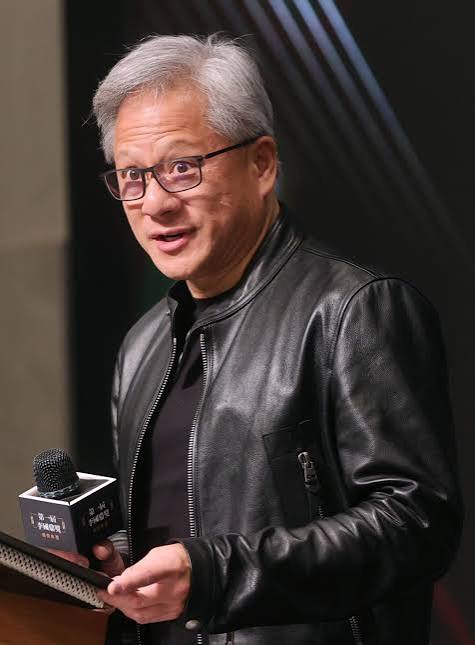
Long before artificial intelligence became one of the world’s most discussed technologies, Jensen Huang was quietly building the company that would eventually power it.
Today, NVIDIA sits at the centre of the global AI revolution.
Its graphics processing units, commonly known as GPUs, have become the computing engines behind large language models, scientific research, autonomous vehicles, robotics, cloud computing and advanced data centres.
As organisations race to adopt artificial intelligence, many are discovering that software alone is not enough.
They need computing power.
That is where Jensen Huang’s vision has fundamentally changed the world.
Building For A Future Few Could See
When NVIDIA was founded in 1993, its primary focus was graphics processing for computer gaming.
At the time, few imagined that graphics chips would one day become essential for artificial intelligence.
Huang believed otherwise.
Instead of limiting NVIDIA to gaming, he invested heavily in designing processors capable of handling increasingly complex mathematical calculations.
Years later, those same processors became perfectly suited for training artificial intelligence models.
Sometimes the greatest innovations are not built for today’s market.
They are built for tomorrow’s.
Powering The Artificial Intelligence Revolution
Every major breakthrough in modern artificial intelligence depends on enormous computational power.
Training AI models requires processing vast amounts of information simultaneously.
Traditional computer processors struggle with these workloads.
GPUs excel at them.
Today, NVIDIA’s chips power AI systems used by companies including Microsoft, Amazon, Google, Meta and OpenAI.
Universities.
Research laboratories.
Healthcare organisations.
Governments.
Financial institutions.
Manufacturing companies.
They all increasingly rely on high performance computing infrastructure powered by NVIDIA technology.
Rather than creating artificial intelligence itself, Jensen Huang built much of the infrastructure that makes artificial intelligence possible.
Creating A New Infrastructure Industry
Artificial intelligence has created demand for something many businesses rarely considered before.
Computing infrastructure.
Modern AI requires enormous data centres filled with specialised processors, networking equipment and cooling systems.
As demand for AI grows, countries are investing billions of dollars in digital infrastructure capable of supporting advanced computing.
This has transformed semiconductors from components hidden inside computers into strategic national assets.
Governments increasingly view advanced chip production as a matter of economic competitiveness and national security.
NVIDIA sits at the centre of that transformation.
Leadership Through Long Term Thinking
Many technology companies focus on quarterly results.
Jensen Huang has consistently focused on long term technological shifts.
NVIDIA spent years investing in research before artificial intelligence became commercially attractive.
That patience has allowed the company to benefit from one of the largest technological transitions in modern history.
The lesson is significant.
Markets often reward organisations that prepare before demand becomes obvious.
Inspiring The Next Generation Of Engineers
Beyond commercial success, Huang has become an influential advocate for engineering, scientific research and technological education.
His presentations regularly emphasise innovation, continuous learning and the importance of solving difficult technical problems.
Around the world, students entering engineering and computer science increasingly view artificial intelligence as a field capable of transforming healthcare, manufacturing, transportation, education and scientific discovery.
NVIDIA’s success has helped inspire that optimism.
Questions Worth Asking
Would artificial intelligence have advanced as quickly without specialised computing hardware?
How many industries will be transformed as AI infrastructure continues expanding?
Will computing power become as strategically important as energy infrastructure over the next decade?
As countries compete to lead the AI economy, who will control the technologies that make artificial intelligence possible?
These questions extend far beyond one company.
They shape the future of the global economy.
Project Herald Insight
Jensen Huang did not simply build one of the world’s most valuable technology companies.
He helped build the infrastructure behind an entirely new technological era.
Artificial intelligence may be changing how people work.
But none of those systems operate without the computing power supporting them.
History often remembers the companies creating revolutionary products.
It sometimes forgets the companies providing the tools that make those revolutions possible.
NVIDIA is one of those companies.
And Jensen Huang’s greatest legacy may ultimately be proving that the future belongs not only to those who build new ideas, but also to those who build the platforms that allow every other innovation to grow.
See more founders: https://www.theprojectherald.com/elon-musk-united-states-tesla-spacex-neuralink-the-boring-company-xai/