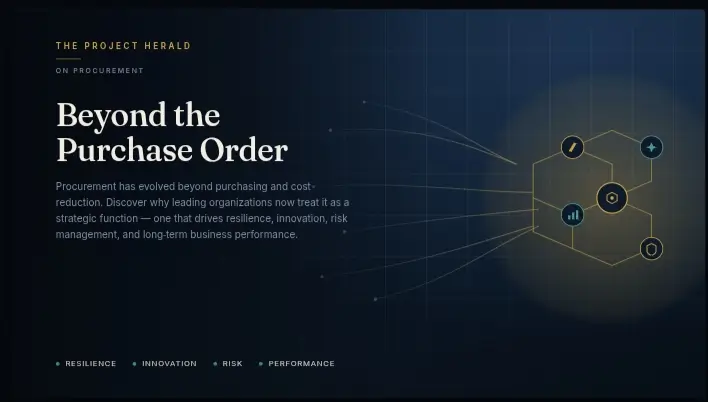
Procurement Is No Longer a Cost Centre. It Is Becoming One of the Most Strategic Functions in Business.
For decades, procurement was viewed primarily as a support function responsible for purchasing goods and services at the lowest possible cost. Success was often measured by negotiated discounts, reduced expenditure, and adherence to procurement procedures.
That view is becoming increasingly outdated.
Across global markets, procurement is evolving from an operational department into a strategic capability that influences profitability, resilience, innovation, and long-term competitiveness. The organizations that continue to treat procurement as an administrative process risk exposing themselves to avoidable financial, operational, and strategic vulnerabilities.
The shift is not theoretical. It has been accelerated by a series of global disruptions over the past several years. The COVID-19 pandemic exposed the fragility of international supply chains. Geopolitical tensions disrupted access to critical raw materials and manufacturing inputs. Inflation, exchange-rate volatility, rising logistics costs, and tighter regulatory expectations have made sourcing decisions significantly more complex than simply choosing the lowest-priced supplier.
Today, procurement decisions influence far more than purchasing budgets. They shape whether production lines remain operational, whether customer commitments are fulfilled, whether projects are delivered on schedule, and ultimately whether an organization can maintain its competitive position.
One of the most significant changes is the growing recognition that procurement is fundamentally a risk management function.
Every supplier represents both an opportunity and a potential exposure. Supplier financial distress, political instability, transportation disruptions, cybersecurity incidents, quality failures, environmental compliance issues, and concentration risk can all interrupt business operations. Organizations that evaluate suppliers solely on price often underestimate these risks until they become costly operational problems.
Forward-looking organizations increasingly evaluate suppliers across multiple dimensions, including reliability, financial strength, operational capability, compliance, sustainability, technological capacity, and long-term partnership potential. While these assessments may not always produce the lowest purchase price, they often result in a lower total cost of ownership and greater business continuity over time.
Another important shift is procurement’s growing influence on corporate strategy.
Historically, strategic decisions were associated primarily with finance, operations, marketing, and executive leadership. Today, procurement contributes valuable market intelligence that informs broader business decisions.
Procurement professionals often identify supply shortages before they affect production. They monitor commodity price movements, assess supplier markets, understand emerging technologies, and observe changing regulatory requirements across industries. This information provides executives with early warning signals that support more informed planning and investment decisions.
In many organizations, procurement has effectively become an extension of strategic planning.
Technology is further accelerating this transformation.
Digital procurement platforms, supplier relationship management systems, predictive analytics, artificial intelligence, and automation are changing how organizations source, evaluate, and manage suppliers. Rather than spending significant time processing transactions, procurement teams are increasingly expected to interpret data, identify risks, negotiate strategic partnerships, and deliver measurable business value.
This evolution also changes the expectations placed on procurement professionals themselves.
Technical purchasing knowledge remains important, but it is no longer sufficient. Modern procurement leaders are expected to understand finance, supply chain management, contract law, sustainability, data analytics, risk management, negotiation strategy, and increasingly, digital technologies.
The profession is becoming more multidisciplinary because the business environment itself has become more interconnected.
For Nigerian businesses, this transition carries particular significance.
Persistent exchange-rate volatility, import dependence across several industries, infrastructure constraints, and changing government policies have increased the complexity of procurement decisions. A sourcing decision that appears cost-effective today may become significantly more expensive if foreign exchange availability changes, logistics costs increase, or supply disruptions emerge.
Consequently, procurement leaders are paying greater attention to supplier diversification, local sourcing opportunities, inventory resilience, and long-term supplier development rather than focusing exclusively on immediate purchase prices.
This represents a fundamental shift in mindset—from minimizing purchase cost to maximizing organizational resilience and long-term value creation.
Perhaps the most important lesson for business leaders is this: procurement should no longer be evaluated only by the savings it generates.
Its true contribution lies in protecting business continuity, improving operational efficiency, strengthening supplier ecosystems, supporting innovation, reducing strategic risk, and enabling sustainable growth.
The organizations that will outperform over the next decade are unlikely to be those with the cheapest procurement departments. They will be those that recognize procurement as a strategic business function capable of influencing enterprise-wide performance.
In an increasingly uncertain global economy, competitive advantage will depend not only on what organizations produce, but also on how intelligently they source, manage, and build the relationships that make production possible.
The Project Herald View
The conversation around procurement must move beyond purchase orders and negotiated discounts. In today’s business environment, procurement sits at the intersection of strategy, resilience, and value creation. Organizations that elevate procurement to the executive table are not simply improving operational efficiency—they are strengthening their capacity to compete, adapt, and grow in an increasingly complex marketplace.
Catch up: https://www.theprojectherald.com/can-the-naira-ever-return-to-500-per-dollar/