- Agricultural Technology
- Executive Leadership
- Digital Innovation
- Africa’s Agricultural Future
The Business Case for Precision Agriculture
From drone services to agricultural intelligence
The strongest evidence of D.E.T Services' development is found not only in its technology proposition but in its earlier operating record. A USAID/Nigeria COVID-19 Food Security Challenge Final Report identifies D.E.T Services as a youth-led agricultural business operating in Abia and Ebonyi States, focused on agricultural input supply and soil and crop management.
The report records $74,801 in funding and describes the company's model as combining precision soil-fertility maintenance, precision agrochemical application, crop-health monitoring and fertilizer distribution through a subscription service.

Results During the USAID Programme Period
Increased fertilizer-application subscribers from zero to 393 farmers • Built a waiting list exceeding 700 farmers • Expanded from one spray drone (10 ha/hr) to two spray drones (28 ha/hr combined) • Added 140 subscribers in Abia State and 253 in Ebonyi State • Built a waiting list representing approximately 400 hectares • Increased annual revenue from approximately $30,000 to more than $100,000
Those historical figures matter because they demonstrate that D.E.T Services' technology proposition has previously been connected to a functioning agricultural service model rather than remaining solely at the concept stage.
The Drone as an Agricultural Machine
For Eni, drones are not simply aerial cameras. They can become agricultural operating tools. D.E.T Services has used agricultural drones for crop monitoring and input application, including fertiliser and other agricultural treatments. The USAID report specifically records the company's acquisition and use of drones for crop monitoring and agricultural-input application.
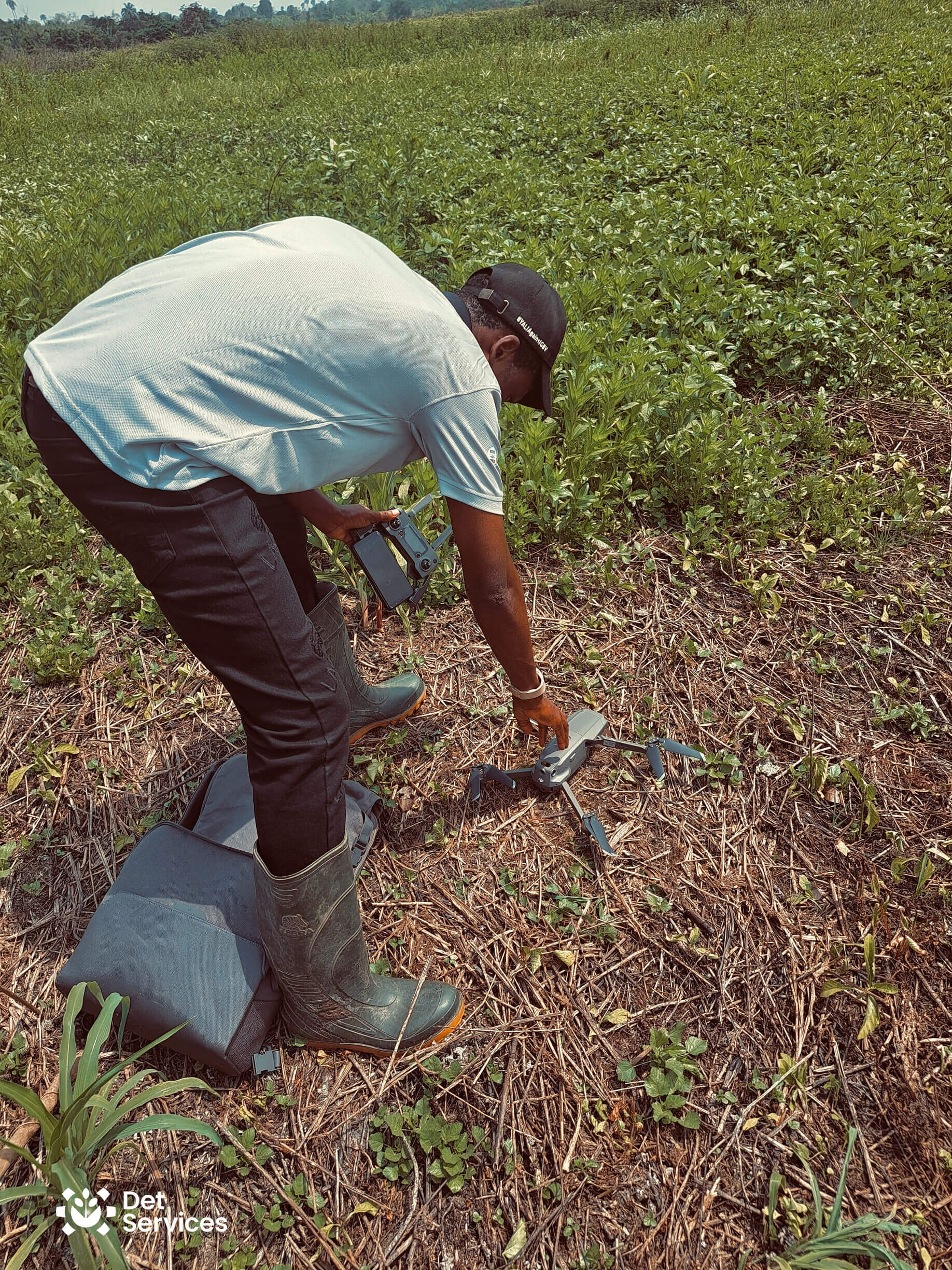
The commercial logic is straightforward. Traditional farm inspection can be labour-intensive; traditional spraying can involve treating areas that may not require the same level of intervention. Precision systems seek to make application more targeted — a means of reducing chemical waste, lowering costs, increasing coverage and improving farm productivity.
From Inputs to Information
One of Eni's more recent arguments goes further: he describes data as an agricultural input in its own right. His stated thesis is that farms should increasingly be treated as data-driven systems rather than simply areas of land on which inputs are applied — data can reveal hidden losses, help determine where inputs should be deployed and provide earlier signals of pests and diseases.
The business is no longer only about applying inputs more efficiently. It is about creating an information layer around the farm.
Research, Policy and the Move Toward Agricultural Intelligence
Building the intellectual foundation behind the business

Eni's work has also extended into agricultural research. At the 2nd African Conference on Precision Agriculture, he was listed as the author of a study titled “Precision Agriculture, the Key to Increased Productivity for Smallholder Farmers; A Case of South-East Nigeria.”
The study examined the impact of precision agriculture on smallholder farming operations in South-East Nigeria. Its central argument was that many smallholder farming systems still depend on traditional, time-consuming approaches and lack precision in agricultural input application, contributing to uneven productivity and input waste. This is significant because it shows that Eni's interest in precision agriculture predates the more recent AI-focused narrative around D.E.T Services — the technology is rooted in a longer-running concern with agricultural efficiency.
A Platform Rather Than a Single Product
The development of D.E.T Services suggests a business model broader than drone deployment. VC4A describes D.E.T Services as an agritech venture seeking to reduce agricultural input waste through precision agriculture, using drone technology to collect environmental data, improve resource management, support targeted spraying and identify areas of soil erosion or nutrient depletion.
That creates the possibility of a broader agricultural intelligence platform: the drone becomes the data-collection mechanism, the sensors become the measurement layer, AI becomes the analytical layer, the farm service becomes the execution layer, and the farmer becomes the ultimate decision-maker.
The Government Connection
Another significant development in Eni's trajectory was D.E.T Services' involvement in a Fourth Industrial Revolution technology demonstration initiative. In a public statement, Eni said the Federal Government called on the company through the project to demonstrate its precision farm-management technology, describing collaboration with the Federal Ministry of Agriculture and Food Security and the Federal Ministry of Communication, Innovation and Digital Economy toward implementing organic precision farming in Nigeria.
This represents an important transition: a technology developed around smallholder farming was being positioned not merely as a private service but as part of a broader conversation around agricultural technology and national innovation. If precision agriculture can move beyond individual farms into broader agricultural programmes, cooperatives, commercial farming operations and government-supported food-security initiatives, the addressable market becomes substantially larger.

The Orange Corners Experience
D.E.T Services also secured a place in the Orange Corners incubation programme, an initiative associated with the Kingdom of the Netherlands and implemented in Nigeria with FATE Foundation. Eni publicly described the programme as providing resources, mentorship, funding and networks to support the company's development.
For an early-stage company, such programmes can provide something that capital alone cannot: access to entrepreneurial networks, structured learning, mentorship and exposure to potential partners.
From Startup to Agricultural Infrastructure
What Ted Eni is really building
The most interesting part of Ted Eni's trajectory is not any individual drone, sensor or AI application. It is the possibility of building agricultural infrastructure around information.
Consider the sequence: a drone maps a farm. Sensors provide additional environmental information. Data identifies areas requiring attention. AI assists with interpretation. Precision equipment delivers the intervention. The farm is monitored again. The process creates another cycle of information.
Observe → Analyse → Decide → Intervene → Measure → Improve
That is fundamentally different from a one-time agricultural service. It is a farm-management system.
The Next Product: AI-Powered Diagnostics
D.E.T Services is developing an AI-powered pest and disease detection application designed to support real-time agricultural decision-making. Drone services require equipment, operators and deployment; an AI diagnostic platform could potentially bring elements of agricultural intelligence closer to the farmer through a more scalable digital interface — allowing farmers to identify potential crop-health problems earlier and determine where further investigation or intervention may be necessary.
The opportunity is particularly relevant in smallholder agriculture, where access to agronomists and sophisticated farm-management systems can be limited.
Farm Risk Assessment
Eni's more recent commercial positioning also points toward farm risk intelligence. A public 2026 offering from Eni describes a rapid farm-risk assessment using drone and field diagnostics to identify hidden yield losses associated with pests, flooding and nutrient stress, and show where losses are occurring and what action may be required.
This is a notable development because it moves the company's proposition closer to the language of risk management. For commercial farms and agricultural projects, the value of identifying a problem before it becomes a major loss can be significantly greater than simply documenting damage after the fact — creating potential applications across commercial farming, agricultural investment projects, large-scale crop production, cooperative farming, agricultural insurance, input management, food-security programmes and climate-risk monitoring.
Climate-Smart Agriculture
Climate adaptation is another central component of Eni's model. Flooding, water stress, soil degradation, pest outbreaks and changing weather patterns create risks that farmers cannot solve simply by increasing input volumes. Precision agriculture can provide a mechanism for responding more selectively.
Soil science and meteorology provide the scientific foundation. Drone technology provides observation. Data provides measurement. AI provides analysis. Agricultural services provide execution. Climate-smart farming becomes the operating framework connecting them.
The Next Chapter of D.E.T Services
Scaling the idea of cheap, smart and profitable agriculture

The long-term opportunity for Ted Eni is therefore considerably larger than building a successful drone-service company. The more ambitious proposition is to help establish precision agriculture as part of the operating infrastructure of African farming — requiring farmer education, accessible pricing, reliable equipment, data, partnerships, capital, and evidence that the technology produces economic value.
D.E.T Services' historical operating results provide an early demonstration of that commercial pathway. Its documented expansion in subscribers, drone capacity and revenue during its USAID-supported period shows that precision agriculture can be packaged as a service business rather than treated solely as an innovation experiment.
The Harvest Heroes Project
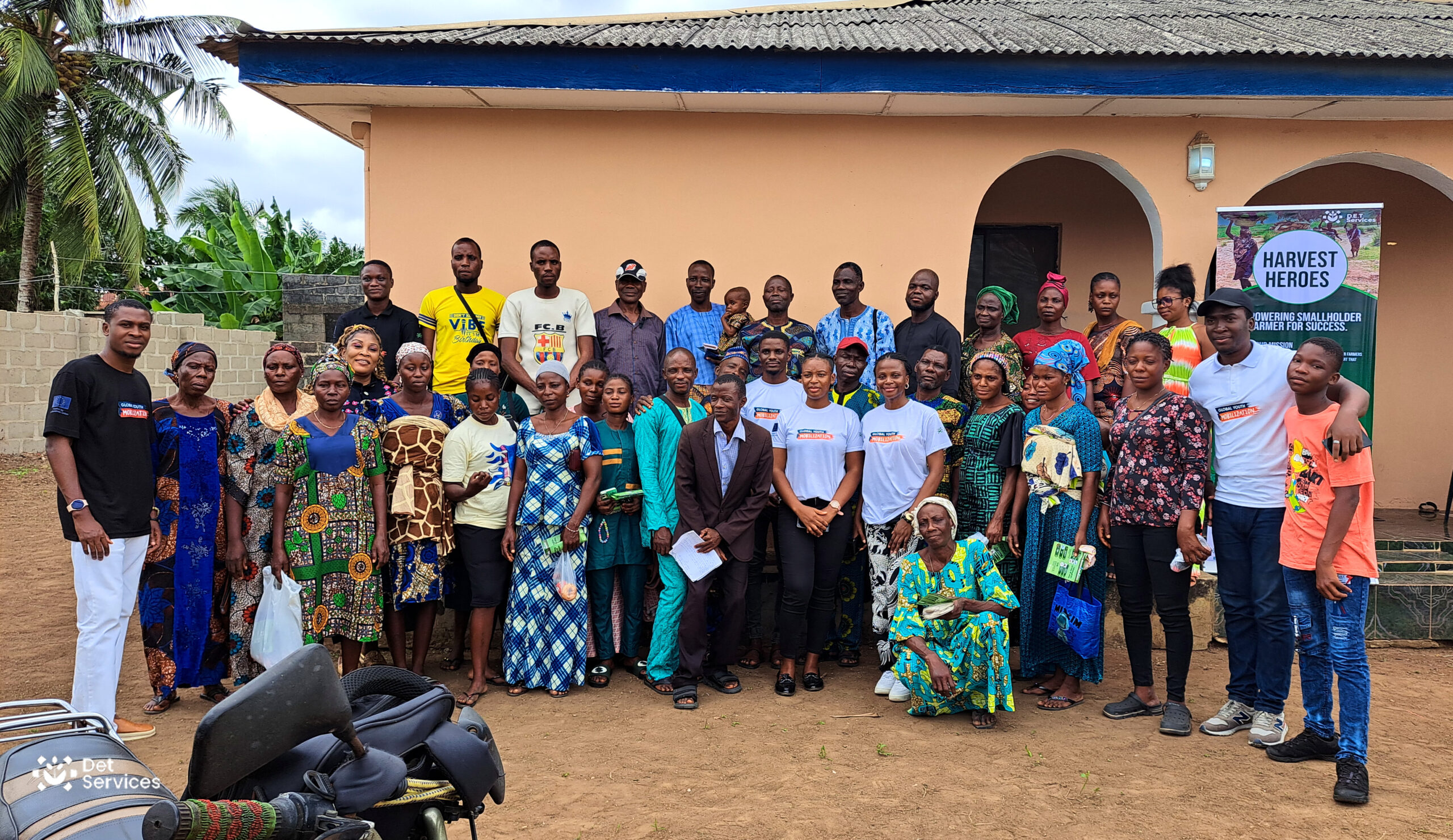
Eni's ambitions also extend into agricultural education. The Harvest Heroes Project is focused on educating young people and rural communities around climate-smart agriculture — because technology adoption is ultimately a human process. A farmer needs to understand why a new system is useful, trust its recommendations, and see it fit existing workflows.
For Eni, building the future of agriculture means not only introducing tools but helping create a generation of farmers and young agricultural professionals who are comfortable using them.
The Entrepreneurial Development
Eni's development has also been shaped by structured entrepreneurial programmes, including the Pivot Challenge 2024, which he credits with business-scaling knowledge, confidence and a valuable network. Combined with the Orange Corners experience, this points to a founder who has used accelerator and incubation environments not merely for visibility but as part of the company's development process.
Leadership Philosophy
Eni's approach to leadership is closely tied to his approach to innovation. He has repeatedly emphasised the importance of understanding the people experiencing a problem before designing a solution — a principle he has publicly associated with his work: “Meaningful innovation begins with empathy.”
This distinction matters because agriculture is an unusually context-dependent industry. A technology that works in one farming environment may not work in another without adaptation, so Eni's proposition depends on remaining close to the field while building increasingly sophisticated technology around it.
The Project Herald Intelligence
Ted Eni's trajectory illustrates an important shift taking place within African agriculture. The next generation of agricultural businesses will increasingly operate across several layers at once: production, data, technology, climate intelligence, inputs, logistics, finance and markets. The farmer remains at the centre, but the infrastructure around the farmer becomes increasingly sophisticated.
The next test is scale: can the company turn its accumulated field experience into repeatable technology, make AI diagnostics more accessible, and expand from individual farm interventions into larger agricultural projects, cooperatives and institutional farming systems?
| Executive: | Ted Eni |
| Position: | Founder & CEO, D.E.T Services |
| Sector: | Agritech / Agriculture / Climate Technology |
| Core Technologies: | AI • Drones • Sensors • Farm Data • Precision Agriculture |
| Academic Foundation: | Soil Science & Meteorology |
| Key Initiatives: | D.E.T Services • Harvest Heroes Project |
| Programmes: | USAID/Nigeria Food Security Challenge • Orange Corners • Pivot Challenge |