Why Every Successful Project Begins by Asking the Right Questions
Every year, governments announce ambitious infrastructure programmes.
Businesses unveil expansion plans.
Developers propose new housing estates.
Energy companies plan power plants.
Technology firms prepare to launch new products.
Some of these projects succeed and create lasting value.
Others are delayed, abandoned or never move beyond the drawing board.
The difference often comes down to one question.
Was the project truly feasible?
Before any responsible organisation commits millions or even billions of dollars to a project, it first needs to determine whether the project should go ahead at all.
That process is called a feasibility study.
What Is a Feasibility Study?
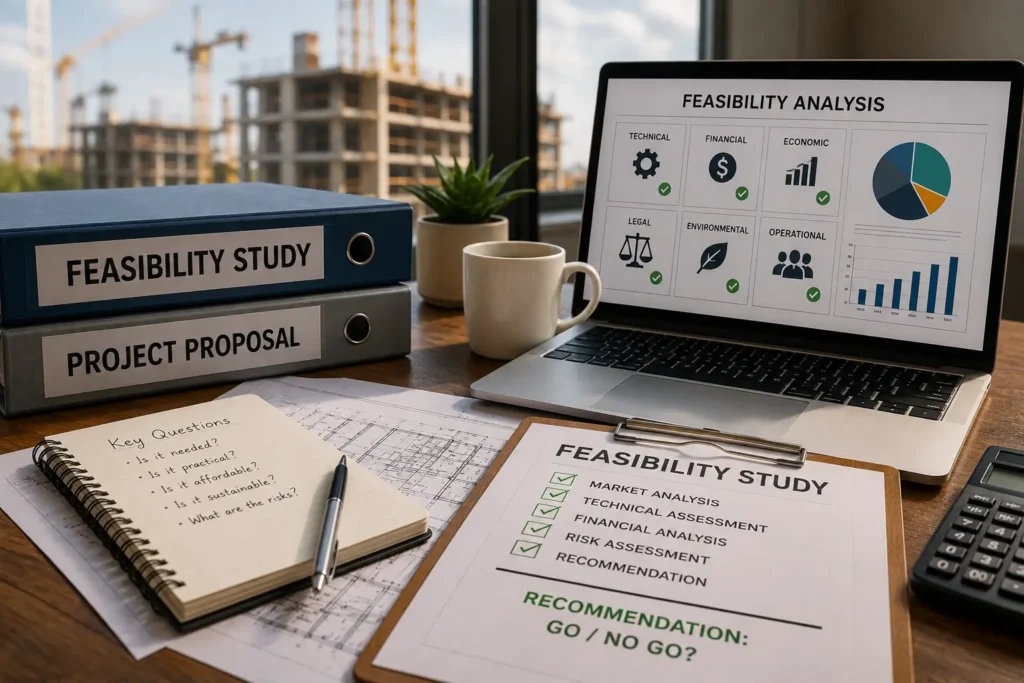
A feasibility study is a detailed assessment carried out before a project begins to determine whether it is practical, financially viable and capable of achieving its objectives.
Think of it as an investigation before making a major commitment.
It helps decision-makers answer one fundamental question:
“Is this project worth doing?”
A feasibility study is not designed to prove that a project is a good idea.
It is designed to discover the truth, even if that truth is that the project should not proceed.
Why Is It Called a Feasibility Study?
The word feasible simply means possible and practical.
A project may sound exciting.
It may attract public attention.
It may even have political support.
But if it cannot be delivered successfully, it is not feasible.
A feasibility study helps separate ambition from reality.
Imagine Building a New Airport
Suppose a government wants to build a new international airport.
The announcement receives widespread attention.
But before construction begins, many important questions need answers.
Is there enough passenger demand?
Can airlines support another airport?
Is the chosen location suitable?
Can the project generate enough revenue?
What are the environmental impacts?
Can the government afford it?
How long will construction take?
Without answering these questions, beginning construction would be extremely risky.
What Does a Feasibility Study Examine?
A good feasibility study looks at several important areas.
Technical Feasibility
Can the project actually be built?
Does the required technology exist?
Are the necessary engineering skills available?
Is the proposed location suitable?
For example, constructing a bridge across a deep river requires understanding soil conditions, water flow, weather patterns and engineering complexity.
Financial Feasibility
Can the project be paid for?
Will enough funding be available?
Can investors recover their investment?
Will future revenue cover operating costs?
A technically brilliant project may still fail if it cannot be financed sustainably.
Economic Feasibility
Will society benefit?
Will the project create jobs?
Improve transportation?
Reduce costs?
Increase productivity?
Some public projects may not generate large profits but still produce significant economic value.
Legal Feasibility
Does the project comply with existing laws?
Are regulatory approvals required?
Will land acquisition create legal disputes?
Ignoring legal issues can delay projects for years.
Environmental Feasibility
How will the project affect the environment?
Will forests be cleared?
Will nearby communities experience pollution?
Can environmental impacts be reduced?
Today, environmental assessments are an essential part of responsible project development.
Operational Feasibility
Even if the project is successfully completed, can it operate efficiently?
Can qualified staff be recruited?
Will maintenance be affordable?
Can the organisation manage the completed asset over many years?
Building something is one challenge.
Operating it successfully is another.
Does Every Project Require a Feasibility Study?
Not every project requires the same level of analysis.
A small retail shop opening another branch may need only a simple assessment.
A billion-dollar railway crossing several states requires years of detailed studies involving engineers, economists, financial experts, environmental specialists, lawyers and government agencies.
The larger the project, the more important feasibility becomes.
Can a Feasibility Study Recommend That a Project Should Not Proceed?
Yes.
In fact, this is one of its most valuable purposes.
Some people assume a feasibility study exists only to justify projects.
The opposite is true.
Sometimes the best outcome is discovering early that a project is unlikely to succeed.
Stopping an unsuitable project before construction begins can save enormous amounts of money, time and public resources.
What Happens After the Feasibility Study?
If the project is found to be feasible, organisations move into more detailed planning.
Designs are developed.
Funding is secured.
Procurement begins.
Construction eventually follows.
The feasibility study becomes the foundation upon which every later decision is built.
Why Do Projects Sometimes Fail Even After a Feasibility Study?
Because a feasibility study is only as good as the information it uses.
Poor data.
Overly optimistic assumptions.
Political pressure.
Changing market conditions.
Unexpected economic shocks.
All of these can affect outcomes.
A feasibility study reduces uncertainty.
It does not eliminate it.
A Simple Way to Remember a Feasibility Study
Imagine you are buying a house.
You like the appearance.
The price seems attractive.
Would you immediately hand over your life savings?
Probably not.
You would inspect the building.
Check the legal documents.
Estimate future maintenance costs.
Confirm ownership.
Evaluate the neighbourhood.
A feasibility study performs the same function for major projects.
It ensures that important questions are answered before major commitments are made.
Project Herald Insight
Many of the world’s most successful projects owe their success not to what happened during construction, but to the quality of the decisions made before construction ever began.
Feasibility studies help governments, businesses and investors make informed decisions based on evidence rather than optimism.
They reduce unnecessary risk, improve resource allocation and increase the likelihood that projects deliver lasting value.
Understanding feasibility studies reminds us that successful projects are rarely built on hope alone.
They are built on preparation, analysis and disciplined decision-making.
Catch up: https://www.theprojectherald.com/understanding-project-life-cycle/