How Every Successful Project Moves from an Idea to Reality
When people see a new airport, bridge, factory or railway under construction, they often assume that the project has just begun.
In reality, construction is usually one of the later stages.
Long before the first excavator arrives on site, months or even years of planning, analysis, approvals and preparation have already taken place.
Every successful project follows a journey.
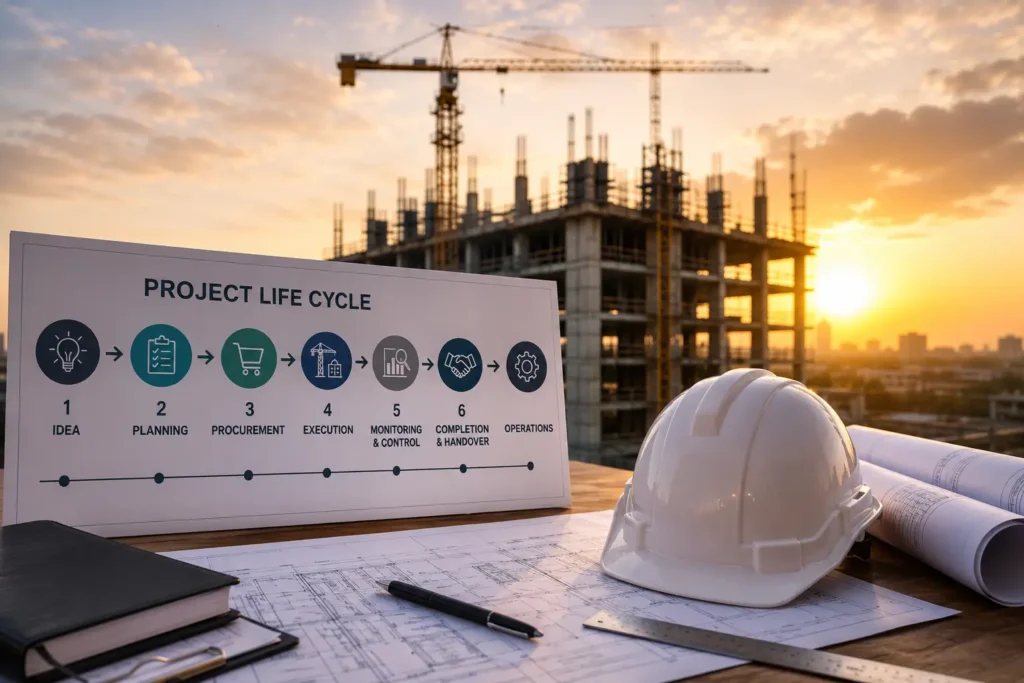
This journey is known as the Project Life Cycle.
Understanding it helps explain why some projects are delivered successfully while others suffer delays, cost overruns or fail altogether.
Let’s explore how it works.
What Is the Project Life Cycle?
The Project Life Cycle is the sequence of stages a project passes through from the moment an idea is conceived until the project is completed and handed over for use.
Think of it as the life story of a project.
Just as every person experiences childhood, adolescence and adulthood, every project passes through different phases before reaching completion.
Although organisations may use different names, the overall journey remains remarkably similar.
Why Does Every Project Need a Life Cycle?
Imagine deciding to build a hospital.
Would you immediately start pouring concrete?
Probably not.
You would first ask important questions.
Do we actually need another hospital?
Where should it be located?
How much will it cost?
Who will pay for it?
Who will design it?
Who will build it?
How long will it take?
Only after answering these questions should construction begin.
The Project Life Cycle ensures that projects move through these decisions in a structured and logical way rather than relying on guesswork.
Stage One: The Idea
Every project begins with a need.
Perhaps a city has become too crowded.
A company wants to expand production.
A government wants to improve transportation.
A university needs more classrooms.
At this stage, people recognise a problem or identify an opportunity.
The idea is still broad.
No detailed plans exist yet.
The question is simply:
“Should we explore this further?”
Stage Two: Planning
Once an idea appears worthwhile, planning begins.
This is often the longest and most important stage of the entire project.
Project teams define objectives.
Budgets are prepared.
Schedules are developed.
Risks are identified.
Resources are estimated.
Stakeholders are consulted.
Approvals are obtained.
Design work begins.
Many people underestimate planning because it happens quietly behind the scenes.
Yet poor planning is one of the biggest reasons projects fail.
Stage Three: Procurement
Before work can begin, organisations must obtain what they need.
This process is called procurement.
Contractors may be selected.
Equipment may be purchased.
Materials are sourced.
Professional consultants are appointed.
Technology systems are acquired.
Procurement is much more than buying things.
It is about ensuring the right people, services and materials are available at the right time, at the right quality and at the right cost.
Stage Four: Execution
This is the stage most people recognise.
Construction begins.
Software is developed.
Factories are built.
Equipment is installed.
Roads are paved.
Workers carry out the plans developed during earlier stages.
Execution is where ideas become visible.
However, successful execution depends heavily on the quality of the earlier planning.
Good execution rarely compensates for poor preparation.
Stage Five: Monitoring and Control
Projects cannot simply be left to run on their own.
Throughout execution, project managers constantly ask important questions.
Are we on schedule?
Are we staying within budget?
Are quality standards being achieved?
Have new risks emerged?
Do changes need approval?
Monitoring allows problems to be identified early before they become much larger and more expensive.
It continues throughout the life of the project.
Stage Six: Completion and Handover
Eventually, the work is finished.
The building is completed.
The software goes live.
The bridge opens to traffic.
The hospital receives its first patients.
But even then, the project is not quite finished.
The completed asset must be inspected.
Quality must be verified.
Documentation must be completed.
Staff may require training.
Ownership is formally transferred to the organisation that will operate the project.
This process is known as handover.
Only then is the project officially complete.
What Happens After the Project Ends?
Many people think the project ends when construction finishes.
In reality, a new phase begins.
Operations.
The airport starts serving passengers.
The railway begins transporting people.
The factory starts producing goods.
The power plant generates electricity.
The project has ended.
The operation has begun.
This is an important distinction.
Projects create something new.
Operations keep that new asset running.
Why Is Every Stage Important?
Imagine skipping the planning stage before building a bridge.
Construction might begin quickly.
But later, engineers discover unstable soil.
Costs increase.
Work stops.
Schedules slip.
Public confidence declines.
Many famous project failures around the world can be traced not to poor construction, but to weaknesses in earlier stages of the Project Life Cycle.
Strong planning often saves far more money than it costs.
Does Every Industry Use the Same Life Cycle?
The details may differ, but the principles remain remarkably consistent.
A pharmaceutical company developing a new medicine follows a project life cycle.
A technology company launching new software follows a project life cycle.
A government building a railway follows a project life cycle.
A bank introducing a digital banking platform follows a project life cycle.
Whether the final product is physical or digital, projects progress through similar stages of planning, execution and completion.
A Simple Way to Remember the Project Life Cycle
Imagine planning a wedding.
First comes the idea.
Then you plan the ceremony.
You book the venue and hire suppliers.
The wedding day arrives.
You monitor that everything is running smoothly.
The celebration ends.
Guests leave.
Life together begins.
The wedding itself was the project.
Marriage is the ongoing operation.
Projects create the beginning of something new.
Operations sustain it.
Project Herald Insight
Every successful project tells two stories.
The first is the visible story that people see: the completed airport, bridge, factory or technology platform.
The second is the invisible story of planning, financing, procurement, risk management and disciplined execution that made the outcome possible.
Understanding the Project Life Cycle helps readers look beyond construction and appreciate the decisions that determine whether projects succeed or fail.
It reminds us that great projects are rarely built by chance.
They are built through careful preparation, thoughtful leadership and disciplined execution long before the first brick is laid.
Catch up: https://www.theprojectherald.com/understanding-projects-explained/