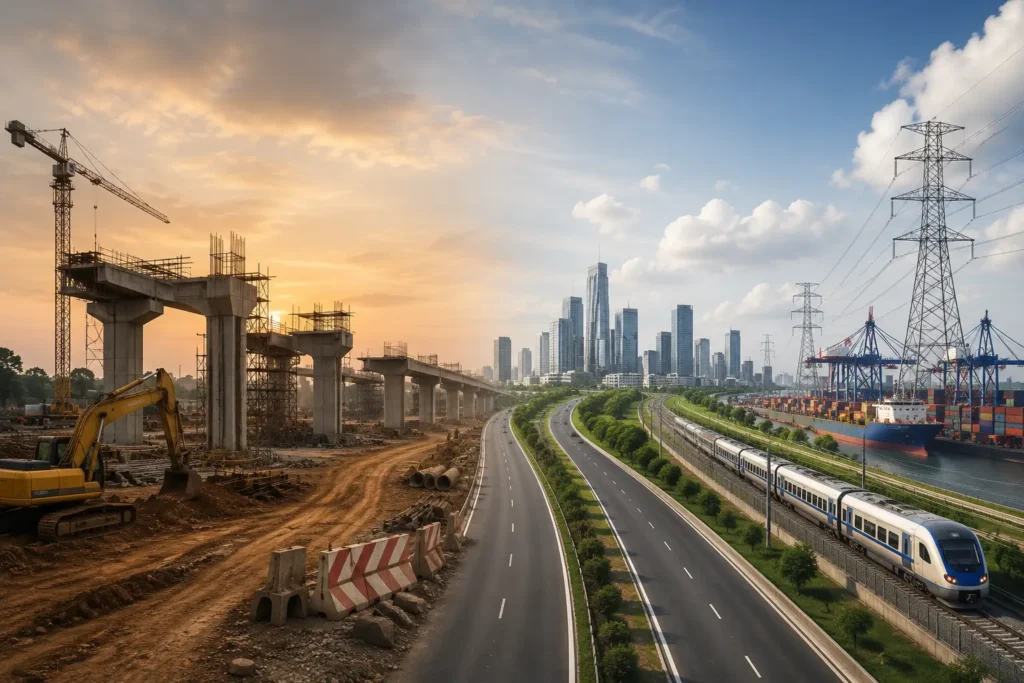
Every year, governments across Nigeria announce ambitious infrastructure projects. Roads are flagged off, bridges are commissioned for construction, rail lines are unveiled, and billions of naira are allocated to projects expected to improve connectivity, boost economic activity and enhance the quality of life.
Yet, years later, many of these projects remain incomplete, significantly delayed or abandoned altogether.
This recurring pattern has become one of Nigeria’s biggest development challenges.
The problem is not that Nigeria lacks infrastructure plans. It is that too many projects struggle to move from groundbreaking ceremonies to successful delivery.
Understanding why this happens is essential because infrastructure creates value only when it is completed, operational and properly maintained.
Infrastructure Is Measured by Delivery, Not Announcements
Infrastructure is often viewed through the lens of project announcements and contract awards.
However, from an economic perspective, announcements have little impact on productivity.
A highway under construction does not reduce transportation costs.
An unfinished railway cannot move goods or passengers.
A partially completed power project cannot supply electricity to businesses.
A modern hospital that remains unopened cannot improve healthcare outcomes.
Infrastructure begins contributing to economic growth only when it becomes functional.
This is why countries with strong infrastructure records place greater emphasis on project execution than on the number of projects announced.
The Cost of Delayed Infrastructure
Every delayed infrastructure project carries costs that extend beyond construction.
Businesses continue to face higher logistics costs.
Farmers struggle to move produce efficiently to markets.
Manufacturers experience supply chain disruptions.
Investors delay expansion because supporting infrastructure is unavailable.
Communities remain disconnected from economic opportunities.
Governments also face rising project costs as inflation, currency depreciation, changing material prices and contract variations increase the amount required to complete projects that should have been delivered years earlier.
In many cases, taxpayers ultimately pay far more than originally planned.
Why Infrastructure Projects Stall
One of the biggest reasons is inconsistent project financing.
Large infrastructure projects require predictable funding over several years. When budget releases fall behind schedule or government revenues come under pressure, construction slows and contractors reduce activity.
Land acquisition is another significant challenge.
Negotiating compensation, resolving ownership disputes and obtaining access to project sites can delay construction long before engineers begin their work.
Contract management also plays a critical role.
Even well-funded projects can experience delays when project supervision is weak, performance milestones are poorly monitored or contractual obligations are not properly enforced.
Policy discontinuity further complicates delivery.
Changes in political leadership sometimes lead to shifting priorities, project reviews or funding reallocations that interrupt ongoing work.
Security challenges can also affect delivery.
Projects located in areas experiencing insecurity often face construction delays, increased operating costs and difficulties protecting workers and equipment.
Procurement Is More Important Than Many People Realise
While engineering often receives the most public attention, procurement largely determines whether infrastructure projects succeed.
Poor contractor selection, weak contract administration, inadequate risk assessment and delayed procurement processes frequently contribute to project overruns.
Strong procurement systems ensure that contractors possess the financial capacity, technical expertise and operational capability required to deliver projects according to agreed standards.
Successful infrastructure delivery is therefore not only an engineering challenge but also a procurement and governance challenge.
Why Investors Pay Attention to Execution
Investors rarely evaluate infrastructure solely by the number of projects announced.
They look for evidence that projects are consistently completed.
Reliable roads reduce transportation costs.
Efficient ports improve trade.
Stable electricity increases industrial productivity.
Modern rail systems strengthen supply chains.
When governments consistently deliver infrastructure on schedule, businesses gain greater confidence to invest because operating risks become more predictable.
Execution therefore sends a stronger signal to investors than announcements alone.
What Successful Countries Do Differently
Countries recognised for strong infrastructure delivery generally share several characteristics.
Projects undergo rigorous planning before construction begins.
Funding arrangements are secured early.
Procurement processes remain transparent and competitive.
Independent project monitoring helps identify delays before they become critical.
Institutional continuity ensures that nationally important projects continue regardless of political transitions.
Perhaps most importantly, these countries treat infrastructure as long-term economic assets rather than short-term political achievements.
Their focus remains on lifecycle performance—from planning and design to construction, operation and maintenance.
The Project Herald View
Nigeria’s infrastructure challenge is gradually becoming less about identifying what should be built and more about consistently delivering what has already been approved.
The country’s future competitiveness will depend not only on increasing infrastructure investment but also on strengthening project governance, procurement systems, contract management, financial discipline and long-term maintenance.
Groundbreaking ceremonies may capture public attention, but completed infrastructure creates economic transformation.
The real measure of national development is not the number of projects announced each year. It is the number of projects that are completed on time, operate efficiently and continue delivering value to businesses, investors and citizens for decades to come.
Read more news: https://www.theprojectherald.com/sectors-best-positioned-benefit-regional-trade-integration-africa/