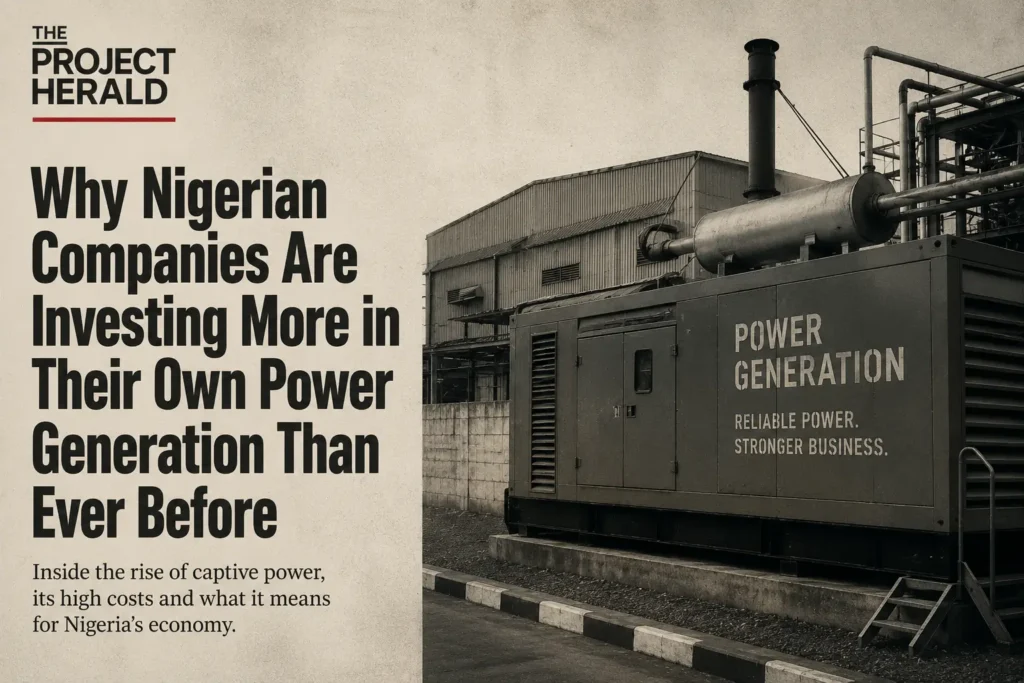
LAGOS, NIGERIA — Across Nigeria, a quiet transformation is taking place inside factories, industrial estates, commercial buildings and corporate headquarters.
Rather than waiting for improvements in the national electricity grid, many companies are taking matters into their own hands by building their own power plants.
From cement manufacturers and breweries to banks, telecommunications companies, food processors and large shopping malls, self-generated electricity has become less of a backup plan and more of a core business strategy.
For many businesses, reliable power is no longer considered an advantage.
It has become a necessity for survival.
Yet while captive power generation helps companies maintain operations, it also reveals a deeper economic challenge. Every naira invested in generating electricity internally is money that could otherwise have been invested in expanding production, hiring more workers, developing new products or opening additional factories.
The growing dependence on self-generated power raises an important question.
What does it say about Nigeria’s business environment when companies increasingly become power producers alongside their primary businesses?
Captive Power Is Becoming a Business Essential
Captive power refers to electricity generated by a company for its own use rather than relying entirely on the national grid.
These systems range from diesel and gas-powered generators to independent gas turbines, solar installations and hybrid energy systems.
For years, many Nigerian businesses installed generators primarily as emergency backup during power outages.
Today, that situation has changed significantly.
For numerous manufacturers and large commercial organisations, generators now operate for extended periods each day because public electricity alone cannot reliably support business operations.
Several of Nigeria’s largest industrial companies have invested heavily in gas-fired captive power plants capable of supplying entire manufacturing complexes.
Many banks operate sophisticated backup systems across their branch networks to ensure uninterrupted digital banking services.
Telecommunications operators maintain thousands of base stations powered partly by generators and increasingly by renewable energy solutions.
Data centres, hospitals and hotels have also expanded investments in independent electricity generation because even brief interruptions can disrupt critical operations.
Reliable Electricity Has Become a Competitive Advantage
Electricity powers nearly every aspect of modern business.
Production lines depend on it.
Cold storage facilities require uninterrupted refrigeration.
Financial transactions rely on digital infrastructure.
Internet connectivity depends on telecommunications equipment operating around the clock.
When electricity becomes unreliable, every part of the economy feels the consequences.
Manufacturers lose production hours.
Retail businesses struggle to preserve perishable goods.
Technology companies risk service disruptions.
Healthcare providers face operational challenges.
Educational institutions experience interruptions to learning.
Companies therefore view reliable electricity as essential infrastructure rather than simply another utility bill.
Those capable of generating stable power internally often enjoy greater operational efficiency than competitors relying solely on inconsistent grid supply.
The Financial Cost Is Much Higher Than Many Nigerians Realise
Building and maintaining independent power systems requires enormous financial investment.
Companies purchase generators, turbines, transformers, fuel storage facilities, electrical distribution systems and maintenance equipment.
They also employ engineers, technicians and specialised maintenance personnel to operate these facilities safely and efficiently.
Fuel represents another significant expense.
Businesses using diesel generators face substantial operating costs, particularly during periods of higher fuel prices.
Gas-powered systems generally offer lower operating costs than diesel, but they still require significant capital investment and dependable gas supply infrastructure.
Renewable energy solutions, particularly solar power combined with battery storage, are becoming increasingly attractive for some commercial applications.
However, the upfront investment remains considerable, especially for energy-intensive industries.
These expenditures increase the overall cost of doing business in Nigeria.
Ultimately, higher production costs are often reflected in the prices consumers pay for goods and services.
Manufacturing Bears a Heavy Burden
Few sectors illustrate the electricity challenge more clearly than manufacturing.
Factories require consistent power to operate machinery, maintain product quality and meet production schedules.
Unexpected power interruptions can damage equipment, interrupt production processes and result in wasted raw materials.
Manufacturers therefore spend billions of naira annually securing alternative power sources to keep operations running.
Industry associations have repeatedly identified unreliable electricity as one of the biggest obstacles limiting Nigeria’s industrial competitiveness.
When production costs rise because companies must generate their own electricity, locally manufactured products become more expensive.
This makes it harder for Nigerian businesses to compete with imported goods produced in countries where manufacturers enjoy more reliable and affordable electricity.
Telecommunications and the Digital Economy Depend on Constant Power
Nigeria’s expanding digital economy also depends heavily on electricity.
Every mobile phone call, online payment, cloud service, video conference and internet transaction passes through infrastructure that requires uninterrupted power.
Telecommunications operators maintain tens of thousands of network sites nationwide, many of which require independent energy systems because of unreliable public electricity.
Financial technology companies, cloud service providers and digital businesses similarly invest heavily in backup power infrastructure to ensure uninterrupted customer services.
As Nigeria accelerates digital transformation, electricity reliability is becoming increasingly important to economic growth.
Small Businesses Face the Greatest Challenge
Large corporations often possess the financial resources to invest in captive power systems.
Small and medium-sized enterprises rarely enjoy the same advantage.
Many rely on small petrol or diesel generators that consume expensive fuel while providing limited electricity.
Others reduce operating hours whenever public electricity becomes unavailable.
Some businesses simply close during extended outages.
For these enterprises, unreliable electricity affects daily income directly.
A neighbourhood bakery cannot bake without power.
A welding workshop cannot operate machinery.
A tailoring business cannot run industrial sewing equipment consistently.
A cold room owner risks losing valuable inventory.
Unlike large corporations, many small businesses lack the financial capacity to invest in more efficient long-term energy solutions.
Why Investors Pay Close Attention to Electricity
Reliable electricity is one of the first issues international investors examine before committing capital to a country.
Modern manufacturing depends on stable power.
So do pharmaceuticals, automotive assembly, electronics production and large-scale food processing.
Where electricity is expensive or unreliable, production costs increase.
Higher costs reduce profitability.
Lower profitability makes investment less attractive.
This partly explains why energy infrastructure remains central to discussions about Nigeria’s economic competitiveness.
Countries that successfully industrialised over recent decades invested heavily in dependable electricity systems before achieving large-scale manufacturing growth.
Recent Reforms Offer New Opportunities
Nigeria’s electricity sector has entered a period of significant reform.
The Electricity Act 2023 expanded opportunities for states to participate more actively in electricity generation, transmission and distribution.
Several state governments have since begun developing independent electricity markets aimed at improving supply within their jurisdictions.
Private investment in renewable energy continues to increase.
Solar mini grids are expanding access in underserved communities.
Industrial clusters are exploring embedded generation projects.
Natural gas remains an important transition fuel capable of supporting industrial development while renewable capacity continues to grow.
Although these developments are encouraging, experts agree that substantial investment will still be required to meet the electricity needs of Africa’s largest economy.
The Project Herald Outlook: Nigerian Companies Should Build Products, Not Power Plants
The resilience demonstrated by Nigerian businesses deserves recognition.
Despite persistent electricity challenges, companies continue investing, expanding and creating employment.
But resilience should not become a permanent substitute for reliable public infrastructure.
Every company that spends billions of naira generating its own electricity is diverting capital away from innovation, expansion, research, skills development and job creation.
In advanced industrial economies, businesses focus primarily on producing goods and services.
Governments and regulated utilities provide the infrastructure that allows those businesses to compete efficiently.
Nigeria’s long-term ambition should be to create an environment where manufacturers manufacture, technology companies innovate, hospitals treat patients and schools educate students without first becoming electricity providers.
Reliable power is more than an infrastructure goal.
It is one of the strongest foundations of industrialisation, investment, productivity and sustainable economic growth.
Until that foundation becomes stronger, many Nigerian companies will continue doing two jobs at once.
Running their businesses.
And generating their own electricity.
In another news: https://www.theprojectherald.com/why-export-diversification-matters-more-than-export-volume/