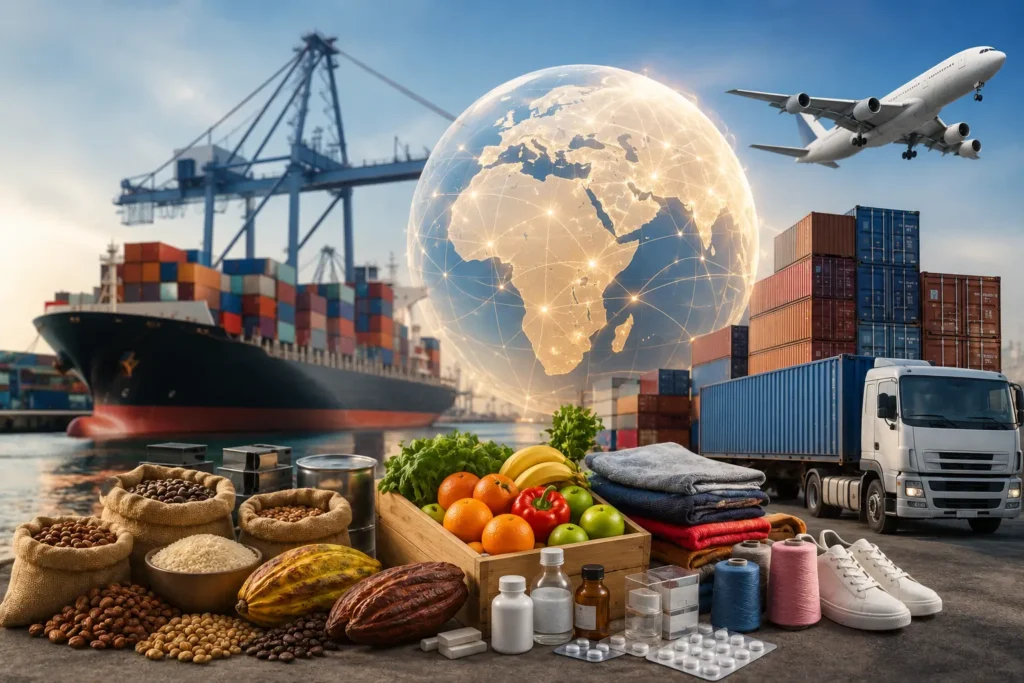
For decades, export performance has often been measured by a single question:
How much did a country export?
It is an important metric, but it is not always the most meaningful one.
A country can record impressive export earnings while remaining economically vulnerable if those exports come largely from a single commodity or a narrow group of products. In contrast, a country with a more diversified export base is often better positioned to withstand global shocks, create jobs, attract investment, and achieve more sustainable long-term growth.
This is why economists increasingly pay as much attention to what countries export as they do to how much they export.
For Nigeria, this distinction has become particularly important as policymakers continue efforts to diversify the economy beyond crude oil.
Export Volume Tells Only Part of the Story
High export volumes can create the impression of a strong external sector.
However, export performance becomes far more fragile when a significant share of earnings depends on one product.
When international prices fall, demand weakens, or supply is disrupted, government revenues, foreign exchange earnings, and economic growth can all come under pressure simultaneously.
This is one of the principal risks associated with export concentration.
Diversification helps reduce that risk by spreading export earnings across multiple industries, products, and markets.
In business, diversification reduces dependence on a single customer.
The same principle applies to national economies.
Diversification Creates More Economic Value
Exporting larger quantities of raw commodities does not necessarily translate into stronger economic development.
What often matters more is how much value is created before products leave the country.
Consider agricultural commodities.
Exporting raw cocoa generates revenue, but processing cocoa into chocolate, cocoa butter, cosmetics, or industrial ingredients captures significantly more value through manufacturing, packaging, branding, logistics, marketing, and distribution.
The same principle applies across numerous sectors, including mining, agriculture, manufacturing, and energy.
Countries that move further up the value chain generally create more employment, generate higher incomes, and strengthen domestic industries.
Export diversification is therefore closely connected to industrialisation.
Diversification Makes Economies More Resilient
Global markets are constantly changing.
Commodity prices fluctuate.
Consumer preferences evolve.
New technologies emerge.
Trade policies shift.
Countries with broader export portfolios are generally better equipped to adapt because weakness in one sector can often be offset by stronger performance elsewhere.
This resilience is particularly valuable during periods of economic uncertainty.
A diversified export base provides multiple sources of foreign exchange rather than relying heavily on a single industry.
That flexibility strengthens macroeconomic stability over the long term.
It Also Attracts Investment
Investors often look beyond current export earnings.
They assess whether an economy possesses multiple competitive industries capable of sustaining long-term growth.
A country exporting manufactured goods, processed agricultural products, technology services, pharmaceuticals, business services, and industrial products presents a broader range of investment opportunities than one dependent primarily on a single commodity.
Diversification therefore expands not only export opportunities but also investment opportunities.
As industries grow, supporting sectors such as logistics, finance, insurance, packaging, digital technology, warehousing, and professional services often expand alongside them.
The economic impact extends well beyond exporters themselves.
Diversification Encourages Innovation
Businesses competing across different export markets must continually improve product quality, efficiency, technology, and production standards.
Over time, this drives innovation throughout the economy.
Companies invest in research, improve manufacturing processes, adopt international standards, and develop products that can compete globally.
These improvements frequently benefit domestic consumers as well.
In this way, export diversification supports higher productivity rather than simply higher export earnings.
Nigeria’s Opportunity Lies Beyond Oil
Nigeria remains one of Africa’s largest exporters of crude oil.
While oil will likely remain an important contributor to export earnings for years to come, the country’s long-term economic resilience will increasingly depend on expanding other competitive export sectors.
Agricultural processing, manufacturing, pharmaceuticals, petrochemicals, digital services, creative industries, solid minerals, professional services, and knowledge-based industries all present opportunities to broaden Nigeria’s export base.
The objective is not to replace one successful export sector with another.
It is to build multiple globally competitive industries capable of generating sustainable foreign exchange, creating employment, and strengthening economic resilience.
The Quality of Exports Matters
Export diversification is not simply about increasing the number of exported products.
Quality matters just as much.
Countries that consistently meet international standards, improve product reliability, strengthen branding, and build efficient supply chains are generally better positioned to secure long-term access to global markets.
Competitiveness remains the foundation of successful exports.
Diversification succeeds when businesses can consistently deliver products and services that international markets are willing to buy.
The Project Herald View
The conversation around exports should extend beyond headline figures.
Export volume remains important, but it tells only part of the story.
The greater measure of long-term economic strength is whether a country can generate export earnings from multiple competitive industries rather than relying heavily on a limited number of commodities.
For Nigeria, export diversification is more than a trade strategy.
It is an industrial strategy, an investment strategy, and ultimately an economic resilience strategy.
The countries that build the strongest economies are not always those that export the most.
They are often the ones that export the widest range of competitive, value-added products and services.
Read more Analysis: https://www.theprojectherald.com/procurement-no-longer-cost-centre-strategic-business-function/