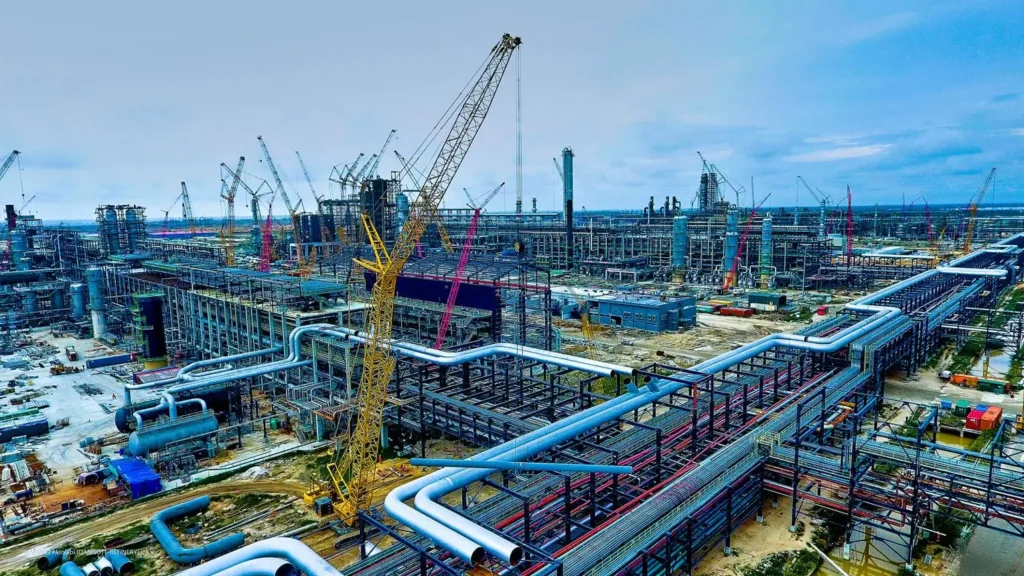
Dangote Group has secured a $2.5 billion private equity investment to support the expansion of its oil refinery and petrochemicals complex in Lagos, in a major capital move that could significantly increase Nigeria’s domestic refining capacity.
The investment is expected to help expand the Dangote Petroleum Refinery’s capacity from its current 650,000 barrels per day to approximately 1.4 million barrels per day by 2028.
The financing reportedly includes participation from the Africa Finance Corporation (AFC) and the African Export-Import Bank (Afreximbank), providing additional institutional backing for the refinery’s expansion plans.
The capital commitment comes as Dangote continues to position the refinery as a major energy infrastructure asset serving Nigeria and the wider African market. The expansion would more than double the facility’s current refining capacity and strengthen its potential role in reducing the region’s reliance on imported petroleum products.
A Major Capital Commitment Behind Refining Expansion
The $2.5 billion investment represents more than a financing event for Dangote. It is capital being directed toward the expansion of an already operational industrial asset with strategic importance to Nigeria’s energy sector.
The Dangote Petroleum Refinery, located in the Lekki Free Zone in Lagos, has a nameplate capacity of 650,000 barrels per day. Reaching the targeted 1.4 million barrels-per-day capacity would place the facility among the largest refining operations in the world and significantly increase its potential output.
For Dangote Group, the investment also strengthens the company’s broader position across the oil and gas value chain, extending its presence beyond the initial construction and commissioning of the refinery into a new phase of capacity expansion.
For investors and businesses tracking Nigeria’s industrial market, the development is also significant because a refinery expansion of this scale can create downstream opportunities across engineering, equipment supply, logistics, maintenance, technology, storage and other industrial services.
The next stage will therefore be important to monitor. The key question is not only how much capital has been committed, but how quickly the financing translates into expansion activity, procurement, construction and increased refining capacity.
The Project Herald will continue to track the investment and the refinery’s expansion as the project moves through its next stages.
See this: https://www.theprojectherald.com/afdb-approves-100-million-support-package-for-ebid/