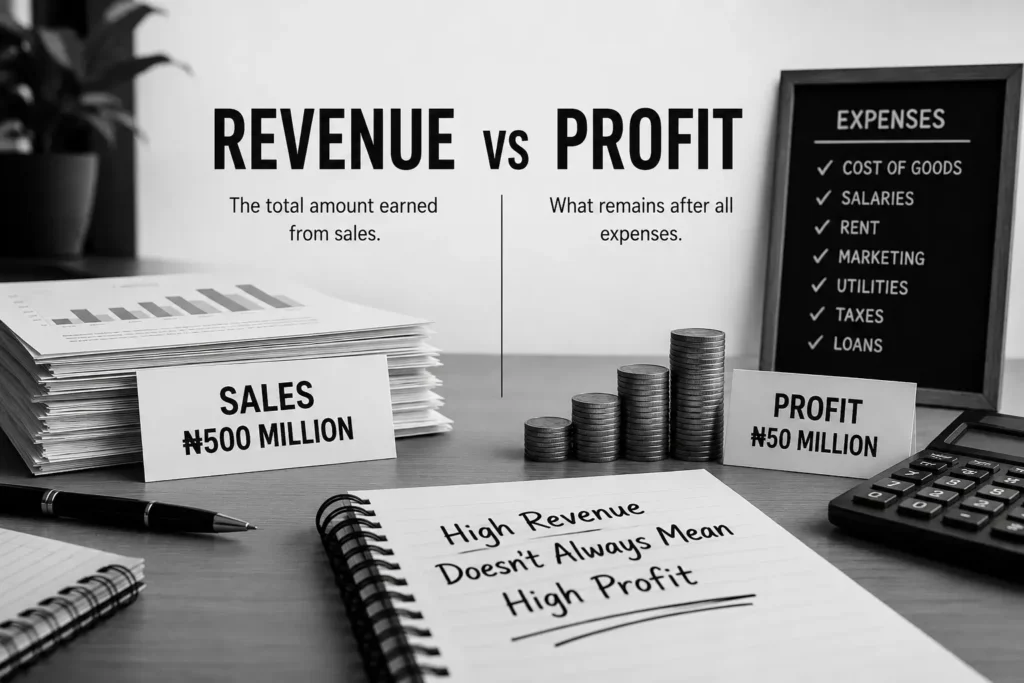
Why a Company Can Make Billions and Still Lose Money
Every year, companies announce impressive financial results.
“We generated ₦500 billion in revenue.”
“Our sales reached $20 billion.”
“We recorded our highest turnover ever.”
To many people, these statements sound like proof that the company is highly profitable.
But there is an important question that often goes unanswered.
How much of that money did the company actually keep?
The answer lies in understanding the difference between revenue and profit.
These two terms are often used interchangeably, but they describe two very different things.
Understanding the distinction is one of the most important foundations of business literacy.
What Is Revenue?
Revenue is the total amount of money a business earns from selling its products or services before any expenses are deducted.
It is sometimes called sales, turnover or the top line because it appears at the top of a company’s income statement.
Imagine you own a bakery.
During one month, customers buy bread, cakes and pastries worth ₦5 million.
That ₦5 million is your revenue.
At this stage, you have not yet paid for flour, electricity, staff salaries, rent or taxes.
Revenue simply tells us how much money came into the business.
What Is Profit?
Profit is the money that remains after the business has paid all of its expenses.
These expenses may include:
Raw materials.
Employee salaries.
Rent.
Electricity.
Marketing.
Transportation.
Taxes.
Loan repayments.
Maintenance.
Once these costs are deducted from revenue, whatever remains is profit.
Profit represents the financial reward for successfully running the business.
A Simple Example
Imagine two restaurants.
Restaurant A earns ₦100 million in revenue during the year.
Its expenses total ₦98 million.
Its profit is only ₦2 million.
Now consider Restaurant B.
It earns only ₦40 million in revenue.
Its expenses are ₦20 million.
Its profit is ₦20 million.
Which business is performing better?
Many people would choose Restaurant A because it generated more revenue.
But Restaurant B actually keeps far more money.
Revenue tells us how much business was done.
Profit tells us how much value the business created for its owners.
Can Revenue Increase While Profit Falls?
Yes.
This happens more often than many people realise.
A company may sell more products than ever before.
However, if production costs rise even faster, profit may decline.
Imagine an airline carrying more passengers than last year.
Fuel prices suddenly increase.
Aircraft maintenance becomes more expensive.
Staff costs rise.
Although ticket sales increase, operating costs rise even more.
Revenue grows.
Profit falls.
This is why investors pay close attention to both numbers.
Why Doesn’t Every Business Focus Only on Profit?
Sometimes businesses deliberately accept lower profits for a period of time.
A company entering a new market may reduce prices to attract customers.
A technology company may invest heavily in research and development.
A retailer may open many new stores.
These decisions increase expenses today but may produce much higher profits in the future.
Successful businesses balance short-term profitability with long-term growth.
Why Investors Care About Profit
Revenue shows that customers are buying.
Profit shows that the business is financially sustainable.
A company with strong revenue but no profit may eventually struggle to survive if losses continue.
Profit allows businesses to:
Expand operations.
Invest in new products.
Repay loans.
Reward shareholders.
Build financial reserves.
Without profit, long-term growth becomes much more difficult.
Does High Profit Always Mean Success?
Not necessarily.
A business might generate strong profits today while ignoring future challenges.
It may fail to innovate.
Lose customers.
Ignore changing technology.
Or underinvest in its workforce.
Likewise, a younger company may report low profits because it is investing aggressively for future growth.
Financial performance should always be understood within the broader context of the business.
A Simple Way to Remember the Difference
Imagine you own a fruit shop.
During one day, customers buy ₦100,000 worth of fruit.
That is your revenue.
After paying wholesalers, workers, transport costs and rent, you have ₦18,000 left.
That ₦18,000 is your profit.
Revenue is the money that comes in.
Profit is the money that stays.
Why This Difference Matters
Every time you hear that a company generated billions of dollars in revenue, ask one more question.
“How much profit did it actually make?”
That single question provides a much clearer picture of the company’s financial health.
It helps explain why some businesses with enormous sales eventually fail, while others with more modest revenue continue growing for decades.
Project Herald Insight
Revenue attracts attention because it reflects the scale of a business.
Profit earns respect because it reflects the quality of that business.
The world’s strongest companies are not simply those that generate the highest sales.
They are the ones that consistently convert revenue into sustainable profit while continuing to invest in future growth.
Understanding the difference between revenue and profit helps readers interpret company earnings, business news and financial reports with greater confidence and clarity.
catch up: https://www.theprojectherald.com/understanding-project-finance/