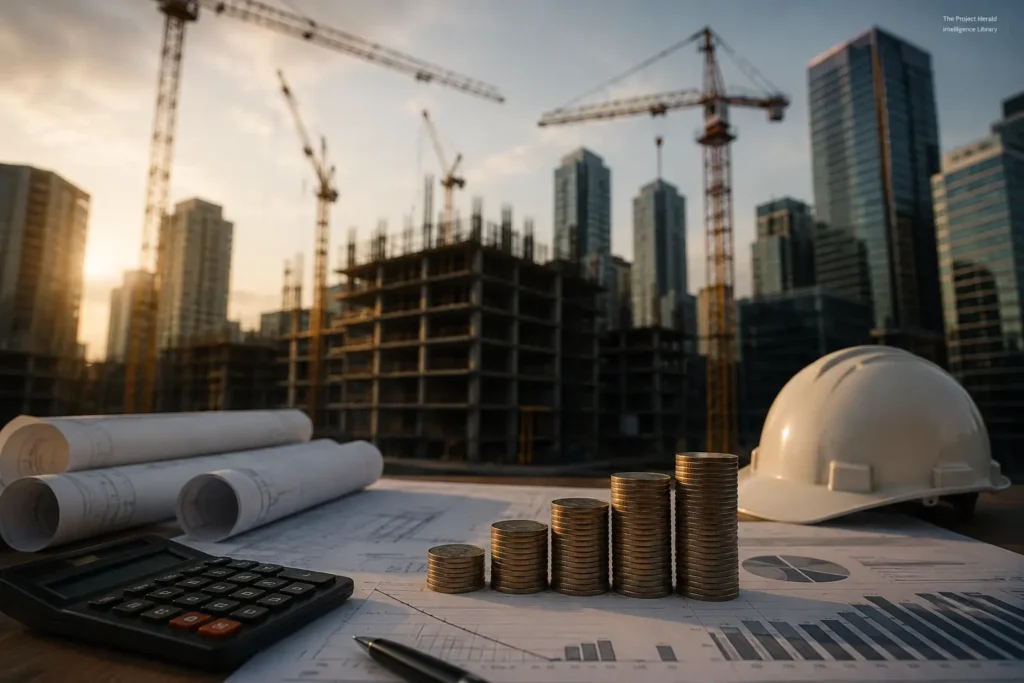
Where Does the Money for Billion-Dollar Projects Come From?
When a new airport is announced, one of the first things people ask is:
“How much will it cost?”
Sometimes the answer is astonishing.
Five billion dollars.
Ten billion dollars.
Fifty billion dollars.
The figures are so large that many people assume governments simply have the money sitting in a bank account.
In reality, that is rarely the case.
Most major projects are carefully financed using a combination of public funding, private investment and long-term financial planning.
Understanding project finance helps explain why some projects move quickly, why others experience delays and why many promising ideas never leave the drawing board.
What Is Project Finance?
Project finance is the process of raising the money needed to plan, build and deliver a project.
It involves determining where the funding will come from, who will provide it, how it will be repaid and who carries the financial risks.
Project finance is not simply about borrowing money.
It is about designing a financial structure that allows a project to succeed over many years.
Why Can’t Governments Pay for Everything?
Governments have many responsibilities.
They fund healthcare.
Education.
Security.
Public salaries.
Social programmes.
Infrastructure.
At the same time, tax revenue is limited.
Even wealthy countries cannot pay for every road, railway, airport or power station entirely from government budgets.
That is why governments often seek additional sources of funding.
Who Pays for Major Projects?
Project finance usually involves several different participants.
Governments may provide part of the funding.
Commercial banks may offer loans.
Private investors may contribute capital.
Development finance institutions may support projects that promote economic growth.
Pension funds and infrastructure investment funds may also invest because large projects can generate stable long-term returns.
Instead of relying on a single source of money, successful projects often combine several funding sources.
Debt and Equity: The Two Main Sources of Finance
Most projects are financed through a combination of debt and equity.
Debt is borrowed money.
Loans from banks or financial institutions must be repaid over time, usually with interest.
Equity is money invested by owners or investors.
Instead of receiving fixed repayments, investors earn returns if the project performs well.
Most large projects use both.
Borrowing too much increases financial risk.
Using only equity may require investors to commit more capital than they are willing to provide.
A balanced financial structure is often the most sustainable approach.
What Happens After Construction?
Many people think financing ends once construction is completed.
It does not.
The project must continue generating enough income to cover operating costs, maintenance, loan repayments and investor returns.
For example, a toll road collects tolls.
An airport earns revenue from airlines, passengers and retail businesses.
A power plant sells electricity.
These future revenues are often what make project financing possible in the first place.
What If a Project Does Not Generate Revenue?
Not every project is designed to make money directly.
A public hospital may never earn enough income to repay its full construction cost.
A public school may not generate commercial revenue.
Yet these projects create enormous social and economic benefits.
In such cases, governments usually provide ongoing financial support because the broader public value justifies the investment.
What Is a Public-Private Partnership?
Sometimes governments work together with private companies to deliver projects.
This arrangement is known as a Public-Private Partnership, often called a PPP.
The government may provide land, approvals or part of the funding.
A private company may finance, design, build and operate the project for an agreed period.
Both parties share responsibilities, risks and rewards according to the contract.
When managed well, PPPs can accelerate infrastructure development while reducing pressure on public finances.
Why Do Some Projects Struggle to Secure Financing?
A good idea is not always enough.
Investors and lenders ask difficult questions.
Has the project been properly planned?
Is demand strong enough?
Can construction be completed on time?
Are costs realistic?
What risks exist?
Can future revenue repay the financing?
If these questions cannot be answered convincingly, raising finance becomes much more difficult.
This is why feasibility studies and project planning are so important.
They build confidence among investors and lenders.
Does Expensive Always Mean Better?
Not necessarily.
A project costing ten billion dollars is not automatically more valuable than one costing one hundred million dollars.
The true measure of success is whether the project delivers lasting value.
A modest rural water project that serves thousands of families may have a greater long-term impact than an expensive project that is poorly planned and rarely used.
Project finance is therefore not about spending the most money.
It is about investing wisely.
A Simple Way to Remember Project Finance
Imagine you want to build your dream house.
You may use some of your own savings.
You may obtain a mortgage from a bank.
Family members might contribute.
Each source provides part of the funding.
Large infrastructure projects work in much the same way.
Instead of one person, there may be governments, banks, investors and development institutions working together to finance a single project.
Project Herald Insight
Behind every major infrastructure project is a financial story that is just as important as the engineering.
The bridges, ports, airports and energy facilities that shape economies are not built simply because they are needed.
They are built because someone was willing to finance them.
Understanding project finance helps readers look beyond construction and recognise the complex financial decisions that determine whether ambitious ideas become reality.
In the world of projects, engineering may build the structure, but finance makes the structure possible.
Read more: https://www.theprojectherald.com/understanding-feasibility-studies/