Why Buying the Right Things the Right Way Can Make or Break a Project
When people hear the word procurement, they often think it simply means buying things.
A company needs cement.
It buys cement.
A government needs computers.
It buys computers.
A contractor needs steel.
It buys steel.
While purchasing is certainly part of procurement, the discipline is far more important and far more strategic than most people realise.
In fact, some of the world’s most successful projects owe their success not only to brilliant engineering, but also to excellent procurement.
Likewise, many failed projects can trace their problems back to poor procurement decisions.
So what exactly is procurement?
What Is Procurement?
Procurement is the process of identifying what a project needs, selecting the right suppliers, negotiating contracts, purchasing goods or services and ensuring they are delivered at the right quality, price and time.
It is much more than spending money.
It is about making good decisions.
Every major project depends on thousands of procurement decisions.
Materials.
Equipment.
Technology.
Professional services.
Construction contractors.
Consultants.
Specialised machinery.
Without procurement, projects simply cannot move forward.
Why Procurement Matters
Imagine you are building a hospital.
The design is excellent.
Funding has been secured.
Construction has begun.
But the contractor purchases low-quality electrical equipment.
Medical equipment arrives six months late.
The air-conditioning system fails to meet specifications.
Suddenly, the entire project is delayed.
Costs increase.
Quality suffers.
The hospital opens later than planned.
The problem was not engineering.
It was procurement.
Good procurement protects both quality and value.
Procurement Is About More Than Finding the Lowest Price
One of the biggest misconceptions is that procurement is about choosing whoever offers the cheapest price.
In reality, the cheapest option is not always the best option.
Imagine buying a generator for a power station.
One supplier offers a very low price.
Another charges more but has a proven record of reliability, better maintenance support and higher efficiency.
Choosing the cheaper option may save money today.
But repeated breakdowns could cost far more over the next twenty years.
Professional procurement focuses on best value, not simply the lowest cost.
What Does the Procurement Process Look Like?
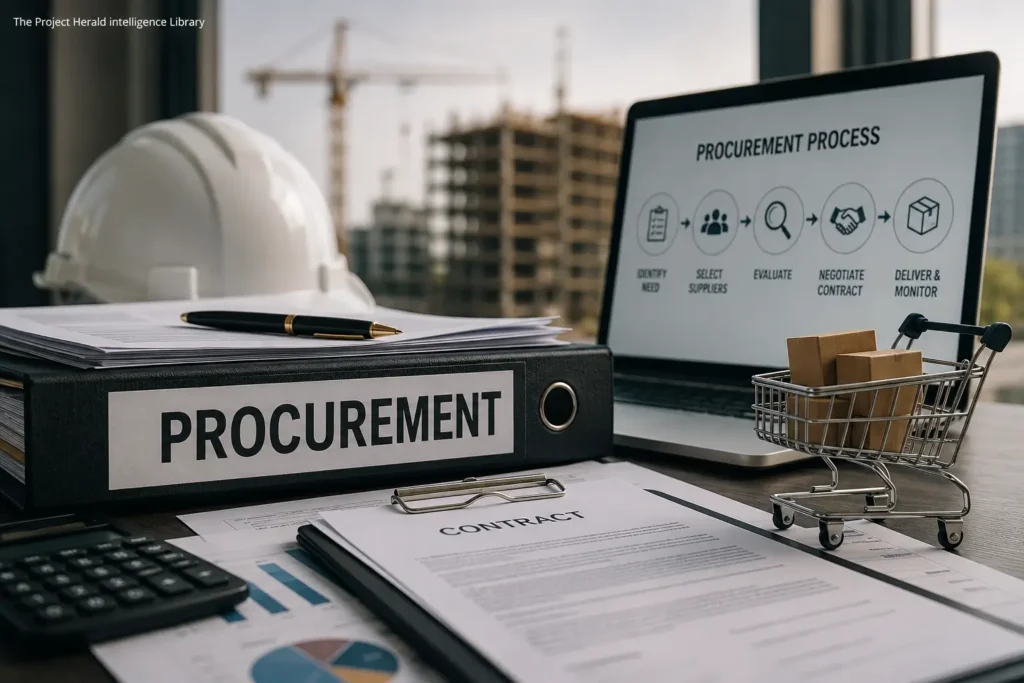
Although every organisation has its own procedures, procurement usually follows several stages.
First, the project team identifies what is required.
Next, technical specifications are prepared.
Potential suppliers are invited to submit bids or proposals.
Those bids are carefully evaluated.
The most suitable supplier is selected.
A contract is negotiated and signed.
The supplier delivers the goods or services.
Finally, performance is monitored to ensure contractual obligations are met.
Every stage exists to reduce risk and improve project outcomes.
What Is Tendering?
For many public projects, organisations do not simply choose a supplier.
Instead, they invite qualified companies to compete for the work.
This process is known as tendering.
Companies submit proposals explaining what they will deliver, how much it will cost and how long the work will take.
The organisation then evaluates the submissions before selecting the most suitable contractor.
Tendering encourages competition, improves transparency and helps ensure public money is spent responsibly.
Who Is Involved in Procurement?
Procurement is rarely handled by one person.
Engineers define technical requirements.
Finance teams confirm budgets.
Lawyers review contracts.
Procurement specialists manage supplier selection.
Project managers coordinate delivery.
Senior executives approve major decisions.
Large infrastructure projects often involve procurement teams working alongside dozens of technical experts.
Why Do Procurement Mistakes Become So Expensive?
A poor procurement decision can affect an entire project.
A delayed shipment may stop construction.
Poor-quality materials may require replacement.
An unreliable contractor may abandon the work.
A poorly written contract may lead to lengthy legal disputes.
Because procurement affects almost every part of a project, mistakes often become expensive very quickly.
Procurement Is Also About Relationships
Successful organisations do not simply buy products.
They build relationships with reliable suppliers.
Trusted suppliers understand quality expectations.
They communicate problems early.
They deliver consistently.
Strong supplier relationships often become a competitive advantage because they improve reliability, reduce delays and strengthen long-term performance.
Procurement in Everyday Life
Procurement is not limited to governments and multinational companies.
A restaurant buying kitchen equipment is carrying out procurement.
A school purchasing computers is carrying out procurement.
A small business hiring an accounting firm is carrying out procurement.
The scale changes.
The principles remain the same.
The goal is always to obtain the right solution at the right quality, cost and time.
A Simple Way to Remember Procurement
Imagine preparing for a family wedding.
You need a venue.
Food.
Photography.
Music.
Decorations.
Transportation.
You could simply choose the cheapest provider for everything.
Or you could compare quality, reliability, experience, price and reputation before making each decision.
That is procurement.
It is the process of making informed purchasing decisions that lead to successful outcomes.
Project Herald Insight
Behind every successful project is a network of suppliers, contractors and service providers whose contributions are often invisible to the public.
Procurement connects project plans with the resources needed to turn those plans into reality.
Done well, it improves quality, controls costs and reduces risk.
Done poorly, it can delay projects, waste resources and undermine public confidence.
Understanding procurement reminds us that successful projects are not built simply by spending money.
They are built by making disciplined decisions about how that money is spent.
Catch up: https://www.theprojectherald.com/understanding-project-finance/