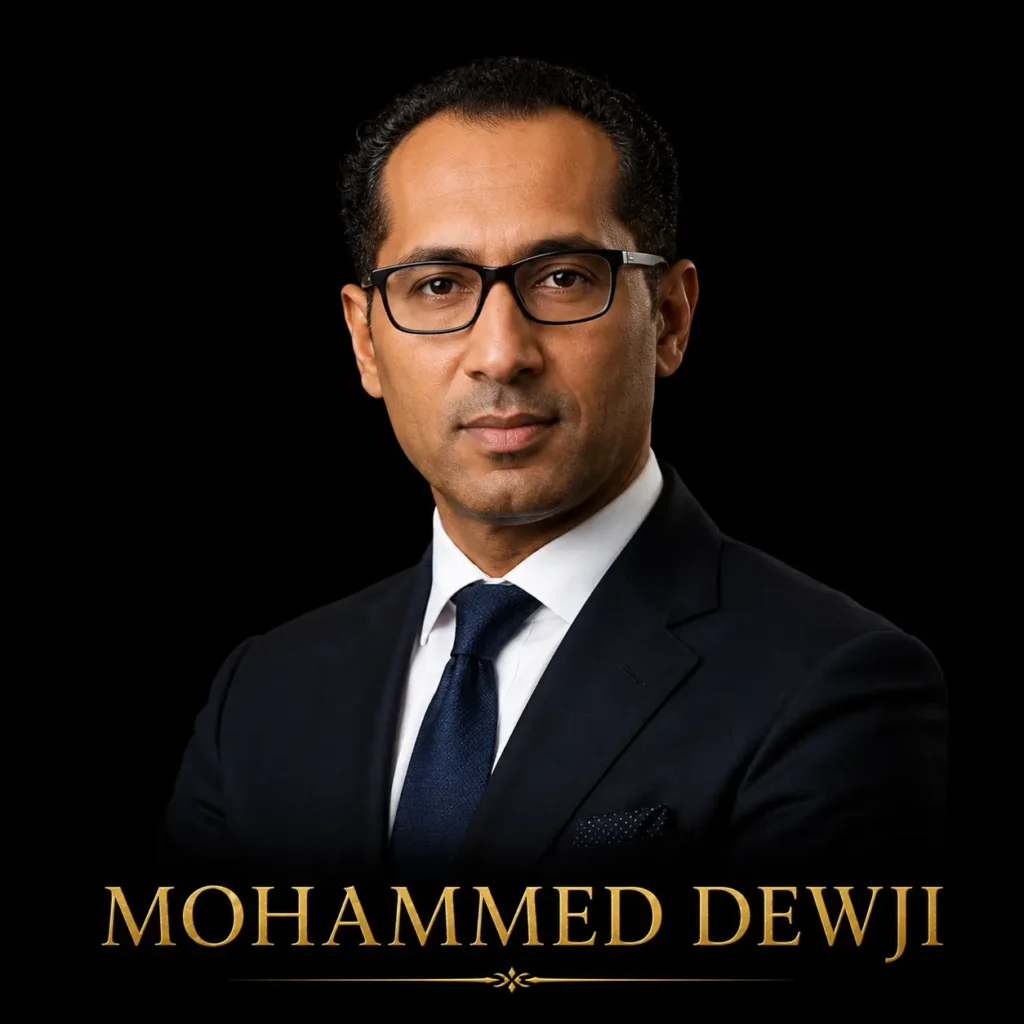
Country: Tanzania
Company: MeTL Group
Role: President & Chief Executive Officer, MeTL Group
Sector: Manufacturing, Consumer Goods, Agriculture, Energy, Mining, Logistics, Real Estate, Hospitality
Founder Category: African Business Leaders / Industrialists
Why Project Herald Is Watching Him
Mohammed “Mo” Dewji is one of East Africa’s most prominent industrialists and the leader of MeTL Group, a diversified Tanzanian conglomerate with operations across manufacturing, agriculture, food and beverages, energy, logistics and other sectors.
What makes Dewji particularly relevant to Project Herald is the direction of MeTL’s current expansion.
The group is moving beyond its established manufacturing and trading businesses into critical minerals, mineral processing, regional manufacturing and tourism, creating a growing pipeline of projects and capital deployment across East Africa.
In 2026, Dewji announced major new investment plans that could place MeTL in two strategically important areas: the graphite supply chain and regional consumer manufacturing.
From Family Business to Pan-African Industrial Group
MeTL was originally established as a family business and was developed into a much larger industrial group under Dewji’s leadership.
Dewji became involved in the business at an early age and subsequently expanded its activities across multiple industries and African markets.
Today, MeTL operates across several sectors, including textiles, edible oils, flour milling, beverages, agriculture, energy, petroleum, logistics and other consumer and industrial businesses.
Forbes describes MeTL as a Tanzanian conglomerate active in textile manufacturing, flour milling, beverages and edible oils, with operations extending into multiple African countries.
The group’s expansion has made Dewji an important example of African private capital being deployed into local manufacturing and regional industrial capacity.
The Graphite Bet
One of the most important developments around Dewji in 2026 is MeTL’s move into graphite.
Dewji has announced plans to invest approximately US$275 million in graphite mining and luxury tourism, with the graphite investment forming a major part of the group’s diversification strategy.
According to reporting on Dewji’s plans, MeTL has already acquired graphite mining assets and expects to begin production from the mines within approximately 18 months.
The move is strategically significant because graphite is a critical material used in battery technologies and is increasingly important to the global electric-vehicle and energy-storage supply chain.
For Project Herald, this creates a potential intelligence chain:
Dewji → MeTL Group → Graphite Mining → Processing → Battery Materials
That chain could generate separate Project and Capital Intelligence records as the development moves from investment plans into mine development, processing and production.
Moving Beyond Raw Minerals
The significance of the graphite strategy is not limited to mining.
MeTL is also looking at value-added processing, with plans for a graphite processing operation capable of producing material for higher-value applications.
This creates a potentially important industrial-development story for Tanzania.
Instead of simply exporting an extracted mineral, the opportunity is to develop additional processing capacity within Africa and capture more value further along the supply chain.
Project Herald will therefore watch the development of the mining assets, processing infrastructure, production capacity, financing arrangements, technology requirements and eventual commercial offtake arrangements.
Expansion Into Kenya’s Beverage Market
Dewji is also taking MeTL’s consumer-manufacturing strategy into Kenya.
In May 2026, MeTL announced plans for a US$50 million soft-drinks manufacturing plant in Mombasa, Kenya.
The proposed facility is expected to produce MeTL’s beverage brands, including Mo Cola, Mo Xtra and Mo Malto.
The investment is estimated at approximately KSh6.5 billion (US$50 million), and construction is expected to begin within the next year.
The project would represent MeTL’s first major industrial investment in Kenya’s beverage manufacturing sector.
It is particularly significant because MeTL already distributes its beverages across several African markets and is attempting to replicate the low-cost consumer strategy that has helped its brands compete in Tanzania.
A Regional Manufacturing Strategy
The Mombasa project is more than a single factory announcement.
It provides evidence of MeTL’s broader strategy of establishing manufacturing capacity closer to major regional consumer markets.
The company already has operations and distribution networks across several African countries, while Dewji has indicated that MeTL is also establishing manufacturing capacity in Uganda.
This creates a potential regional manufacturing network around MeTL’s consumer products.
For Project Herald, the Mombasa facility therefore warrants tracking from:
Land → Planning → Financing → Construction → Equipment → Commissioning → Production
Building Toward a Larger MeTL
Dewji’s current investment strategy is also tied to an ambitious longer-term objective for MeTL.
The group is pursuing substantial revenue growth through diversification into areas including graphite, tourism and additional industrial businesses.
The graphite and Kenya beverage projects demonstrate how the strategy is being translated into identifiable capital and project activity.
Rather than relying solely on MeTL’s traditional businesses, Dewji is positioning the group around new growth sectors while continuing to expand its existing industrial base.
Beyond Commercial Investment
Dewji’s influence also extends into philanthropy through the Mo Dewji Foundation, which he founded in 2014.
The foundation focuses on education, healthcare and clean-water initiatives in Tanzania.
According to MeTL, the foundation has impacted more than 100,000 people through its programmes and partnerships.
While these activities are not necessarily commercial intelligence records, they are relevant to understanding Dewji’s broader leadership footprint in Tanzania.
Why Businesses Should Pay Attention
Dewji’s current activities intersect with several areas of growing commercial importance in Africa:
Critical minerals
Graphite mining
Mineral processing
Battery-material supply chains
Manufacturing
Consumer goods
Beverages
Agriculture
Energy
Logistics
Regional trade
Hospitality and tourism
His expansion is particularly interesting because it combines established industrial capacity with new investments in emerging sectors.
What Project Herald Is Watching
Project Herald will be watching the conversion of MeTL’s announced investment plans into actual projects and commercial activity.
The immediate signals include the development of MeTL’s graphite mining and processing strategy in Tanzania, the proposed US$50 million beverage manufacturing plant in Mombasa, further manufacturing expansion in East Africa, potential financing arrangements, construction activity, equipment requirements and eventual production milestones.
The graphite strategy is particularly important because it could position a Tanzanian industrial group within the rapidly developing African critical-minerals value chain.
Project Herald Assessment
Why he is on the Founders to Watch list: Mohammed Dewji has built MeTL into a diversified African industrial group and is now directing new capital toward critical minerals, processing, manufacturing and regional expansion.
Key Signal: MeTL is pursuing approximately US$275 million in graphite mining and luxury-tourism investments, while separately planning a US$50 million beverage manufacturing plant in Mombasa, Kenya.
Opportunity Areas: Graphite mining, mineral processing, battery materials, engineering, mining services, manufacturing equipment, beverage production, packaging, logistics, energy, infrastructure, project finance and regional distribution.
Key Risk: The expansion is exposed to commodity-price volatility, mining and permitting risks, project-financing requirements, construction execution, market competition, regulatory conditions and the challenges of scaling across multiple African markets.
What Project Herald Is Watching: Whether Dewji’s announced investments progress from planning into financed projects, construction, commissioning and commercial production.
Related Intelligence: MeTL Group Plans US$275m Investment in Graphite Mining and Processing; https://www.theprojectherald.com/intelligence/metl-group-275m-private-equity-graphite-investment/
MeTL Group US$50m Mombasa Soft-Drinks Manufacturing Plant:https://www.theprojectherald.com/intelligence/metl-group-50m-mombasa-soft-drinks-plant/
21st Century Food & Packaging — €2m+ Grain Storage Equipment Contract – Procurement Intelligence: https://www.theprojectherald.com/intelligence/metl-grain-storage-equipment-contract-agi-emea/
MeTL Group — East African Industrial Conglomerate Expanding Across Manufacturing and Agribusiness – Corporate intelligence; https://www.theprojectherald.com/intelligence/metl-group-east-africa-industrial-conglomerate/
MeTL Group Graphite Mining & Processing Programme — Mozambique – Project intelligence; https://www.theprojectherald.com/intelligence/metl-group-graphite-mining-processing-mozambique/