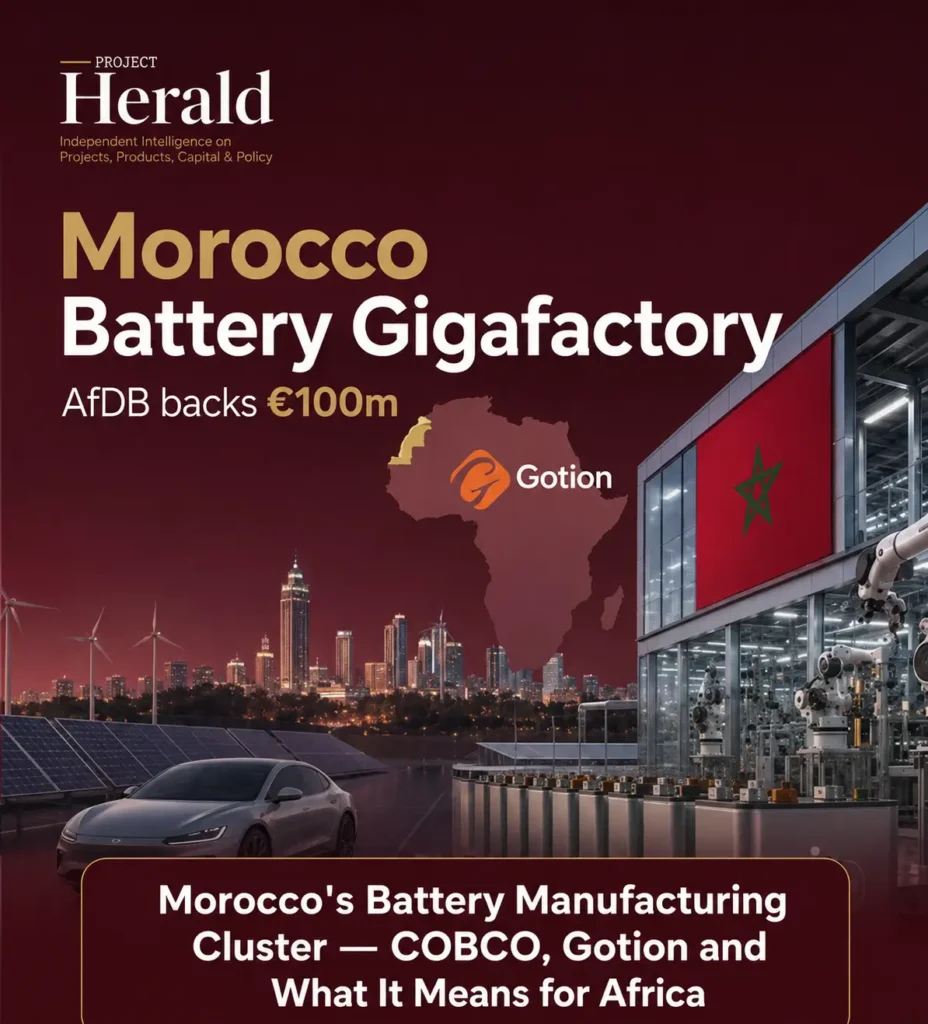
Africa has been a raw material supplier to the global battery industry for decades. Cobalt from the DRC, lithium from Zimbabwe and Zambia, manganese from South Africa — the continent has provided the inputs while the manufacturing value has been captured elsewhere. A cluster of developments now underway in Morocco represents a direct challenge to that arrangement, and the commercial implications extend well beyond Morocco itself.
What Is Already Operating
The first thing to understand is that this is not a future story. COBCO — a joint venture between Moroccan investment fund Al Mada and China’s CNGR Advanced Materials — inaugurated a cathode precursor plant at Jorf Lasfar in June 2025. The plant is operational, with initial capacity of 40,000 tonnes per year of nickel-manganese-cobalt (NMC) precursor material. It has already signed a supply agreement with Belgian materials group Umicore, one of Europe’s leading battery materials companies, which means it has a confirmed offtake partner for its output.
The expansion plan is equally significant: COBCO intends to scale to 120,000 tonnes per year of NMC precursor, add 60,000 tonnes per year of LFP cathode material, and build out critical-mineral refining and battery-recycling facilities on the same site. That combination — precursor production, cathode manufacturing, refining and recycling in one location — is what makes this more than a single plant. It is the beginning of an integrated materials cluster.
What Is Coming Next
The Gotion Power Morocco gigafactory near Kenitra sits one step further down the value chain. Where COBCO produces the materials that go into battery cells, Gotion will manufacture the cells themselves. The project involves a total investment of $6.5 billion across two phases. Phase one — a $1.3 billion investment delivering 20 GWh of battery cell production capacity — has ground preparation completed and construction commencing now, with production targeted for the third quarter of 2026. Phase two would expand capacity to 40 GWh, though no timeline has been confirmed for that stage.
Gotion’s customer base is European. The company has stated it has received orders from European car manufacturers and intends to export the majority of production to Europe. That export orientation matters commercially: it means Morocco is not just building manufacturing capacity for domestic or regional consumption. It is positioning itself as a supplier into one of the world’s most demanding industrial markets, with the regulatory and logistics proximity to Europe that other African manufacturing locations cannot easily replicate.
The African Development Bank has approved a EUR 100 million loan to the Gotion Morocco gigafactory, which provides both financing support and an important signal of multilateral confidence in the project’s viability.
The Policy Framework That Made This Possible
Neither project happened by accident. Morocco’s free trade zone and investment incentive framework was specifically designed to anchor an integrated EV battery cluster — combining tax incentives, free zone status, infrastructure provision and a deliberate effort to attract the full value chain rather than individual facilities. The Jorf Lasfar industrial zone where COBCO operates and the Kenitra automotive zone where Gotion is building are not coincidental locations. They are part of a structured industrial geography that Morocco has been building for over a decade, anchored initially by the Renault and Stellantis vehicle assembly plants that gave the country its first foothold in the European automotive supply chain.
The lesson that other African governments are now examining is not just “attract foreign investment.” It is “build the conditions for a cluster, then let the cluster attract itself.” Morocco’s vehicle production gave it credibility with European OEMs. That credibility made it a viable location for battery supply. Battery supply is now pulling in materials processing upstream. Each layer has made the next layer easier to attract.
What This Means in Practice
Three implications stand out for investors, developers and policymakers tracking the continent’s industrial trajectory.
First, the COBCO expansion and Gotion construction phase will generate substantial procurement demand over the next 18 to 24 months — in construction, equipment supply, logistics, utilities and technical services. Companies in those sectors with the capability to work at industrial scale in Morocco should be mapping their positioning now rather than after contracts are awarded.
Second, the cluster model is beginning to validate itself. When a cathode precursor plant, a battery gigafactory and a supporting policy framework exist in the same geography, the next logical entrants are the separator manufacturers, the recycling operators, the testing and certification facilities, and the specialised logistics providers. The cluster creates its own pull.
Third, for African governments watching Morocco’s progress, the template is becoming legible. The combination of free zone incentives, infrastructure provision, strategic location relative to export markets, and deliberate sequencing of the value chain is a replicable model — not for every country, but for those with the geographic and policy conditions to credibly compete for a defined piece of the global industrial supply chain.
Africa has supplied the materials for the battery revolution for years. Morocco is now the first country on the continent to systematically capture manufacturing value from those same materials. The cluster at Jorf Lasfar and Kenitra is the clearest evidence yet that the pattern can change.