- The Theft Economy
- Who Owns the Risk?
- Ogoniland: The Evidence in the Ground
- The Bill for Every Barrel Lost
- What Does Recovery Actually Cost?
Contents
The Niger Delta Pipeline Crisis
The Cost Beneath the Surface
The economic, environmental and human consequences of the Niger Delta pipeline crisis.
Editor's Note: The Price of Moving Oil
Why pipeline integrity is a commercial, environmental and public accountability issue.
The Network That Moves the Money
The infrastructure connecting oil production to export markets, corporate earnings and government revenue.
The Failure Points
Corrosion, equipment defects, operational failures and third-party interference.
The Theft Economy
Crude oil theft, illegal connections and the commercial consequences of pipeline sabotage.
When the Repair Becomes a Risk
Reported defects in locally manufactured repair clamps and the operational spills linked to them.
Who Owns the Risk?
The transfer of SPDC to Renaissance and the questions of ownership and accountability.
Ogoniland: The Evidence in the Ground
The UNEP findings on oil contamination, public health risks and environmental restoration.
The People Outside the Balance Sheet
The consequences of oil pollution for livelihoods, fishing, agriculture and community welfare.
The Dispute After the Spill
Incident investigations, competing accounts, attribution and the importance of credible spill data.
The Bill for Every Barrel Lost
Production disruption, lost revenue, repair costs and environmental liabilities.
What Does Recovery Actually Cost?
The financial and operational demands of remediation, restoration and long-term monitoring.
Can the System Be Made Reliable?
Preventive maintenance, quality control, surveillance and stronger operational oversight.
The Final Account
What the Niger Delta pipeline crisis reveals about infrastructure integrity and commercial accountability.
The Cost Beneath the Surface
The infrastructure that carries national wealth also carries national risk.
Nigeria's oil economy depends on an extensive network of infrastructure that is largely invisible to the people who depend on its performance. Pipelines move crude from producing fields towards processing facilities and export terminals. Flow stations gather production. Pumps, valves and other equipment regulate the movement of hydrocarbons through systems that must operate across difficult terrain and, in parts of the Niger Delta, environmentally sensitive waterways and wetlands.
When these systems work, the infrastructure can appear unremarkable. When they fail, the consequences can extend far beyond the point of rupture.
Oil may enter soil, creeks and groundwater. Production may be interrupted. Repairs and containment operations may follow. Communities may face disruption to fishing, farming and other livelihoods. Operators and regulators may be required to investigate the incident, determine its cause, assess the damage and establish what must happen next.
Yet a pipeline incident is rarely a complete story in itself.
The circumstances surrounding a failure matter. So does the age and condition of the asset, the quality of its maintenance, the security environment, the speed of the response and the reliability of the evidence used to assign responsibility.
In the Niger Delta, these questions exist alongside a long history of environmental contamination, contested spill attribution, crude theft, community grievances and difficult remediation efforts.
The result is a crisis that cannot be understood through environmental damage alone. It must also be examined as an infrastructure-management problem, a commercial risk and a test of institutional accountability.
For the oil industry, the stakes include asset reliability, production continuity, operating costs and the ability to maintain confidence among regulators, investors and host communities.
For the public, the stakes include environmental protection, livelihoods, government revenue and the question of whether those responsible for damage can be held to account.
This edition of The Failure File investigates the systems behind the crisis: how pipelines fail, how the industry responds, where the evidence points and what a credible path towards improvement would require.
The Failure File — The Project Herald
The Price of Moving Oil
Oil is often discussed in terms of barrels produced, export earnings, foreign exchange and government revenue. These measures are important, but they do not tell the entire story of the infrastructure that makes production and transportation possible.
Behind every barrel lies a chain of physical assets, technical decisions, maintenance obligations, security arrangements and commercial relationships. Each part must function within acceptable limits if the system is to remain reliable.
The Niger Delta presents a difficult test of that reliability.
For decades, oil pollution has affected parts of the region. Pipeline incidents have occurred under different circumstances, including operational failures and third-party interference. The effects have varied by location, volume, duration and the characteristics of the receiving environment.
The consequences have also been unevenly distributed. A production interruption may appear on an operator's balance sheet. Contamination may be experienced by a household that depends on a local water source, a fisher whose catch is affected or a farmer whose land requires assessment and remediation.
These costs are connected, but they are not interchangeable.
A company-reported spill volume is not a complete measure of environmental damage. An estimate of lost production does not measure the effect on a community. A cleanup contract does not, by itself, establish that an affected ecosystem has recovered.
Responsible analysis requires us to distinguish each of these questions.
The scientific assessment of Ogoniland by the United Nations Environment Programme in 2011 documented extensive contamination and recommended a comprehensive restoration programme. It remains an important reference for understanding the scale and complexity of environmental remediation in the Niger Delta. It does not, however, establish the cause of every subsequent spill across the region.
Similarly, industry disclosures can provide valuable incident data and technical explanations, but they must be read with attention to their stated scope and methodology.
This edition approaches the crisis through that discipline. We examine infrastructure integrity, operational responsibility, crude theft, corporate ownership, environmental evidence and the economics of recovery. Where a cause is disputed, it should remain disputed until the evidence supports a conclusion.
The purpose is not to assign blame in advance. It is to examine the decisions, systems and obligations that determine whether a failure is prevented, investigated and properly addressed.
Because the real measure of an oil-producing economy is not only what it extracts.
It is also how responsibly it manages the infrastructure, environmental risks and human consequences that extraction creates.
Editorial Desk
The Project Herald
The Network That Moves the Money
Inside the infrastructure behind Nigeria's oil economy
The Niger Delta's oil infrastructure is not a single pipeline or a single operating company. It is a network of producing assets, gathering lines, flow stations, larger transportation pipelines, terminals, contractors and supporting services.
The exact configuration differs from one production area to another. Some assets connect wells to nearby processing facilities. Others move crude over longer distances towards export infrastructure. Each stage introduces its own operating requirements and potential failure points.
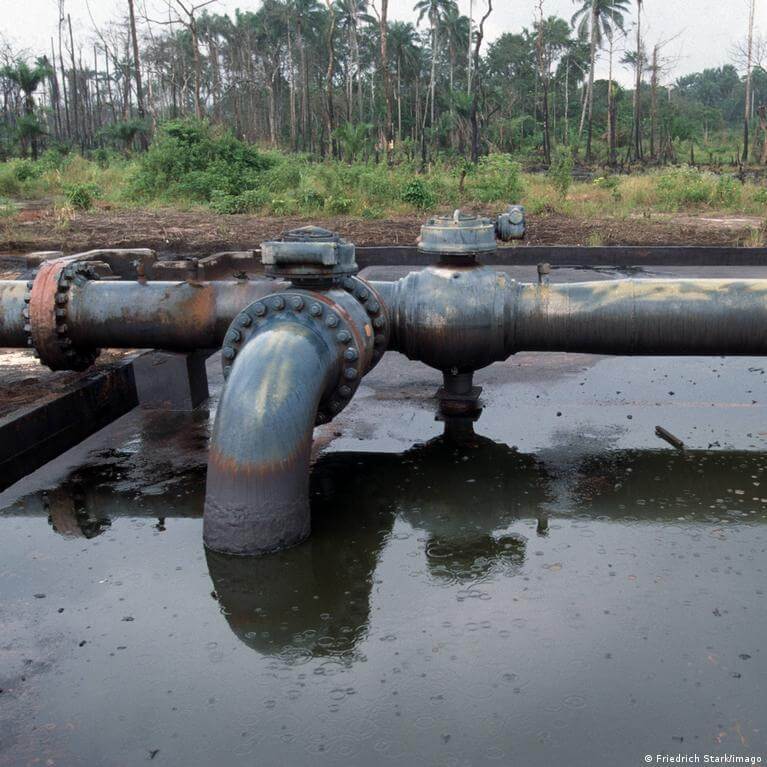
Oil pipeline infrastructure in the Niger Delta.
The distinction matters because the phrase pipeline failure can describe incidents with very different technical and commercial characteristics.
A leak from a gathering line may affect a relatively local area. A major release from a transportation pipeline can create a different containment and response challenge. A problem at a terminal or loading facility may interrupt operations even where the pipeline itself remains intact.
Understanding the infrastructure is therefore the first step towards understanding the crisis.
The chain behind a barrel
At the production end, crude is collected from wells and routed through flow lines and gathering systems. Depending on the facility, water and other unwanted materials may need to be separated before the oil proceeds through the transportation network.
Pipelines then move the crude towards receiving facilities and, ultimately, export or processing infrastructure. Valves, pumps, instrumentation and other equipment support the safe and controlled movement of hydrocarbons.
The network must be inspected, maintained and operated according to its design and operating conditions. Operators need to understand corrosion risks, pressure conditions, asset age, mechanical integrity and the consequences of a loss of containment.
In the Niger Delta, maintaining access to infrastructure can also be difficult. Wetlands, waterways, remote communities and security constraints can complicate inspections and repairs.
These conditions do not make failure inevitable. They make sound engineering, risk assessment and operational planning more important.
The commercial chain
Pipeline reliability affects more than engineering departments.
A transportation interruption can constrain production or delay the movement of crude. Repairs require people, equipment and materials. Depending on the circumstances, an incident may also trigger environmental assessments, regulatory engagement, compensation claims, litigation or additional security expenditure.
The financial consequences vary significantly between incidents. They should not be reduced to one headline estimate without a clear methodology.
The broader principle, however, is straightforward: infrastructure integrity is part of the economics of oil production.
An asset that cannot reliably perform its intended function carries operational and financial risk. An asset that fails and releases hydrocarbons may create an additional environmental and legal burden.
What the data can—and cannot—tell us
The Nigerian Oil Spill Monitor, maintained by the National Oil Spill Detection and Response Agency (NOSDRA), provides records associated with Joint Investigation Visits conducted after oil spills.
NOSDRA explains that its database relies on these records and information supplied by oil companies. It also acknowledges that records can be incomplete, including missing geographical information, and warns users to interpret differences in reported spill counts carefully.
Consequently, the number of recorded incidents should not automatically be treated as a definitive ranking of operator performance.
The quality of the underlying data is itself part of the infrastructure challenge.
Commercial implication: Pipeline integrity must be managed as a measurable business responsibility. Asset condition, inspection coverage, incident frequency, repair quality and response performance all matter—but only if the information used to assess them is sufficiently reliable.
Source notes: NOSDRA, Nigerian Oil Spill Monitor, “About the Data”; Shell Annual Report and Form 20-F 2024.
The Failure Points
How a pipeline loses integrity
A pipeline does not fail for one universal reason. Its failure may involve material degradation, defective components, external damage, operating conditions or deliberate interference. In some cases, more than one factor may be involved.
Determining the cause requires technical evidence, not assumptions based on the appearance of the damage or the location of the incident.
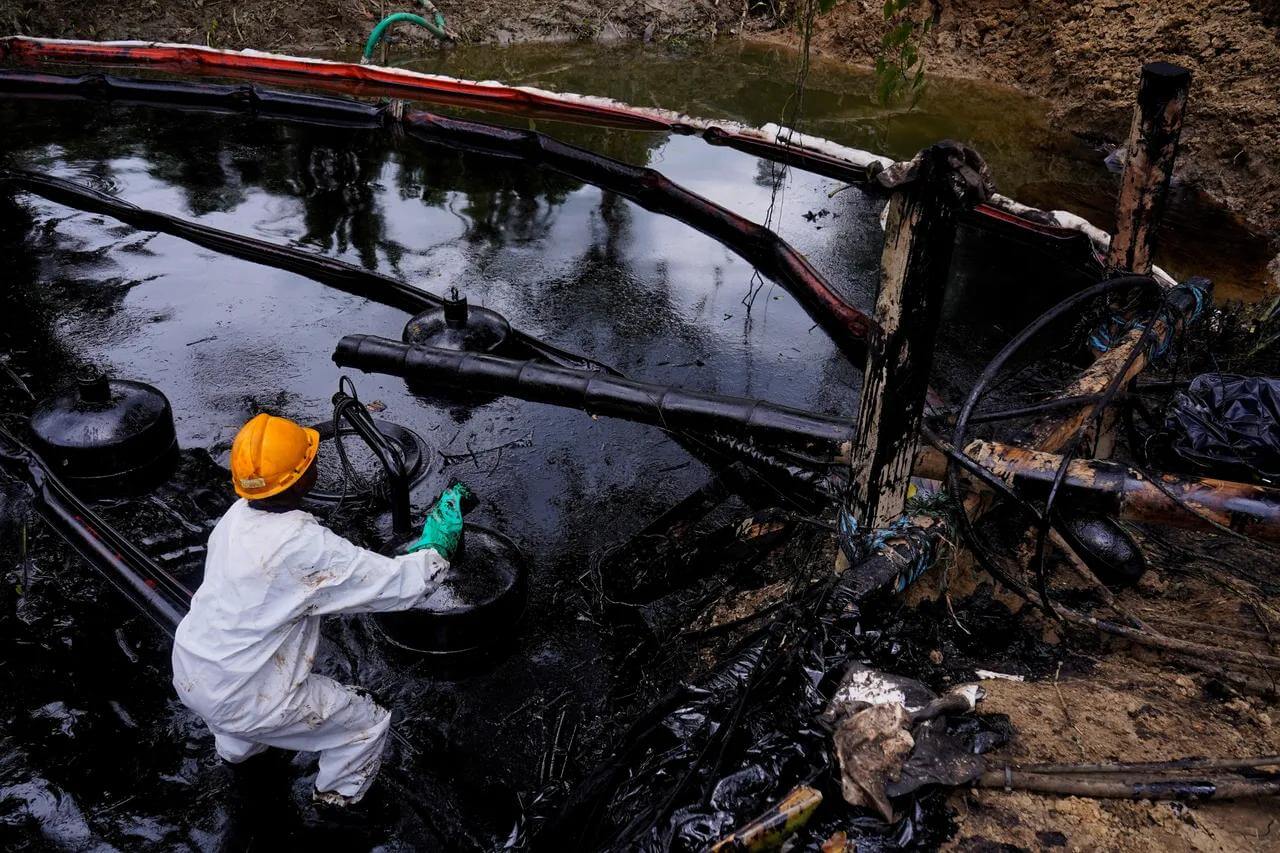
Response work at a pipeline rupture in B-Dere, Gokana, in May 2025. The photograph does not establish the cause of the incident.
1. Corrosion and material degradation
Pipelines are exposed to conditions that can gradually degrade their materials. Corrosion management, inspection, protective systems and appropriate maintenance are therefore essential parts of asset integrity.
The risk depends on the material, operating environment, design, protective measures and condition of the asset. Corrosion should not be presumed to be the cause of a specific spill without supporting evidence.
2. Defective components
A pipeline system is only as reliable as its components and their installation. Clamps, joints, valves and other fittings must be suitable for their intended application and installed correctly.
A component defect may not become apparent until the equipment is exposed to actual operating conditions. Quality assurance must therefore extend beyond procurement to testing, traceability, installation and subsequent monitoring.
3. Mechanical damage
Excavation, impact and other external forces can damage pipeline infrastructure. In areas where pipelines pass through populated or commercially active environments, preventing accidental interference requires clear controls and effective coordination.
4. Operating and maintenance failures
Poor maintenance planning, inadequate inspection, unsuitable repairs or failures to act on known warning signs can undermine asset integrity.
An investigation must establish what was known before an incident, what action was taken and whether the relevant procedures were followed.
5. Third-party interference
Illegal tapping, theft and deliberate damage can compromise a pipeline's integrity and create a pathway for hydrocarbons to escape.
Such incidents must be investigated on their individual evidence. The existence of crude theft in the region does not establish that theft caused every spill.
The importance of independent diagnosis
A sound incident investigation establishes the location and extent of the release, identifies the damaged component, examines the physical evidence and reviews operating and maintenance records. It should also document the methods used to determine the cause.
Where possible, evidence should be preserved and technical conclusions subjected to appropriate scrutiny.
The distinction between an incident's immediate cause and its underlying causes is equally important.
A failed component may be the immediate cause. The deeper questions may concern its specification, manufacturing quality, inspection regime, installation, operating conditions or the decisions made after earlier warning signs.
Those questions determine whether the investigation produces a lasting lesson or merely identifies the point where the oil escaped.
Editorial note: The cause of each incident discussed in this edition must be supported by the relevant investigation, technical findings or disclosed evidence.
The Theft Economy
Illegal connections, crude theft and the security of oil infrastructure
Crude theft creates a complex challenge for Nigeria's petroleum industry. It can deprive legitimate operators and the state of revenue, disrupt production and compromise infrastructure. Where illegal connections or other interventions damage pipelines, the resulting release may also threaten nearby land and waterways.
But the theft economy cannot be understood through the physical act of tapping a pipeline alone.
It involves access to infrastructure, the movement of stolen crude, informal or illicit processing and distribution networks, and the ability of enforcement agencies to disrupt the chain.
The scale and organisation of these activities can vary by location and period. A responsible investigation must establish what the available evidence supports rather than treat every allegation as a proven description of an entire community or industry.
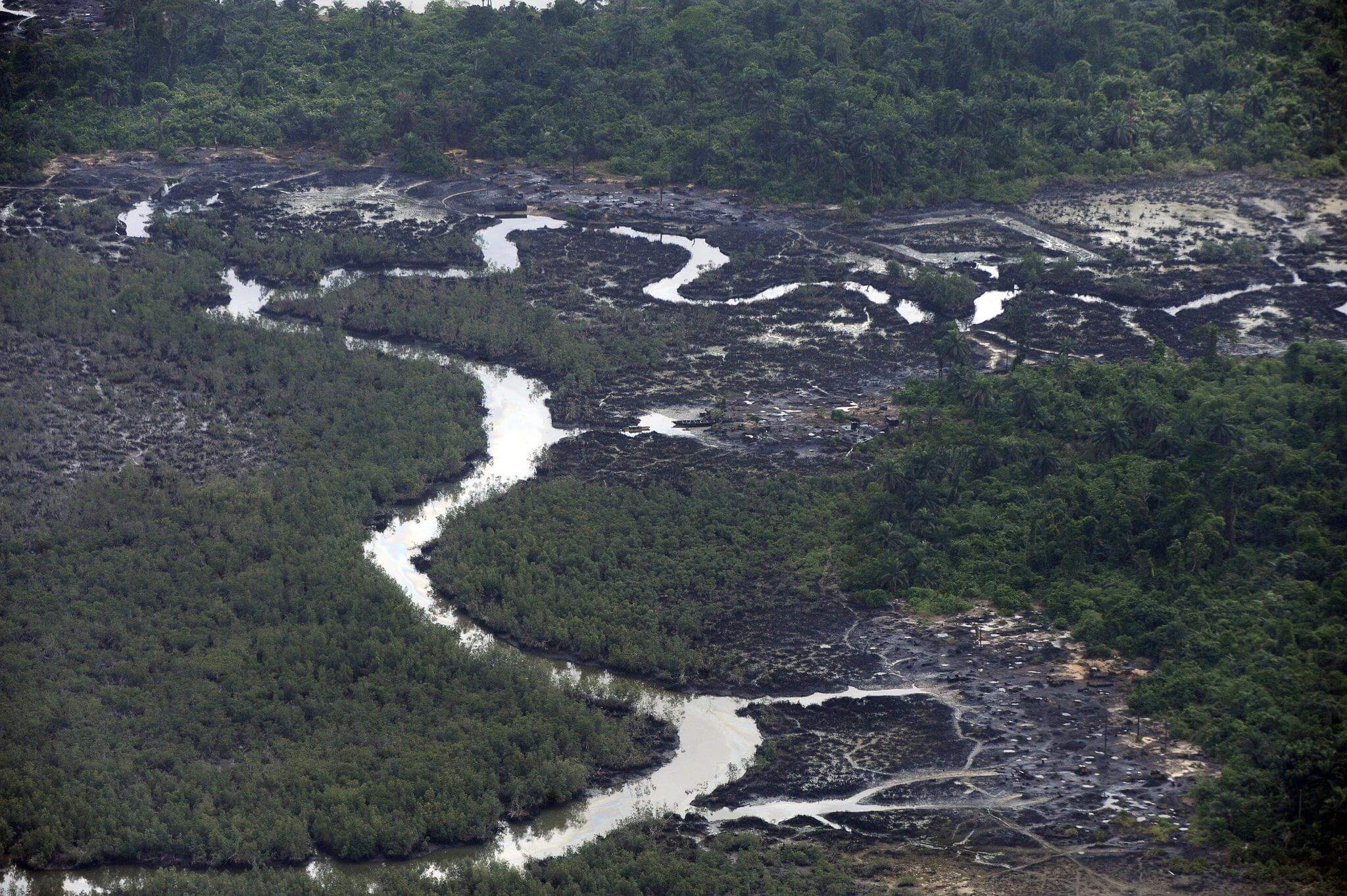
Aerial view of a documented oil-spill site in the Niger Delta. The photograph illustrates the consequences of pipeline damage; it does not establish the cause of this spill.
Security is not the same as integrity management
Pipeline security seeks to deter, detect and respond to unauthorised access or interference. Integrity management seeks to ensure that the asset remains fit for service.
The two functions overlap, but neither replaces the other.
A pipeline can require maintenance even where there is no evidence of theft. Conversely, a well-maintained pipeline can remain vulnerable to deliberate interference if its security arrangements are inadequate.
Effective risk management must address both.
The evidence problem
Shell's 2024 reporting provides a useful example of why incident categories matter. For the SPDC-operated joint venture, Shell reported 84 spills above 100 kilograms associated with crude theft and sabotage during 2024, representing approximately 2,000 tonnes of spilled oil. It reported 139 such incidents and approximately 1,400 tonnes in 2023.
Shell attributed about 81 per cent of spill incidents above that threshold from SPDC joint-venture facilities in 2024 to third-party illegal activities.
These figures are company-reported data for a defined set of operations. They should not be presented as the total number or volume of spills across the Niger Delta.
The difference between the number of incidents and the volume released is also significant. A year with fewer incidents can still record a higher total volume if a small number of events are especially large.
What effective prevention requires
A serious response requires coordinated security operations, reliable reporting, timely repair, investigation of criminal networks and protection of affected communities.
It also requires better information about the performance of preventive measures. Authorities and operators should be able to explain whether incidents are becoming less frequent, whether damage is being detected sooner and whether repairs are reducing repeat failures.
Security expenditure should be evaluated against outcomes, not merely the amount spent or the number of patrols conducted.
Commercial implication: Crude theft is not only a revenue problem. Where it compromises infrastructure, it can become a combined security, operational, environmental and reputational risk.
Source: Shell Annual Report and Accounts and Form 20-F 2024, section on spills in Nigeria.
When the Repair Becomes a Risk
A documented case of component failure
In infrastructure management, a repair is intended to restore integrity. Yet a repair can introduce a new risk if the materials, components or installation methods are unsuitable.
Shell's 2024 reporting on its former Nigerian onshore subsidiary provides a specific case for examining this problem.
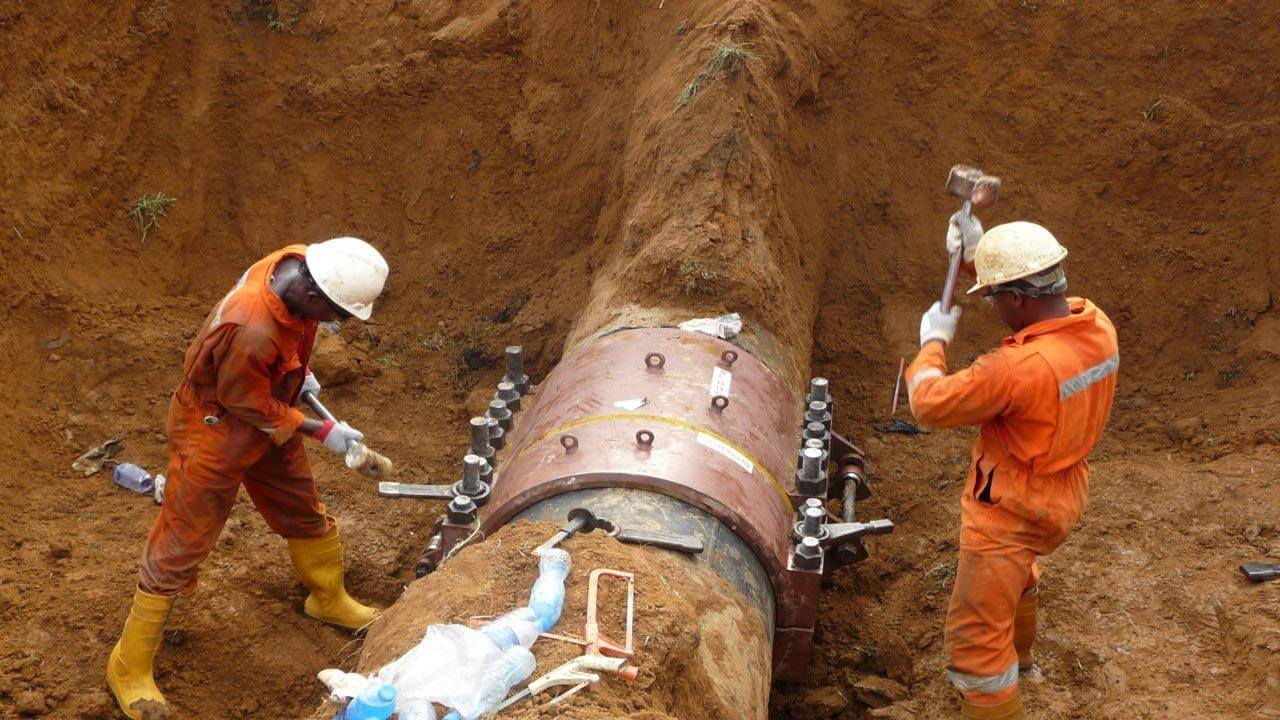
Illustrative image: technicians working on a pipeline repair clamp. The photograph is not evidence of the defective clamps described in this article.
According to the company's annual report, SPDC, acting as operator of the SPDC joint venture, reported 20 operational spill incidents above 100 kilograms in 2024, compared with nine in 2023.
Shell attributed much of the increase in the number of operational incidents to factory defects in a locally manufactured clamp used in pipeline repairs following the removal of illegal connections. The company reported that the manufacturer recalled the affected batch and that SPDC had begun replacing the clamps.
Shell also reported approximately 370 tonnes of operational spill volume for the SPDC joint venture in 2024, compared with approximately five tonnes in 2023. It stated that two significant incidents—one onshore on the Trans Niger Pipeline and another offshore at a terminal loading buoy—accounted for 89 per cent of the 2024 operational spill volume.
These disclosures identify an important distinction: operational spills and spills associated with theft or sabotage are separate reporting categories.
They should not be combined without explanation.
What the case reveals
The clamp example illustrates how a problem arising during repair work can become an operational integrity issue.
Removing an illegal connection may be necessary to restore a pipeline to its intended condition. But the subsequent repair must also be reliable. A defective component can undermine the work intended to eliminate the original hazard.
This raises questions relevant to any infrastructure operator:
- Were components manufactured to the required specification?
- Were suppliers and production batches traceable?
- Were inspection and testing procedures adequate?
- How quickly could an affected batch be identified?
- Were similar components installed elsewhere?
- What controls were used to prevent recurrence?
These are questions for quality assurance, engineering and procurement—not merely for the maintenance team.
The procurement lesson
A purchase order is not proof of technical suitability. Nor is a supplier's commercial reputation a substitute for documented quality control.
Critical components require clear specifications, appropriate certification and testing, traceability and defined acceptance criteria. Where a defect is discovered, the operator needs a process for identifying affected installations and replacing or correcting them.
The available disclosure does not establish every technical detail of the clamp failures or the complete chain of responsibility. Those questions should not be filled with speculation.
What it does establish is that component quality can have material consequences for operational performance.
Source: Shell Annual Report and Accounts and Form 20-F 2024, Nigeria operational spills.
Who Owns the Risk?
Corporate ownership, operational control and environmental responsibility
Oil infrastructure is often operated through complex corporate arrangements. A single asset or production system may involve a designated operator, joint-venture partners, government participation, specialist contractors and multiple regulatory obligations.
Understanding those relationships is essential when assessing who made a decision, who controlled an operation and who is responsible for responding when something goes wrong.
The Niger Delta's changing ownership landscape makes this especially relevant.
A significant corporate transition
On 13 March 2025, Shell announced the completion of its sale of The Shell Petroleum Development Company of Nigeria Limited (SPDC) to Renaissance.
Following the transaction, the company was renamed Renaissance Africa Energy Company. It continued to operate the joint venture in which the participating interests were reported as:
Participating Interests as Reported
■ Renaissance: 30 per cent
■ Nigerian National Petroleum Company Limited: 55 per cent
■ TotalEnergies: 10 per cent
■ Agip Energy and Natural Resources (Nigeria): 5 per cent
The transaction marked a major change in ownership of Shell's former onshore operating business in the Niger Delta.
It did not mean that the underlying infrastructure ceased to exist, nor did it automatically resolve historical environmental questions.
The difference between ownership and responsibility
Four questions must be distinguished when examining a corporate transition.
Who owns the operating company? This identifies the shareholders and their interests.
Who operates the asset? The operator manages day-to-day activities under the applicable arrangements and obligations.
Who is responsible for a particular incident? That depends on the circumstances, evidence, relevant law and the applicable contractual and operational responsibilities.
Who must address historical liabilities? This requires examination of the transaction documents, regulatory approvals, legal obligations and any applicable decisions or agreements.
These questions may be related, but they are not interchangeable.
A change of ownership should therefore prompt careful examination of how environmental obligations, operational capabilities and remediation commitments are managed. It should not be treated as proof that a particular party has either escaped responsibility or accepted every historical claim.
The accountability test
Investors, regulators, host communities and other stakeholders need clarity about the management of existing assets, maintenance programmes, spill response, remediation and unresolved disputes.
Transparency matters because an operating company cannot demonstrate improved performance through corporate announcements alone. It must provide credible evidence of what has changed in practice.
The relevant measures include incident frequency and severity, maintenance execution, response times, compliance with applicable requirements and independently verifiable remediation progress.
Commercial implication: Corporate restructuring changes the ownership map. It does not eliminate the need to establish responsibility for each asset, incident and obligation.
Sources: Shell, “Completion of sale of SPDC to Renaissance,” 13 March 2025; Shell Annual Report and Form 20-F 2024.
Ogoniland: The Evidence in the Ground
What the science established—and why restoration is a long-term undertaking
The environmental history of the Niger Delta cannot be understood without examining Ogoniland.
In 2011, the United Nations Environment Programme published an extensive environmental assessment of Ogoniland. Commissioned by Nigeria's Federal Government, the assessment examined contamination affecting land, water, ecosystems and communities after decades of oil operations.
The study was significant not simply because it documented pollution, but because it established a scientific baseline for understanding the extent of contamination and the work required to address it.
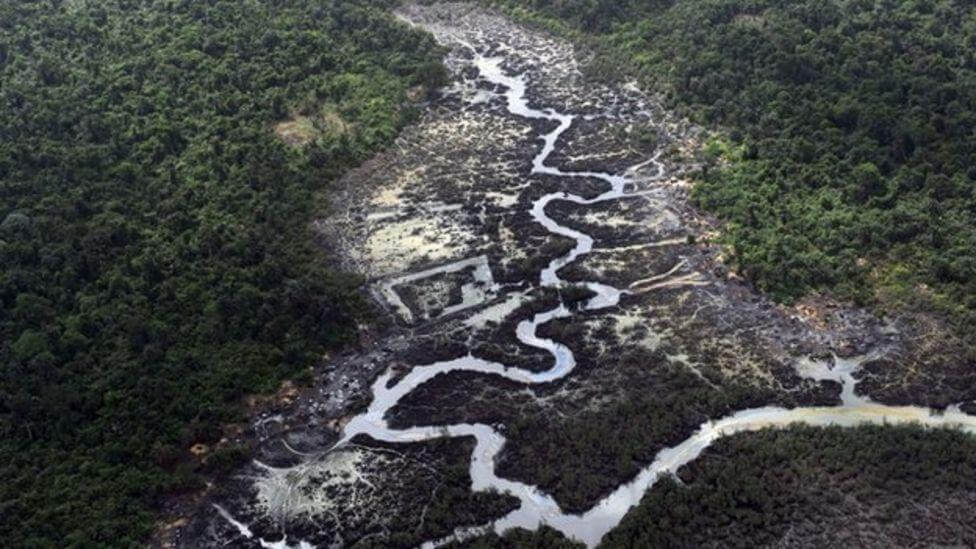
Aerial view of oil-polluted creeks and mangrove vegetation in the Niger Delta.
UNEP's investigation examined more than 200 locations, surveyed approximately 122 kilometres of pipeline rights of way, reviewed more than 5,000 medical records and engaged with communities across the assessment area. Its researchers analysed thousands of samples from soil and water.
The findings indicated that contamination had, at a number of locations, penetrated further and deeper than previously understood. The report identified serious concerns about drinking-water quality, soil contamination and the condition of ecosystems, including mangroves.
Contamination is not always visible
An oil sheen on the surface of water is visible evidence of a release. But the absence of a visible sheen does not establish that soil or groundwater is uncontaminated.
Hydrocarbons may persist below the surface. Their behaviour depends on the composition of the oil, the characteristics of the soil, groundwater conditions and other environmental factors.
Consequently, meaningful assessment requires sampling, laboratory analysis and interpretation by appropriately qualified specialists.
The same principle applies to remediation. Removing visible oil may be an important step, but it does not automatically establish that contaminated soil, groundwater or ecological systems have recovered.
The difference between cleanup and restoration
UNEP's recommendations envisaged a substantial, long-term restoration effort. The work requires prioritisation based on risk, appropriate remediation methods, monitoring and institutional capacity.
The environmental problem is therefore also a governance problem.
Who sets the standards? Who commissions the work? Who verifies that the work meets those standards? Who monitors the site afterwards? What evidence is made available to affected communities?
Without clear answers, it becomes difficult to determine whether a project has delivered lasting environmental improvement.
What this report does not establish
The UNEP assessment is a foundational study of Ogoniland. It is not a universal diagnosis of every community or pipeline incident in the Niger Delta.
Different locations require their own assessments, and the cause of a specific spill must be established from the evidence relating to that event.
That distinction strengthens the case for science-led decision-making rather than weakening it.
Source: United Nations Environment Programme, Environmental Assessment of Ogoniland, 2011.
The People Outside the Balance Sheet
The local consequences of infrastructure failure
For an oil operator, a pipeline incident may begin as an operational event. For people living nearby, the consequences can enter the routines of daily life.
A release can contaminate land or water, disrupt access to fishing grounds and agricultural areas, or create uncertainty about whether local resources remain safe to use. The extent of the damage depends on the nature of the release, the location, the environmental conditions and the effectiveness of the response.
These effects cannot be adequately understood through aggregate spill volumes alone.
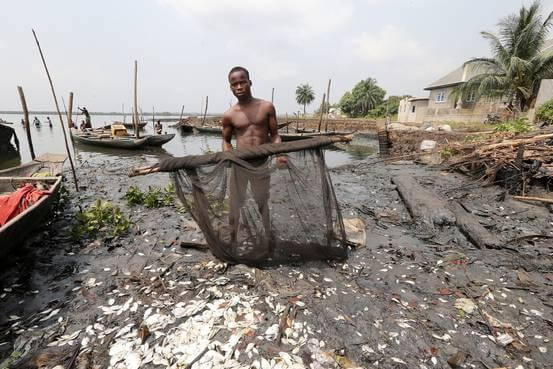
A fisherman stands in polluted water with an oil-stained net in the Niger Delta.
Livelihoods and local economies
In communities where fishing and farming are important sources of income and food, environmental contamination can threaten both immediate earnings and longer-term productivity.
Where a water source is affected, households may need alternative supplies. Where land is contaminated, its use may be restricted pending assessment or remediation. Local businesses can also experience disruption when access, trade or community activities are affected.
The actual consequences must be established through evidence. Not every spill produces the same effects, and the scale of an impact should not be assumed without investigation.
Health and environmental evidence
Claims about health consequences require particular care.
UNEP's Ogoniland assessment documented serious concerns about contaminated drinking water and other environmental exposures. Those findings support the need for appropriate testing, public-health safeguards and long-term monitoring.
However, attributing an individual illness to a particular spill requires evidence specific to the exposure and the medical circumstances. Environmental contamination and individual clinical causation are related questions, but they are not the same question.
Responsible reporting must preserve that distinction.
The importance of community evidence
Residents often possess valuable information about the timing and location of incidents, changes in local conditions and the practical consequences of contamination.
Their testimony should be documented carefully and attributed accurately. It should be considered alongside sampling results, investigation records, operational data and other relevant evidence.
Communities should not be treated merely as background subjects in photographs. They are stakeholders whose experience can help explain what official records may not capture.
What accountability should look like
A credible response should include timely communication, access to relevant findings, appropriate environmental and health assessments, effective remediation and a clear process for addressing legitimate claims.
It should also recognise that compensation, where applicable, is not the same as environmental restoration.
A payment may address a particular loss or legal obligation. It does not automatically restore contaminated soil, rebuild an ecosystem or establish that water is safe.
Source: UNEP, Environmental Assessment of Ogoniland, 2011. Additional community-specific claims require independent reporting and corroboration.
The Dispute After the Spill
Evidence, attribution and the search for accountability
After a spill, the first priority is to protect people and the environment and to contain the release. But an equally important process follows: determining what happened.
That process can be difficult when the incident occurs in a remote area, when the physical evidence changes quickly or when the parties involved disagree about the cause.
The distinction matters because attribution can influence liability, compensation, remediation obligations and the measures required to prevent recurrence.
The Joint Investigation Visit
In Nigeria, Joint Investigation Visits are an established part of the process for examining reported oil spills. They can involve relevant company representatives, regulatory personnel and other stakeholders, depending on the incident and applicable procedures.
The investigation may consider the point of release, the apparent source, the volume and extent of the spill, the surrounding environment and the likely cause.
These findings can be important, but the quality of the conclusion depends on the evidence collected and the methods used to interpret it.
A disputed incident may require further technical analysis, additional records or legal determination.
Why the data requires care
NOSDRA's Oil Spill Monitor is a valuable public resource, but the agency's own explanation identifies limitations in the underlying records.
The database draws on Joint Investigation Visit records and information supplied by oil companies. NOSDRA notes that some records may be incomplete, including missing geographical data. It also cautions that a low number of recorded spills does not necessarily demonstrate superior environmental performance.
These qualifications are important.
A comparison of companies, locations or years must account for the reporting threshold, the period covered, the assets included and the completeness of the available information.
An increase in recorded incidents may reflect an actual change in performance, a change in reporting or a combination of factors. The available evidence must be examined before a conclusion is reached.
When accounts differ
Companies, communities and regulators may disagree about a spill's cause, volume or consequences.
The correct response is not to assume that one party is automatically right. It is to examine the available evidence, disclose what is known and identify what remains unresolved.
Where an official investigation has reached a conclusion, the magazine should report that conclusion accurately and explain its scope. Where a finding is contested, that status should be made clear. Allegations should not be presented as established facts.
The standard that matters
Reliable accountability requires timely incident reporting, transparent methodology, access to relevant evidence, technically sound investigation and an appropriate mechanism for resolving disputes.
Without those elements, even a large database can leave fundamental questions unanswered.
Source: NOSDRA, Nigerian Oil Spill Monitor, “About the Data.”
The Bill for Every Barrel Lost
The economics of pipeline failure
The financial consequences of a pipeline incident rarely fit into a single number.
An operator may face repair costs, containment expenditure, production disruption, additional security requirements and the cost of investigating the event. Depending on the circumstances, there may also be environmental remediation obligations, compensation claims, litigation and regulatory consequences.
The government may face reduced revenue where production or transportation is disrupted. Communities may experience losses that are not reflected in the operator's reported costs.
These categories overlap, but they should not be treated as identical.
Production loss is not the same as spill volume
A spill volume measures the quantity of oil released under a defined reporting methodology. It does not automatically measure the amount of production lost.
Some oil may be recovered. A pipeline may be shut down before a release occurs. A security incident may interrupt production without producing a major spill. Conversely, an incident may cause significant environmental damage even if its effect on total production is limited.
Any estimate of financial loss must explain which of these factors it includes.
What company disclosures show
Shell's 2024 reporting provides a useful illustration of the difference between incident frequency and incident severity.
For the SPDC-operated joint venture, Shell reported 20 operational spills above 100 kilograms in 2024, compared with nine in 2023. The reported operational spill volume rose from approximately five tonnes to approximately 370 tonnes.
Shell stated that two significant incidents accounted for 89 per cent of the 2024 operational spill volume.
Reported Operational Spills: SPDC Joint Venture
| 2023 | 2024 | |
| Operational spills above 100 kg | 9 | 20 |
| Operational spill volume (approx.) | 5 tonnes | 370 tonnes |
| Share of 2024 volume from two incidents | — | 89 per cent |
Company-reported figures for a defined reporting category.
These figures demonstrate why a simple count of incidents may not be sufficient to assess performance. A small number of large releases can dominate the annual volume.
They also show why the scope of a statistic matters. The figures relate to a specific joint venture and a defined reporting category. They are not a comprehensive estimate of the Niger Delta's total economic or environmental losses.
The costs that are difficult to calculate
Environmental damage can extend beyond immediate containment and repair.
A contaminated site may require sampling, remediation and long-term monitoring. Determining the appropriate intervention may involve laboratory work, engineering design and repeated assessment.
There may also be disputes about the extent of contamination, the baseline condition of the environment and the measures needed to restore it.
These costs cannot be responsibly estimated without defined assumptions and site-specific evidence.
Why investors should care
Infrastructure integrity is a commercial issue because the condition of an asset influences its reliability, operating requirements and exposure to disruption.
A credible risk assessment should consider incident frequency, incident severity, maintenance performance, response capability, environmental obligations and the quality of the data used to assess those factors.
It should not reduce risk to a single financial ratio or assume that a low reported spill count means an asset is safe.
Source: Shell Annual Report and Accounts and Form 20-F 2024. No region-wide financial total is asserted in this article.
What Does Recovery Actually Cost?
Remediation, restoration and the problem of proving progress
Environmental recovery is not a single operation. It is a sequence of assessments, interventions and verification activities that must be appropriate to the type and extent of contamination.
The work may involve removing recoverable oil, excavating or treating contaminated soil, addressing groundwater pollution, restoring affected ecosystems and monitoring the site over time.
The appropriate approach depends on the evidence. Different contaminants, soils and environmental conditions require different responses.
Oil-polluted creeks and mangrove vegetation in the Niger Delta.
From assessment to intervention
A credible remediation programme begins with a clear understanding of the site.
Sampling and laboratory analysis help establish where contamination is present, what substances are involved and how they may affect people and ecosystems. The findings inform the design of the intervention.
The work should then be assessed against relevant standards and objectives. Where contamination remains, additional measures may be necessary.
This process requires technical competence and reliable quality control. Poorly specified work, unsuitable methods or inadequate verification can undermine the intended result.
Why completion is not the same as recovery
A contractor may complete the work specified in a contract. That does not necessarily establish that the environment has returned to an acceptable condition.
The distinction depends on the contract's scope, the applicable standards, the quality of implementation and the evidence available after the work.
A completed work order is an administrative milestone. Environmental recovery is an outcome that must be demonstrated.
The importance of independent verification
Effective oversight requires clear baseline data, transparent methods, documented results and appropriate follow-up monitoring.
Independent verification can help determine whether the work meets its stated objectives. It can also reveal where additional action is required.
The process should make it possible to distinguish between work completed, standards met and longer-term outcomes achieved.
The governance question
UNEP's Ogoniland assessment demonstrated the scale and complexity of the restoration challenge. Its recommendations emphasised a structured programme, institutional capacity and long-term monitoring.
The broader lesson is that environmental remediation is not simply a matter of funding individual projects. It requires a functioning system for setting priorities, procuring competent services, supervising implementation and verifying results.
Funding is necessary. It is not sufficient.
Source: UNEP, Environmental Assessment of Ogoniland, 2011.
Can the System Be Made Reliable?
From recurring risk to measurable improvement
The Niger Delta pipeline crisis is complex, but complexity should not become an excuse for accepting preventable failures.
The response must address the condition of the infrastructure, the quality of operational controls, the security environment, the reliability of incident reporting and the effectiveness of environmental remediation.
No single intervention can resolve every part of the problem. Progress depends on a coordinated set of measures that can be evaluated over time.
1. Make asset integrity measurable
Operators should maintain risk-based inspection and maintenance programmes appropriate to the assets they manage.
Critical information includes asset condition, known defects, inspection coverage, maintenance backlogs, repair quality and the status of vulnerable pipeline sections.
The objective is to identify and manage risk before a loss of containment occurs.
2. Strengthen procurement and quality assurance
Critical components should meet defined technical specifications and be subject to appropriate inspection and testing.
Suppliers should be traceable, installation requirements should be clear and defects should trigger a documented process for identifying affected assets.
The repair-clamp case described in Shell's 2024 reporting demonstrates why procurement quality and operational integrity cannot be treated as separate concerns.
3. Improve incident reporting
Spill data should be timely, sufficiently complete and clear about methodology.
Incident reports should distinguish operational failures from third-party interference where the evidence permits. They should also explain the confidence and limitations associated with a finding.
Better data supports more reliable comparisons, more effective policy and stronger public accountability.
4. Evaluate security by outcomes
Security arrangements should be assessed by their ability to prevent unauthorised interference, detect incidents promptly and reduce repeat occurrences.
Spending levels and patrol numbers are inputs. The reduction of risk is the outcome that matters.
5. Verify remediation
Cleanup and restoration programmes should have clear objectives, documented baseline conditions, appropriate standards and transparent verification.
The public should be able to distinguish between work that has been commissioned, work that has been completed and outcomes that have been independently demonstrated.
6. Make accountability clear
Operators, regulators, contractors and public institutions should have defined responsibilities under the applicable legal and operational arrangements.
Where a failure occurs, the investigation should identify what happened, why it happened, which controls failed and what action is required to prevent recurrence.
The Performance Dashboard
A serious improvement programme should monitor indicators such as:
- Spill frequency and total volume, with clear definitions.
- The severity and recurrence of incidents.
- Time taken to detect, contain and report releases.
- Completion of high-priority integrity repairs.
- Compliance with component quality requirements.
- Progress against remediation milestones.
- Independent verification of environmental outcomes.
The indicators must be interpreted together. No single measure can capture the full performance of a complex system.
The Final Account
The cost of leaving risk unmanaged
The Niger Delta pipeline crisis sits at the intersection of engineering, economics, environmental protection and public accountability.
The region's petroleum infrastructure is commercially important, but its value cannot be separated from the responsibilities that accompany its operation.
Pipelines must remain fit for service. Repairs must be reliable. Security risks must be managed. Incidents must be investigated using credible evidence. Environmental damage must be assessed and addressed. Where responsibility is disputed, the relevant facts and legal questions must be examined rather than assumed.
These requirements are not competing priorities. They are connected parts of responsible infrastructure management.
The evidence also makes clear why generalisations are inadequate.
A pipeline may fail because of a defective component, operational problems, corrosion, external damage or deliberate interference. Different causes require different preventive measures. Different sites require different remediation approaches. Different claims require different evidence.
A serious response must recognise these distinctions without losing sight of the wider pattern of risk.
The commercial consequences are substantial. Unreliable infrastructure can disrupt production, increase maintenance requirements and expose operators to additional costs. Poor-quality data makes it harder for investors, regulators and the public to assess performance. Unresolved environmental damage can prolong disputes and undermine confidence in institutions.
For communities, the consequences are more immediate. The condition of land and water can affect livelihoods, daily life and confidence in the safety of local resources.
The test of progress must therefore extend beyond production targets, financial results or the announcement of new projects.
It must include evidence that infrastructure is becoming more reliable, that incidents are being investigated properly, that remediation is delivering its intended outcomes and that responsibilities are being fulfilled.
The Niger Delta does not need another promise that the problem will be addressed. It needs credible evidence of what has changed.
That evidence should be visible in the condition of the infrastructure, the quality of incident reporting, the effectiveness of prevention and the recovery of affected environments.
Because the cost of a pipeline failure is not confined to the moment the oil escapes.
It continues wherever the damage remains unresolved, wherever the evidence is insufficient and wherever the systems intended to prevent a recurrence have not yet demonstrated that they work.
The Failure File — Issue 002
The Project Herald
Source Notes and Editorial References
1. United Nations Environment Programme (UNEP)
Environmental Assessment of Ogoniland (2011). The principal scientific reference for the assessment of oil contamination in Ogoniland, including its methods, findings and restoration recommendations.
https://wedocs.unep.org/handle/20.500.11822/7947
2. National Oil Spill Detection and Response Agency (NOSDRA)
Nigerian Oil Spill Monitor — About the Data. Explains the use of Joint Investigation Visit records, data limitations and the need for caution when interpreting reported spill counts.
https://www.nosdra.oilspillmonitor.ng/data.html
3. Shell plc
Annual Report and Accounts and Form 20-F 2024. Provides Shell's reported figures for operational spills and spills associated with crude theft and sabotage at SPDC joint-venture facilities, as well as the company's explanation of the repair-clamp defects.
https://www.sec.gov/Archives/edgar/data/1306965/000130696525000007/shel-20241231.htm
4. Shell plc
Completion of sale of SPDC to Renaissance (13 March 2025). Confirms the transaction, the ownership interests in the joint venture and the continuation of Renaissance as operator.
https://www.shell.com/news-and-insights/newsroom/news-and-media-releases/2025/shell-completes-sale-of-spdc/spdc-sale.html