Nigeria Moves to Digitise Public Procurement as BPP Targets Contractor Capacity, Price Intelligence and Transparency
The bureau's reform agenda links procurement data, contractor classification and cost benchmarks to actual project delivery, though much of the work remains in development.
Policy · Procurement · Governance · Infrastructure
Nigeria's Bureau of Public Procurement (BPP) is advancing a reform agenda aimed at making public procurement more transparent, data-driven and closely connected to actual project delivery. The bureau's Director-General, Dr Adebowale Adedokun, outlined several initiatives during a stakeholder engagement with civil society organisations in Abuja, including procurement digitalisation, contractor classification, price intelligence and more structured public oversight.
The proposed changes address longstanding weaknesses in public procurement: limited access to reliable procurement information, insufficient visibility into contractors' delivery capacity, inflated project costs and gaps between contract awards and completed public infrastructure.
A Digital System for Procurement Information
The BPP said it was working to digitise procurement processes and improve access to information. A proposed platform would allow registered civil society organisations to access information about projects in their areas and provide feedback on implementation.
This could strengthen oversight across the public-project lifecycle, from procurement planning and tendering to contract awards and execution. It also reflects a broader shift towards treating procurement data as a tool for monitoring public expenditure rather than simply recording administrative compliance.
Contractor Capacity Becomes a Procurement Concern
The bureau is developing a classification system and database for contractors based on their experience and capacity. The stated objective is to reduce the risk of companies securing contracts they lack the resources or technical capability to execute.
For the construction and infrastructure sectors, this is commercially significant. Contractor classification can influence prequalification, tender competitiveness and the evidence bidders must provide to demonstrate relevant experience, equipment, personnel and financial capacity.
The bureau also disclosed plans for a database of procurement officers as part of efforts to professionalise the system.

Price Intelligence and Cost Control
Another element of the reform agenda is the development of price-intelligence mechanisms to establish benchmarks for public projects and flag potential cost inflation.
Reliable benchmarks could help procurement authorities compare bids against market prices for construction materials, equipment, services and project inputs. For suppliers and contractors, this could make pricing assumptions and supporting documentation more important during tender preparation.
However, the announcement describes work in development; it does not establish that a national price-intelligence platform is already operational.
Why the Gap Between Award and Delivery Matters
The reform agenda is aimed at a specific weakness: the distance between a contract being awarded and a public asset actually being completed. Each of the three initiatives, digital information, contractor classification and price benchmarks, addresses a different point where that gap can open, whether through limited public visibility, an under-qualified contractor or an inflated price.
Taken together, they point towards a procurement environment in which a company's track record, capacity and pricing are documented and compared more systematically than before, rather than assessed largely on the strength of a bid submission.
Commercial Implications
Contractors, engineering firms, suppliers and procurement consultants should monitor the BPP's implementation plans, particularly any new requirements for contractor registration, classification, price documentation and electronic procurement.
The proposed framework could also create opportunities for procurement technology providers, data-management firms, audit specialists and organisations providing contract-performance monitoring.
The principal question is whether these proposals will translate into operational systems, enforceable standards and consistently accessible procurement information.
Procurement Watch
Agency: Bureau of Public Procurement (BPP)
Director-General: Dr Adebowale Adedokun
Initiatives outlined: Procurement digitalisation, contractor classification and database, procurement-officer database, price-intelligence mechanisms
Oversight element: Proposed platform for registered civil society organisations
Status: Work in development; no national price-intelligence platform confirmed as operational
What Happens Next
The next signals to watch are the launch dates and technical requirements of each system: the civil society information platform, the contractor classification database and any price-intelligence benchmarks. Contractors will want to know what documentation classification will demand, and suppliers will want to know how benchmarks will be set and applied during bid evaluation.
Until those details are published, companies preparing for public-sector tenders can reasonably begin organising evidence of their experience, equipment, personnel and financial capacity, since those are the categories the proposed classification is intended to measure.
Source: THISDAY, BPP Working to Digitise Procurement Process, Improves Access to Information, 8 October 2026.
Ondo Water Project Opens Procurement for More Than 250 Kilometres of Tertiary Distribution Networks in Akure
Procurement · Water Infrastructure · Civil Engineering
The Ondo State Water Corporation has published a procurement notice for the construction and installation of tertiary water-pipeline networks under the Nigeria Urban Water Sector Reform and Akure Water Supply and Sanitation Project. The project is supported by financing from the African Development Bank (AfDB).
The notice covers three packages, Lots 5, 6 and 7, across designated sectors of the Akure water-distribution network. Together, the stated network lengths total 251.61 kilometres, representing a substantial package of distribution infrastructure.
The Three Procurement Packages
Lot 5, Sectors 1, 2 and 6 (87.62 km): Construction of tertiary water-pipeline networks across the three designated sectors.
Lot 6, Sector 3 (47.80 km): Supply and installation of the tertiary pipeline network serving Sector 3.
Lot 7, Sectors 5, 7 and 8 (116.19 km): Supply and installation of the water-distribution pipeline network across the designated sectors.
Why the Distribution Network Matters
Water projects depend on more than treatment capacity or the availability of bulk water. Distribution infrastructure determines whether treated water can reach households, businesses and institutions across the service area.
Tertiary networks form part of the distribution system that brings water closer to end users. Their construction requires coordinated civil works, pipeline installation, connections, testing and commissioning, alongside appropriate quality assurance and restoration of affected surfaces.
The notice therefore points to a potential supply chain involving pipeline manufacturers and distributors, civil engineering contractors, installation specialists, fittings and valves suppliers, testing providers and construction-equipment operators.
Commercial Implications
The three-lot structure gives interested companies a defined starting point for assessing the procurement. Contractors should review the official bidding documents to establish the precise scope, technical specifications, qualification criteria, submission procedures and closing dates for each lot.
Suppliers should not assume that the notice creates a direct purchase order for materials; the quantities, specifications and purchasing arrangements must be established from the tender documents.
The publication is evidence of a procurement opportunity, not confirmation that a contractor has been selected or that the works have commenced.
Procurement Watch
Issuer: Ondo State Water Corporation
Project: Nigeria Urban Water Sector Reform and Akure Water Supply and Sanitation Project
Financing support: African Development Bank (AfDB)
Lots: 5, 6 and 7
Combined network length: 251.61 km
Status: Open, verify deadline, funding conditions and bidder requirements from the official notice
Source: African Development Bank procurement notice, Procurement of Works for Tertiary Pipes Network, Lots 5–7, 8 October 2026.
US Development Finance Corporation Plans Greater Equity Investment in Africa's Critical Minerals and Strategic Infrastructure
Capital · Development Finance · Mining · Transport
The United States International Development Finance Corporation (DFC) plans to increase its use of direct equity investments in Africa, including in critical-minerals projects and strategically important supply chains. The shift signals a broader role for US government-backed development finance in businesses and infrastructure considered important to economic security and the energy transition.
The announcement was reported by Reuters on 9 October, following comments from Vibhuti Jain, the DFC's regional managing director for Africa. The agency said it had several potential equity investments in its pipeline, including projects in the critical-minerals sector, although it did not disclose individual projects or investment amounts for that pipeline.
A Substantial Existing Investment Footprint
The DFC reported more than US$14 billion in investment commitments across Africa, with more than US$3 billion in critical-minerals projects or related activities.
Its portfolio spans strategic sectors that include mineral development and transport infrastructure. The agency is supporting rare-earth development initiatives, a graphite mine in Mozambique and rehabilitation of the Lobito Corridor, which connects mineral-producing areas in Central Africa to the Atlantic coast.
These investments reflect the commercial importance of the infrastructure required to move minerals from extraction sites to processing facilities and international markets. Mining investments can depend on reliable railways, ports, electricity, water and logistics services as much as on the underlying mineral resource.
Why Equity Matters
Development finance institutions traditionally use instruments such as loans, credit guarantees and political-risk insurance to support investments that may struggle to attract sufficient private financing on acceptable terms.
Equity is different. Rather than lending money that must be repaid according to a loan agreement, an equity investor acquires an ownership interest and shares in the company's potential returns and risks.
For companies developing capital-intensive projects, equity can strengthen the balance sheet and help attract additional financing. It can also mean that the investor participates directly in the project's long-term commercial performance.
The DFC indicated that debt financing, guarantees and political-risk insurance would remain more common than equity in the foreseeable future. The significance of the announcement is therefore an expansion of its financing toolkit, not a wholesale replacement of lending with ownership investments.
The Critical-Minerals Competition
Critical minerals are important inputs for electric vehicles, batteries, renewable-energy technologies and other industrial supply chains. Governments seeking to diversify sourcing away from concentrated suppliers have increasingly viewed mineral production and transportation infrastructure as strategic investments.
African countries possess mineral resources that could support this diversification. However, converting resource potential into commercially viable production requires capital, reliable infrastructure, regulatory certainty, processing capacity and routes to market.
The DFC's increased interest in equity could be relevant to companies operating across this value chain, particularly where projects require substantial early-stage investment or where infrastructure constraints limit commercial development.
Commercial Implications
For African project developers and investors, the immediate opportunity is to identify projects that align with the DFC's strategic priorities and financing requirements. Potential areas include mineral extraction, mineral processing, logistics corridors, digital infrastructure and associated energy systems.
Contractors and suppliers may benefit indirectly if new investments progress into construction and expansion. However, a financing strategy announcement should not be interpreted as a tender notice, an approved investment for a specific project or a guarantee of procurement opportunities.
The next development to watch is the disclosure of individual investments, financial commitments and project milestones that demonstrate how the expanded equity strategy is being implemented.
Capital Watch
Institution: US International Development Finance Corporation (DFC)
Statement by: Vibhuti Jain, regional managing director for Africa
Reported Africa commitments: More than US$14 billion
Critical minerals-related: More than US$3 billion
Examples in portfolio: Rare-earth initiatives, Mozambique graphite mine, Lobito Corridor rehabilitation
Equity pipeline: Several potential investments; projects and amounts not disclosed
Commercial Intelligence: Africa's strategic-project pipeline may increasingly depend on a combination of equity, debt, guarantees and political-risk protection. For project sponsors, the key question is not merely whether capital is available, but whether the project can meet an investor's commercial, technical and strategic requirements.
Source: Reuters, US agency to do more equity investing in Africa, official says, 9 October 2026.
Oil Rises to US$104.28 as Geopolitical Uncertainty Keeps Energy Markets on Edge
Oil & Gas · Energy Markets · Project Economics
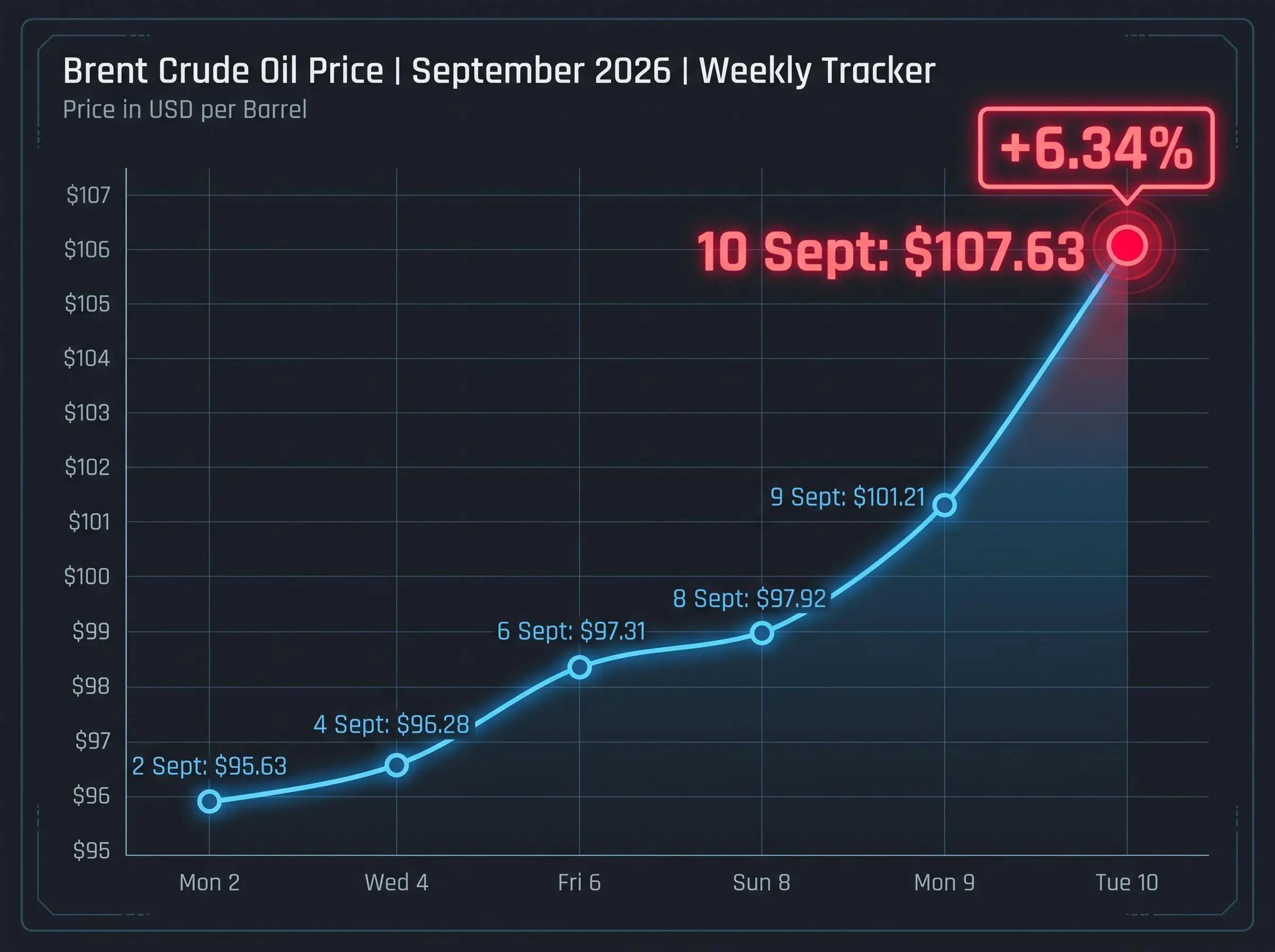
International oil prices rose sharply on 8 October as geopolitical uncertainty continued to influence expectations for global energy supply. Brent crude, the international benchmark, settled at US$104.28 per barrel, up 4.1% on the day, according to the Associated Press. The market movement formed part of a period of pronounced price volatility associated with uncertainty surrounding the Iran war and its potential impact on the global energy industry.
Markets React to Supply Uncertainty
Brent crude approached US$106 per barrel during the trading session before retreating following comments from US President Donald Trump about productive discussions with Iran and the prospect of no US military attack before the November elections. Prices subsequently moved higher again before the close.
The day's trading illustrated how quickly oil prices can respond to changing expectations about geopolitical risk. Even in the absence of a confirmed physical supply disruption on that particular day, concerns about future production, shipping and the restoration of normal energy flows can influence the price buyers are prepared to pay.
The movement also occurred within a wider financial-market environment in which higher oil prices, bond yields and technology-stock losses contributed to uncertainty. The report did not establish that the price increase was caused by a single supply interruption.
Implications for African Oil Producers
Higher benchmark prices can improve potential revenue for oil-exporting countries and upstream producers, depending on production volumes, crude quality, fiscal arrangements, operating costs and the prices actually realised.
For Nigeria and other African producers, stronger prices can support government revenue and the economics of producing fields. However, the benefit is not automatic. Production constraints, infrastructure reliability, financing costs and domestic fiscal arrangements affect how much of the benchmark-price increase reaches producers or public budgets.
The same price movement creates a different set of challenges for fuel importers, airlines, manufacturers, transport operators and businesses dependent on diesel-powered generators.
Project Costs and Procurement Exposure
Oil-price movements can affect commercial projects through several channels.
Construction logistics: Diesel and other fuel costs influence the transportation of materials, heavy equipment and personnel.
Materials and manufacturing: Petroleum-based inputs and energy-intensive production can affect the prices of selected construction materials and industrial products.
Power generation: Businesses dependent on liquid fuels may face changes in operating expenditure.
Project financing: Sustained energy-price increases can influence inflation expectations, interest-rate assumptions and the cost of capital.
Procurement contracts: Contractors may need to manage fuel-price escalation, delivery costs and the allocation of inflation risk under their contracts.
The impact on any particular project will depend on its energy exposure, location, contract structure and ability to pass higher costs to customers.
Commercial Implications
Project developers and procurement teams should distinguish between a one-day price movement and a sustained change in the market. A single closing price does not, on its own, justify revising an entire project's financial model.
Where energy exposure is material, companies should review fuel assumptions, logistics costs, supplier quotations and contract provisions for price adjustment. Long-duration projects may also need sensitivity analysis to understand how different oil-price scenarios affect operating expenditure and project returns.
For oil producers, the relevant consideration is whether higher prices translate into stronger realised revenue and sustainable production. For contractors and industrial buyers, it is whether the increase feeds into actual supplier costs.
Commercial Intelligence: The 8 October movement reinforces the importance of treating energy-price volatility as a project risk. The immediate commercial task is to identify which budgets, contracts and supply chains are exposed, not to assume that every project cost will rise by the same percentage as crude oil.
Market Watch
Brent crude settlement: US$104.28 per barrel
Daily change: Up 4.1%
Intraday high: Approached US$106
Driver: Geopolitical uncertainty linked to the Iran war
Note: Report did not attribute the rise to a single confirmed supply interruption
Source: Associated Press, Rising oil prices, falling technology stocks and reversing bond yields keep Wall Street unsettled, 8 October 2026.
Nigeria's October Procurement Pipeline Includes NLNG Jetty Services, Capital Projects and Agribusiness Supplies
Procurement · Construction · Energy · Agriculture
Several Nigerian procurement opportunities were listed on 8 and 9 October, covering public-sector capital projects, agribusiness support and specialised services for the energy industry. The notices indicate demand across multiple sectors, although each opportunity has its own eligibility requirements, commercial scope and submission deadline.
The opportunities below were listed on eTenders Nigeria. Companies should obtain the original solicitation documents and verify the requirements with the issuing organisation before preparing a bid.
NLNG Seeks Expressions of Interest for Jetty Depth Recovery Services
Nigeria LNG (NLNG) published an Invitation for Expression of Interest for Jetty Depth Recovery Services at the Corporate Head Office on 9 October 2026. The deadline listed is 30 October 2026.
The notice concerns services associated with restoring or maintaining the required depth at a jetty. Depending on the actual scope, such work may involve marine surveys, sediment assessment, dredging or related marine engineering services. The published listing alone does not confirm which methods or equipment are required.
The opportunity is potentially relevant to marine contractors, dredging specialists, hydrographic survey firms, marine-equipment providers and qualified subcontractors. The precise scope, technical qualifications, submission instructions and commercial terms must be confirmed from the original NLNG notice.
Federal College of Agricultural Produce Technology, Kano: 2026 Capital Projects
An Invitation for Submission of an Expression of Interest for 2026 Capital Projects was published on 9 October 2026, with a listed deadline of 15 October 2026.
The listing identifies a capital-project procurement opportunity at the Kano-based institution. However, the available summary does not specify the individual projects, their values or the exact professional services required. Consultants, contractors and service providers should review the original notice to determine whether the packages cover construction, rehabilitation, equipment, consultancy or other capital expenditure.
Important: An expression of interest is not itself a contract award. Interested companies must follow the prescribed submission process and demonstrate the qualifications required for the relevant package.
National Eye Centre, Kaduna: 2026 Capital Projects
An Invitation to Tender/Prequalification for the National Eye Centre Kaduna 2026 Capital Projects was published on 9 October 2026, with a listed deadline of 19 October 2026.
The notice identifies a capital-project procurement process at a specialist healthcare institution. The available listing does not establish the precise works, equipment requirements, package values or number of contracts involved. Construction companies, medical-equipment suppliers, engineering firms and other vendors may find an opportunity if their capabilities match the packages in the official solicitation.
Interested companies should establish whether the procurement involves building works, rehabilitation, medical equipment, electrical systems, mechanical services or other categories before committing resources to a bid.
Kano's Special Agro-Industrial Processing Zones: Agribusiness and Agritech Starter Packs
A Request for Bids for Procurement of Starter Packs to Support MSMEs in Agribusiness and Agritech for Job Creation in Kano State was published on 9 October 2026, with a listed deadline of 6 November 2026.
The procurement is directed at supplying starter packs intended to support micro, small and medium-sized enterprises operating in agribusiness and agricultural technology. The listing establishes the purpose of the procurement but does not provide enough information to identify the exact contents, quantities or specifications of the packs.
Agricultural input distributors, equipment suppliers, technology vendors and businesses supplying eligible agribusiness tools should examine the original bid documents to determine the required items, delivery arrangements and qualification criteria. The opportunity is particularly relevant to suppliers able to demonstrate product quality, reliable distribution and the capacity to fulfil public-sector orders.
Additional Notices Listed on 8 October
The same platform listed three further opportunities from GAIN Nigeria: a request for proposals for group-life insurance services (deadline 21 October 2026), a request for proposals for health-insurance services (deadline 21 October 2026) and a request for proposals for an internet service provider (deadline 19 October 2026).
These are service-procurement opportunities rather than infrastructure construction projects. They may be relevant to qualified insurers, brokers and telecommunications providers.
Commercial Implications
The notices provide an opportunity to identify potential buyers and upcoming procurement requirements before deadlines expire. However, publication on a tender-information platform should be treated as an initial lead, not as sufficient evidence that a company qualifies or that the opportunity remains open.
A particularly important distinction is the difference between an expression of interest, a request for bids, a prequalification exercise and an award notice. Each represents a different stage of the procurement process.
Opportunity Watch: Deadlines
Federal College of Agricultural Produce Technology, Kano: 15 October 2026
National Eye Centre, Kaduna: 19 October 2026
GAIN Nigeria, internet service provider: 19 October 2026
GAIN Nigeria, group-life and health insurance: 21 October 2026
NLNG, jetty depth recovery services: 30 October 2026
Kano agribusiness and agritech starter packs: 6 November 2026
Commercial Intelligence: The most relevant opportunities in this group are NLNG's jetty services notice and the Kano agribusiness starter-pack procurement because they identify specific requirements and potential supplier categories. The two capital-project notices warrant further document-level review before the scope can be described in greater detail.
Source: eTenders Nigeria, 8–9 October 2026.